Jimmy Kimmel: What does the FCC do


President Donald Trump suggested that television networks that give him “bad publicity” should be stripped of their licenses, which raises questions about the authority of the administration to do so.
“I mean, they get a license. I think maybe their license should be removed,” Trump told journalists on the Air Force one while returning from a state visit to the United Kingdom.
The remarks occurred after the threat of regulatory action of the administration led ABC to suspend the television host at the end of the evening Jimmy Kimmel.
Kimmel had comments on the suspect of the murder of Charlie Kirk, saying that Trump supporters had tried to “characterize this child as something other than one of them”.
In the United States, the broadcasting licenses are issued by the Federal Commission Commission (FCC), which raises the question: can the Trump administration really revoke dissemination licenses? And does the FCC have the power to regulate the content?
What is the FCC and what does it regulate?
The FCC, created in 1934, was initially responsible for authorizing the radio frequencies of the radio then and subsequent television -.
It holds the most authority on local television and radio stations, but it generally does not regulate cable or satellite television channels or online content, depending on its website.
The Commission does not directly oversee national networks – NBC, ABC, CBS and Fox are the most important – which provide news, sport and other programs at local outlets.
It establishes rules to disclose sponsors, emergency emissions and content concerning obscenity and decency.
In addition, the FCC manages access to internet access and examines the mergers and acquisitions of telecommunications companies.
Daniel Deacon, assistant professor by law at the University of Michigan, said that the FCC can actually stop business mergers by refusing the transfer of dissemination licenses to new owners.
“They can effectively kill an agreement by telling a broadcasting company that they cannot have the licenses of the company they buy,” he said.
Is the FCC controlled by Democrats or Republicans?
The FCC is led by five commissioners, appointed by the American president and confirmed by the Senate. No more than three commissioners can come from the same political party.
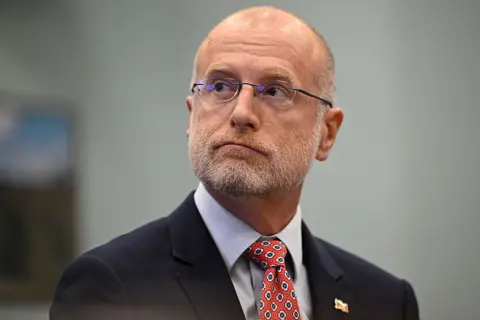
The current president is Brendan Carr, a republican who has been a commissioner since 2017. Carr was promoted to direct the committee at the start of Trump’s second term.
The other FCC commissioners are Anna Gomez, Democrat and Republican Olivia Trusty. Two positions are vacant after a pair of commissioners, a democrat and a republican, resigned in June.
What did the FCC commissioners said about Jimmy Kimmel?

 Getty images
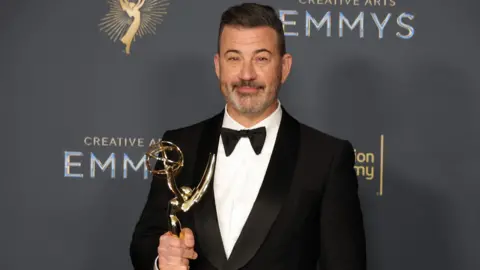
Controversy occurred when Carr, the president of the FCC, called for action against Jimmy Kimmel after the end of the evening host joked on the mourning of Charlie Kirk by Trump and seemed to be falsely suggested by the killer of the right -wing influence was a supporter of Trump.
On Wednesday, in a podcast organized by Benny Johnson, a longtime collaborator with the Turning Point organization of Kirk, Carr said that there were “remedies” that the FCC could explore.
“We can do it the simplest way or the hard way,” said Carr. “These companies can find ways to change driving and act, frankly, on Kimmel where there will be additional work for the FCC to come.”
In a few hours, Nexstar and Sinclair, two companies that have dozens of local stations across the country affiliated with the ABC network, said they would stop Kimmel’s program.
ABC later confirmed that Kimmel’s program would be suspended indefinitely.
Gomez, the only commissioner affiliated with the FCC, published a declaration criticizing the pressure of the administration and accusing ABC of “capitulation of the cowardly company”.
“We cannot allow an inexcusable act of political violence to twist in a justification for censorship and government control,” she said.
“This FCC does not have the authority, the capacity or constitutional law to the content of the police or not punish the broadcasters that the government does not like.”
 Getty images
What role did Nexstar play?
Nexstar is the largest owner of local television station in the United States with around 200 points of sale.
This week, he announced an offer of $ 6.2 billion to buy a rival, Tegna, which has more than 60 stations.
The agreement would require the approval of the FCC and the relaxation of the rules concerning the consolidation of the industry.
In a statement, Andrew Alford, president of the NEXSTAR broadcasting division, described Kimmel’s comments “offensive and insensitive to a critical moment in our national political speech”.
But criticisms argued that the company’s position was influenced by the Trump administration.
In response, a company spokesperson said that the decision to remove Kimmel’s program “had been made unilaterally by the Nexstar management team, and that they had no communication with the FCC or any government agency before making this decision.”
Does the FCC demand that the stations broadcast opposite views?
In 1949, the Commission began to apply a rule known as the doctrine of equity, which required that the stations have different points of view on controversial issues.
But the broadcasters had the flexibility of the interpretation of the rule and there was no requirement that all the points of view gave an equal antenna time.
The rule was eliminated in 1987 during the Reagan administration as part of a broader thrust towards deregulation.
The broadcasters are always required to give an antenna time equal to the political candidates opposed during the elections, but the FCC does not impose balanced coverage on other questions.
Can the FCC cancel a broadcast license?
As president and on the campaign track, Trump periodically came back to the idea that the broadcasters who criticize him could lose their licenses.
FCC rules in general require local stations must disseminate in the public interest.
But his website also mentions that it is prohibited for the law to prevent the dissemination of a particular point of view.
That said, the experts say that the rules are wide and give the agency an important room for maneuver.
“Essentially, the broadcasters do not have the complete rights of the first amendment we have,” explains Brent Skorup, legal scholarship holder of the Libertarian Cato Institute.
SKORUP says that the application of licenses regulations has dropped since the Reagan administration in the 1980s, but that a variety of points of sale – from socialist broadcasters to religious stations – have been sanctioned during the previous years of the FCC.
“In theory, the FCC could still cancel station licenses,” he said. “The two parties during the decades did not want to abandon the very powerful license system.”


