Maduro capture by U.S. divides region, thrilling Trump allies and threatening foes


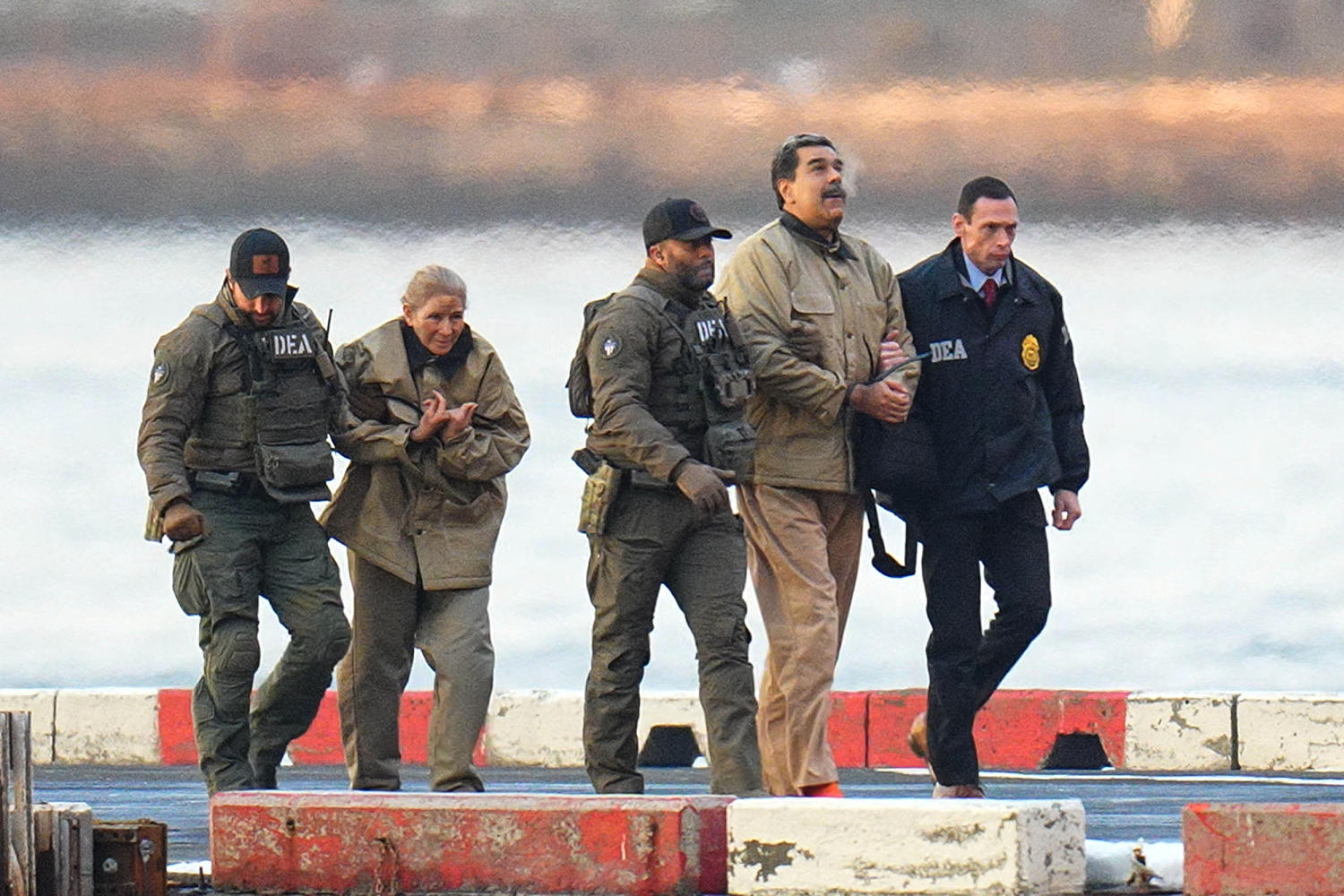
MEXICO CITY — In his news conference focusing on the U.S. capture of Venezuelan strongman Nicolás Maduro, President Donald Trump laid out an extraordinarily blunt view of the use of U.S. power in Latin America that exposed political divisions from Mexico to Argentina as pro-Trump leaders rise across the region.
“American dominance in the Western Hemisphere will never again be questioned,” Trump proclaimed just hours before Maduro was driven through the offices of the U.S. Drug Enforcement Administration in New York.
The scene marked the culmination of months of escalation in the confrontation between Washington and Caracas, which has revived memories of a bygone era of blatant American interventionism in the region.
Since taking office less than a year ago — and quickly renaming the Gulf of Mexico the Gulf of America — Trump has launched boat strikes against suspected drug traffickers in the Caribbean, ordered a naval blockade on Venezuelan oil exports and meddled in elections in Honduras and Argentina.
Through a combination of tariffs, sanctions and military force, he has pressured Latin American leaders to advance his administration’s goals of combating drug trafficking, stopping immigration, securing strategic natural resources and countering the influence of Russia and China.
The aggressive new foreign policy — which Trump now calls the “Donroe Doctrine,” referring to 19th-century President James Monroe’s belief that the United States should dominate its sphere of influence — has carved the hemisphere into allies and enemies.
“The Trump administration has tried in different ways to reshape Latin American politics,” said Gimena Sanchez, Andes director at the Washington Office on Latin America, a think tank. “They are showing their teeth throughout the region.”
Regional divisions exposed
Saturday’s dramatic events – including Trump’s promise that Washington would “rule” Venezuela and take control of its oil sector – have galvanized opposing sides of a polarized continent.
Argentine President Javier Milei, Trump’s ideological soulmate, characterized one camp as supporting “democracy, the defense of life, liberty and property.”
“On the other side,” he added, “are the accomplices of a narcoterrorist and bloody dictatorship which is a cancer for our region.”
Other right-wing leaders in South America have also used Maduro’s ouster to declare their ideological affinity with Trump.
In Ecuador, conservative President Daniel Noboa issued a stern warning to all supporters of Hugo Chávez, Maduro’s mentor and founder of the Bolivarian revolution: “Your structure will completely collapse across the continent.”
In Chile, where last month’s presidential election marked by fears over Venezuelan immigration brought down the left-wing government, far-right President-elect José Antonio Kast hailed the U.S. raid as “great news for the region.”
But Latin America’s left-wing presidents – including Brazil’s Luiz Inácio Lula da Silva, Mexico’s Claudia Sheinbaum, Chile’s Gabriel Boric and Colombia’s Gustavo Petro – have expressed serious concerns about what they see as harassment by the United States.
Lula said the raid had set “an extremely dangerous precedent.” Sheinbaum warned that this “jeopardized regional stability.” Boric said this “violates a key pillar of international law”. Petro called it an “aggression against the sovereignty of Venezuela and Latin America.”
Trump has already punished or threatened all four leaders for failing to comply with his demands, while strengthening and bailing out allies who show loyalty.
A story of intervention
For Lula – one of the last surviving icons of the “Pink Tide,” the left-wing leaders who dominated Latin American politics at the turn of the 21st century – Trump’s military action in Venezuela “recalls the worst moments of interference in Latin American politics.”
These moments range from the occupation of Central American and Caribbean countries by U.S. troops to promote the interests of American companies like Chiquita in the early 1900s to Washington’s support for repressive military dictatorships in Argentina, Brazil, Chile, Paraguay, and Uruguay to fend off Soviet influence in the 1970s.
The historical echoes of Maduro’s fall have fueled not only harsh condemnations and street protests among Trump’s left-wing opponents, but also worried reactions from some of his close allies.
Usually generous in his support for Trump, President Nayib Bukele has been strangely silent in El Salvador, a country still scarred by a brutal civil war between a repressive U.S.-allied government and left-wing guerrillas. He posted a meme mocking Maduro after his capture on Saturday, but expressed none of the jubilation seen among his regional counterparts.
In Bolivia, where old anti-American dogmas die hard because of memories of the bloody US-backed war on drugs, new conservative President Rodrigo Paz welcomed Maduro’s removal as responding to “the true popular will” of Venezuelans who tried to overthrow the autocrat in a 2024 election widely seen as fraudulent.
“Bolivia reaffirms that the way out for Venezuela is to respect the vote,” Paz said.
His message has not aged well. Hours later, Trump announced he would work with Maduro loyalist Vice President Delcy Rodríguez rather than the opposition that prevailed in the 2024 elections.
“It appears that at this point the Trump administration is making decisions about Venezuela’s democratic future without reference to the democratic outcome,” said Kevin Whitaker, former State Department deputy chief of mission in Caracas.
Asked on Sunday when Venezuela would hold democratic elections, Trump said: “I think we’re looking more at resolving this issue.”
A rising right and countries on alert
The Trump administration’s attack on Venezuela extends its broader crusade to bring together a column of allied — or at least acquiescent — governments in Latin America, sailing with the political winds blowing across much of the region.
Recent presidential elections, from Chile to Honduras, have produced hard-line, Trump-like leaders who oppose immigration, prioritize security, and promise a return to better, bygone times without globalization or “wokeness.”
“The president is going to look for allies and partner countries in the hemisphere that share his kind of broader ideological affinity,” said Alexander Gray, a senior fellow at the Atlantic Council, a Washington research institute.
Those who do not share this ideology were put on notice this weekend. Trump said Cuba’s communist government “seems ready to fall.” He criticized Sheinbaum’s failure to root out Mexican cartels, saying “we’re going to have to do something with Mexico.” He reiterated allegations that Petro “likes to make cocaine” and warned that “he won’t do it for very long.”
“Our goal is to have viable, prosperous countries around us where oil can really come out,” he told reporters on Air Force One on Sunday. “This is our hemisphere.”


