Administration blocked as it tries to cut CDC funds that Trump just signed into law : NPR

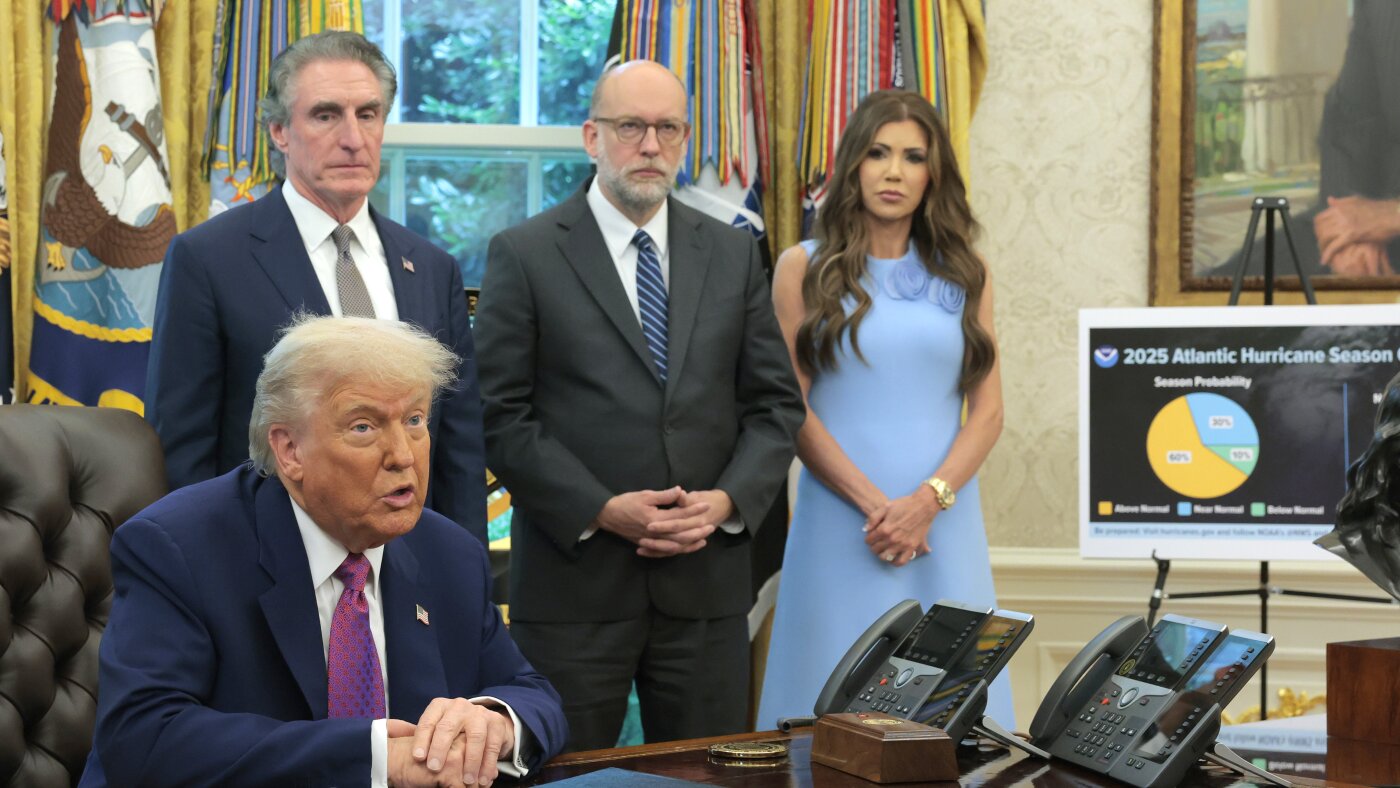

OMB Director Russell Vought (center, behind President Trump) is the lead defendant in a lawsuit filed by four state attorneys general over more than $600 million in CDC grant cuts announced this week. Homeland Security Sec. Kristi Noem and Sec. interior. Doug Burgum is also pictured in the Oval Office in June 2025.
Anna Moneymaker/Getty Images
hide caption
toggle caption
Anna Moneymaker/Getty Images
It was deja vu from 2025: the Centers for Disease Control and Prevention this week announced cuts of more than $600 million in public health funding in California, Illinois, Colorado and Minnesota – four states run by Democrats.
Immediately, the affected state attorneys general filed their suit Wednesday evening in a federal district court in Illinois seeking a temporary restraining order.
And the next day, a federal judge blocked the Trump administration’s action with a temporary restraining order issued Thursday evening.

In an opinion accompanying the order, U.S. District Judge Manish S. Shah wrote that although the stated reason for the cancellations was that the grants did not align with CDC priorities, “recent statements plausibly suggest that the reason for the guidance [to cut the funds] This is hostility toward what the federal government calls “sanctuary jurisdictions” or “sanctuary cities.”
The entire process is consistent with how the federal government has operated since President Trump’s second inauguration last year. But the context is new. Not all of these grants were put in place by a previous Democratic administration. The $600 million is included in the funding bill that was passed with bipartisan support in Congress and signed into law by Trump himself just weeks ago.
“Essential for personal safety”
In Santa Clara County, California, the official notice of the end of the grant arrived Thursday morning. “Two important grants that we rely on for essential public health functions to keep people safe and healthy have been canceled,” said Dr. Sarah Rudman, director of the county public health department. “The way these grants are applied across our department, they are integrated into a wide range of activities that we sometimes have to undertake by law and are absolutely integral to keeping people safe.”

As an example, she says, one of the grants pays for a staff member in their public health laboratory. “This staff member is critical to our overall ability to test for diseases that most other labs cannot test for, such as Ebola, anthrax and measles,” she says. “We’re not going to stop testing for these diseases today, but our ability to do it as well and as quickly as we always do is immediately at risk.”
Santa Clara is just one of dozens of local health departments targeted in grant cancellations. A joint statement from other affected public health services said the cuts could affect everything from HIV prevention in Chicago, to reducing gun injuries in Denver and access to healthy, affordable food in Minneapolis.
Rudman says the feeling is “bullwhip” when federal subsidies can be canceled suddenly with little explanation, although she says she’s relieved that the judge moved quickly to temporarily block the cuts.
“It is absolutely imperative that our funding is stable and predictable,” she says. “We need to plan ahead and know we have the resources to do it.”
New budget, same sudden cuts
These latest grant cancellations follow a trend that began last year, at the start of the second Trump administration. Sometimes these decisions have been overturned under public pressure or successfully overturned in court.
In this case, the attorneys general say, the cancellations are part of President Trump’s recent threats to withhold all federal payments to some Democratic-led cities and states, in retaliation for policies the president doesn’t like.
“The Office of Management and Budget (OMB) then spent the last two weeks of January developing a list of funds to potentially target in disadvantaged states,” the complaint states. “In early February, OMB issued a directive (the “Targeting Directive”) directing agencies to cut funding to complaining states, starting with more than $600 million in public health funding from the CDC.”
The OMB did not respond to NPR’s request for comment. OMB Director Russell Vought is the lead defendant in the state AG’s lawsuit, which is also suing the Department of Health and Human Services and the CDC.
When it comes to funding for public health services, “all the cancellations we’ve seen over the last 12 months appear to have been ordered by the Office of Management and Budget,” says Adriane Casalotti, chief of government and public affairs at the National Association of County and City Health Officials. “This has been outside the norm of federal public health funding for decades.”
While the 2025 grant cancellations were explained by HHS as necessary to align the agency’s work with the new administration’s priorities, Health Secretary Robert F. Kennedy Jr. and other Trump officials have now been in office for a full year. All grants awarded since Trump’s inauguration have been approved by his own administration’s political appointees, Casalotti notes.
Some of the grants canceled this week were even included in President Trump’s 2026 budget and the bipartisan HHS budget that was passed this month and signed by Trump on February 3.
“When we look at the public health infrastructure grants that were canceled in these states, Congress actually gave them a $10 million increase in its final legislation – that was supported in the House. [budget] bill and the Senate bill,” Casalotti says. “These funds have tremendous support at all levels.”
Three days notice
There was something different about the grant cancellation process this time, notes Rep. Rosa DeLauro, D-Conn., ranking member of the House Appropriations Committee.
“We have included a provision in Labor-HHS 2026 [budget] Because of this provision, the House and Senate Appropriations Committees were emailed a list of CDC grant cancellations earlier this week. The emails, obtained by NPR, include a long list of grant numbers, and the reason for each reads: “Inconsistent with agency priorities” with a link to an “About the CDC” web page.
“Look, if you get a notification, you create public outrage,” DeLauro says. She credits the three days’ notice with giving targeted states time to take legal action so quickly. “You know, diseases don’t care who you voted for – Republicans, Democrats, Independents – Americans are going to be hurt by these actions,” she said.
NPR contacted Sen. Bill Cassidy, R-Louisiana, who chairs the HELP Committee which oversees HHS and had not received a response at the time of publication.
California Attorney General Robert Bonta predicted that the temporary restraining order would be followed by a victory for the states in the case.
“I’ve said it before and I’ll say it again: If President Trump and those who work for him want to stop losing in court, they should stop breaking the law,” Bonta said in a press release.


