Agriculture’s ‘Green Revolution’ is now turning to climate change


An stifling heat wave decimated the growing of Pritam Singh wheat in 2022.
That year, temperatures reached a record of 127 degrees Fahrenheit in Haryana, India, where Singh operates a 35-acres farm. The torrid heat has scratched the wheat and forced it to ripen faster, he remembers, leading to only half of his usual harvest. Through India, the heat wave caused the production of wheat of 3 million metric tonnes, and the Punjab and Haryana states have also reported slowing grain yields. This led the government to stop wheat exports to manage national food security.
Secure · fiscal deductible · takes 45 seconds
Secure · fiscal deductible · takes 45 seconds
But two years later, even if the temperatures were the highest they have been for more than a decade, Singh was much more optimistic when he planted his seeds. Indeed, the international corn and improvement center of wheat based in Mexico, known by its Spanish initials CIMMYT, had worked with local partner organizations to distribute buckets without cost of resilient seeds in the climate in Singh and to millions of farmers like him across the country. The most rude seeds, currently sown in 40 million hectares, had been crossed to survive hard heat and minimum precipitation, ensuring that Singh would not undergo the devastating loss of 2022.
“The production of wheat by ACRE in 2024 has exceeded all expectations,” he told Grist, attributing his success to the new seeds, which he received before the sowing season in October.
The project has been a continuation of CIMMYT’s long -standing efforts, which has been developing high -performance varieties of crops using conventional reproduction techniques since 1943. This is how it works: organizational researchers select wheat varieties with genes known for metere attacks and well -faces in extreme climates. These varieties then become the “parental cultures” which are raised to create more resilient strains. Plants with desirable genetic features are intercreed and planted for several cycles before the best sample was selected from hundreds of thousands of plants. (This is distinct from genetic modification, which consists in modifying or injecting DNA into the genome of an organism; Cimmyt uses certain techniques of genome publishing in some of its other efforts, mainly to improve the resilience of corn.)
The organization was founded by Norman Borlaug, an agronomist winner of the Nobel Prize, whose work has launched the so-called Green Revolution, which has considerably increased cultures in the world. His first tests – funded by the Mexican government and the Rockefeller foundation based in the United States – helped Mexico to become self -sufficient in its wheat production in the 1950s.
Since then, the organization has sent grains conventionally to developing countries through non -profit organizations, agricultural universities and other regional partners in 88 countries. It manages one of the largest world collections of genetic resources in corn and wheat. Thanks to its breeding program, it has developed about two -thirds of the varieties of wheat and a third of the varieties of cultivated corn in the world.
Now, the same techniques that feed the 20th century explosive world population are used to adapt agriculture to one of the most serious threats in the 21st. Since 2011, the organization has turned to the development of corn and wheat strains which can withstand erratic weather conditions and higher temperatures triggered by climate change. Cimmyt-India works in tandem with institutions such as the Indian Institute of Wheat and Barley Research, the International Institute for Research on Rice and the Indian Agricultural Research Council, said Ravi Singh, a retired scientist associated with Cimmyt. His list also includes provincial government institutions and private companies working on wheat breeding.
These efforts are becoming increasingly important because the heat waves become longer and more persistent in certain parts of the world. In India, temperatures that generally increase at the end of may have started to skyrocket weeks earlier. North-west states of India such as Punjab and Haryana generally experience five to six days of heat waves per year, but the country’s meteorological department has planned about twice this year this year.
Higher temperatures are likely to thwart wheat growth in the region. Today, wheat in the region meets nutritional needs of 35% of the world’s population. A recently published study estimated that, for each additional degree Celsius is increasing average surface area temperature, global farms will produce 120 unpleasant calories per person and per day due to the lower yields of basic crops. This projected loss is particularly serious for wheat producing regions in northern India. As the second producer of wheat in the world, the threatened yields of India could have large -scale economic and nutritional consequences.
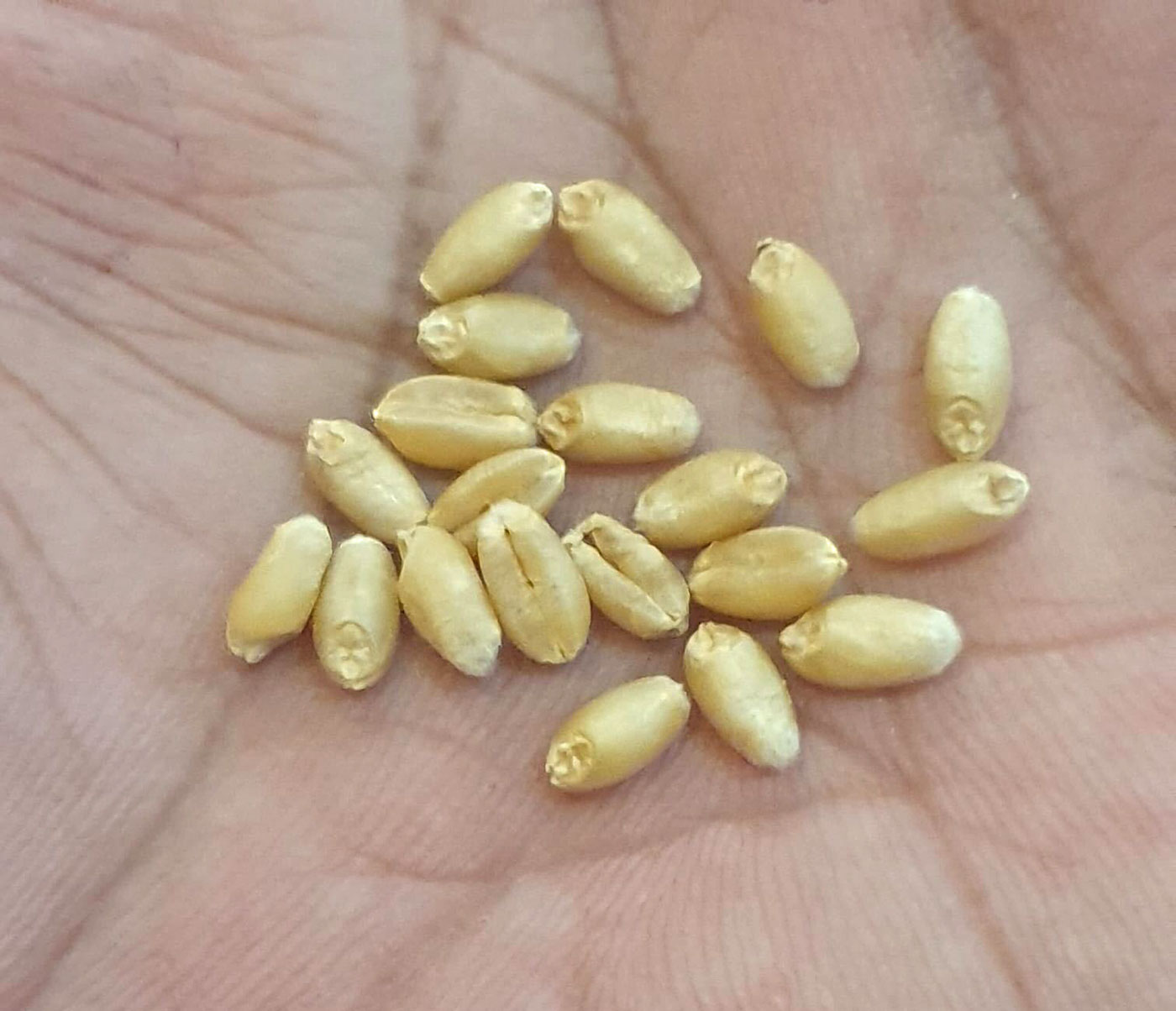
With the kind authorization of Pritam Singh
A critical concern is to protect the “grain filling” phase, when a wheat plant moves the nutrients from its balls to the ball as it is preparing to germinate. But the filling of the grains stops when temperatures become too high, which gives grains smaller than those cultivated in cooler conditions, according to experiences carried out by Scott Boden from the University of Adelaide, which studies the flowering times and the quality of the grains in Asian wheat.
Data measuring wheat growth in northern India show that culture is particularly sensitive to climate change; Temperatures above 30 degrees Celsius (86 degrees F) should slow down the grain filling phase. This has prompted countries in hot weather such as India to turn more and more towards high cultivation varieties in particular to resist such uncertainties. In August 2024, the Indian government introduced 109 varieties of climate and nutritional resilient crops, some of which were partially developed by Cimmyt, according to Velu Govindan, a senior scientist of the organization’s wheat farming.
These breeds were only the last of a long line of innovations. In October 2024, nearly 2,600 varieties had been published in the last decade by the Indian Agricultural Research Council, an autonomous organization under the Ministry of Agriculture with which Cimmyt works in close collaboration. More than 80% of them have been well written against climate stressors.
Since the 1960s, Cimmyt has been working to identify genes that determine how crops – mainly wheat and corn – react to the heat and stress of drought. In his establishment in Mexico, Cimmyt tests thousands of varieties crossed under conditions designed to reproduce heat waves and drought, said Govindan.
“We are looking for genes that build stressors [and] Use this information to carefully decide which parents cross, “he said.
By developing resilient varieties, the organization first conducts trials in laboratories, then in fields, where controls of resistance to disease, heat and tolerance are carried out – some covering two or three years. Once the varieties are shared with regional partners, they carry out additional tests on several field sites, which can sometimes take a few more years.
Despite these efforts, there are certain factors that even Cimmyt cannot control, which could hinder the success of these varieties. These can range from a new pathogen that can overcome the resistance genes deployed – or even farmers refusing to move away from a well -known variety of cultures, said Ravi Singh, the retired scientist.
The more than 400 varieties that work best are shipped to partner organizations in South Asia and Africa, which then broadcast free seeds to farmers like Pritam Singh. For its part, Singh adopts a hybrid approach. The farmer has experienced various varieties of wheat for almost two decades, based on advice and seeds of university experts but also on his knowledge of local conditions.
In the 1960s, under the direction of the geneticist Ms. Swaminathan, India welcomed the Green Revolution to increase agricultural production by using high -efficiency varieties to mitigate malnutrition in the country. Although it has achieved its objectives of increased cereal production and lowering food costs, the revolution was criticized for encouraging monocroping and high consumption of pesticides, which has left a lasting impact on the ground. He also excluded a large number of small farmers who could not afford new varieties of seeds or pesticides.
This is a gap that Cimmyt hopes to fill, and the organization says that it intends to help small farmers like Pritam Singh who, otherwise, would not have access to more cunning seeds designed for climate resilience.
But the region remains in the grip of a myriad of problems that Cimmyt seeds cannot resolve themselves. According to Gurpreet Dabrikhana, the essential nutrients to reach the grains, according to Gurpreet Dabrikhana, a cereal defender, a Gurpreet Dabrikhana lawyer, a defender of organic farming. Dabrikhana fears that Cimmyt’s approach does not adequately consider variations under local soil conditions and could ultimately accelerate the degradation of topsoil. “These approaches are very centered on crops and not focused on the ground,” he said.
At more than 5,000 miles in South Africa, the pathologist of plants Norman Muzhinji, who teaches at the University of the Free State, told Grist that the country’s institutions have collaborated with Cimmyt “to adopt and adapt varieties of food security and high strengthening farmers.”
This year, even the temperatures at 46 degrees Celsius did not derail the harvest of Pritam Singh – a welcome gap of the calamity of 2022, when temperatures increased up to 50 degrees C. But it does not recognize that luck is also a factor in its recent successes: intermittent rain spells offered an essential respect.
In recent years, even the crossed seeds he has planted have failed, which has cost him thousands of rupees in harvest losses. This makes Singh skeptical: “The varieties of breeders [from CIMMYT] Can resist 2 or 3 degrees of heat more than regular stumps, but what happens if the temperature increases? »»
Correction: This story originally described the role of CIMMYT in the varieties of crops introduced by the Indian government in 2024.