Alabama fans cheer Charles Bediako in loss to Tennessee because of his victory vs. NCAA


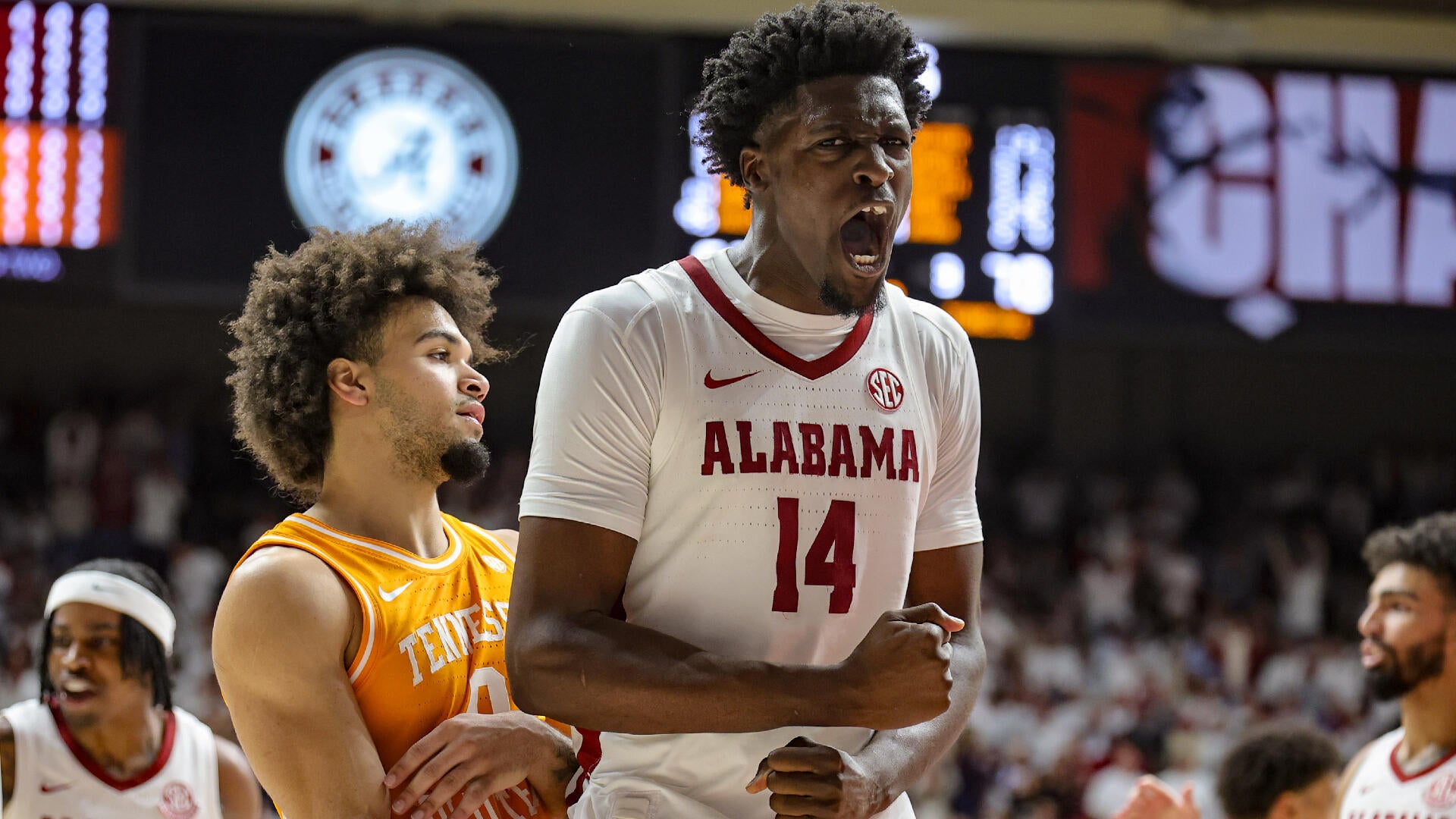
TUSCALOOSA, Ala. – If this was the end of college basketball as we knew it, it ended with a warm ovation.
As Charles Bediako, a 23-year-old who played for the G League’s Motor City Cruise a whole week ago, checked in with 16:11 left in the first half, he was greeted again with a standing ovation from many of the 13,474 Alabama fans inside Coleman Coliseum. Bediako will undoubtedly receive much less welcoming reactions if he is eligible to continue playing after Saturday night’s 79-73 loss to Tennessee, but Alabama fans seemed to appreciate that the Crimson Tide defied the NCAA’s wishes and played him.
Bediako quickly scored four points after taking the court, including a dunk that once again put an electric Tide crowd on its feet. If you were wondering why Alabama was willing to go through all this trouble, to draw such strong and often negative reactions from its peers, this was it. In the first half, Bediako gave Alabama the kind of elite rim runner it was missing, scoring eight points on 4-4 shooting. He finished with 13 points, two blocks and three rebounds in 25 minutes of action.
“I thought he was good,” Alabama coach Nate Oats said. “He almost led us in blue-collar points. He needs to get a few more rebounds for us, he knows that and he told me that in the first half when he came out. The guys all liked him and he’s a great teammate. He’s going to help us get going, we just need to bounce him back a little bit, especially on the defensive end.”
This is an important thing to remember: Alabama is going through all these difficulties not because it is revolutionary and trying to stick to the NCAA. He’s doing it because he badly needed a backup big man, and Bediako was the best possible addition midseason. Even with Bediako’s contribution, a short-handed Alabama team, without its second and third leading scorers, lost its second straight home game for the first time in six seasons.
Bediako has another hearing Tuesday to determine if this was a one-time foray into college basketball or if he can stay with this Alabama team for the rest of the season. When asked about it on Saturday night, Bediako evaded the question, but his response indicated he didn’t want it to end after just one game.
“My main focus is on the next game and improving with the team,” Bediako said.
If he succeeds in obtaining an injunction on Tuesday, it could be just the beginning of what’s to come in college basketball. The line between professional athlete and college athlete has already blurred to an almost infinitesimal difference. This year alone we have seen what we thought were clear and inscrutable rules fall away.
Parallels with Baylor’s Nnaji
First, it was Baylor that brought in James Nnaji, who was drafted 31st overall in the 2023 NBA Draft but never played in the NBA or at the collegiate level. Notably, the NCAA approved Nnaji’s waiver — it didn’t for Bediako — but it still seemed like a crossroads.
Nnanji’s return prompted Bediako to consider a return to college basketball after playing for Alabama from 2021 to 2023. Bediako went undrafted in 2023 and did not play in the NBA but signed a two-way contract with the San Antonio Spurs. That should have prevented a collegiate return — once you relinquish eligibility and sign an NBA deal, you can’t go back, or so we believed — but he managed to get a temporary restraining order (TRO) to play in Saturday’s important home game against Tennessee.
Who knows what will happen next. A school somewhere could become even more aggressive in trying to add a former NBA player to its roster. How about trying to convince a non-playing 15th man in the NBA to come back for another year of college basketball and a big NIL payday that comes with it?
This is the world we live in. The NCAA is irresponsible and incapable of enforcing its rules. Despite strong statements from NCAA President Charlie Baker and Vice President of Basketball Dan Gavitt, Alabama continued undeterred. As long as you can appear in front of a friendly local judge, anything is possible these days. If Saturday night is any proof, the fan base will love you for it.
“What they’re doing now is exploiting the NCAA and they’re forum shopping in some ways, saying, ‘Well, if that’s the case, we’re going to move from federal court to state court where we might get a more favorable outcome,'” said Mitch Gilfillan, a former college basketball coach and now an attorney at Quinn Johnston. “Until Congress acts, which it doesn’t appear to be the case, I think you’re going to continue to see more and more challenges.”
Scott Schneider, a Title IX attorney and employment law expert, calls this “a real structural problem in the way the NCAA is organized.” Due to the NCAA’s unincorporated association structure, it is technically a citizen of every state where it has a member institution. This makes it vulnerable to state courts which may be friendlier to the local university than the national NCAA organization.
Getty Images
Schools seek home advantage
It played out in Tuscaloosa, where Tuscaloosa County Judge James Roberts donated at least $100,000 to the Crimson Tide Foundation, according to its website. His wife, defense attorney Mary Turner Roberts, continues to represent former Alabama basketball player Darius Miles, who was charged with capital murder in the January 2023 shooting of Jamea Harris.
This isn’t exclusively an Alabama situation, either.
This could help Ole Miss quarterback Trinidad Chambliss secure a sixth year of eligibility after being denied by the NCAA and subsequently filing a lawsuit in Lafayette County, Mississippi. This could help Duke in its recently filed lawsuit against quarterback Darian Mensah, as a local judge already granted a TRO to prevent Mensah from enrolling at another school.
“If they were a corporation or if they were organized in a different way, this lawsuit that was filed against them in Alabama, what they could do at this point is move it to federal court,” Schneider told CBS Sports. “But because they’re citizens of Alabama, they can’t do that. You see that in the Chambliss lawsuit, you see that with (Bediako) in Alabama and you see it over and over again. If I can file a lawsuit in a favorable forum, I’ll probably get a good outcome.”
Alabama will learn more on Tuesday, but comments like Oats’ “he’s going to help us move forward” certainly indicate how the school thinks it’s going to go. It’s also not a bad electoral strategy for local judges to side with the people’s university.
After the match ended, fans waited to cheer on Bediako as he left for the locker room. A trio of elementary school fans had handmade signs they wanted Alabama’s newest basketball player to sign. In a surreal moment emblematic of the current state of college sports, Bediako happily autographed this one which read: “Bama Pay$ Better”.
“Everyone came out to support us,” Bediako said. “It was great to be back, especially with an Alabama on my chest.”
To say the least, many in the sport don’t believe it’s all that great that Bediako is back and playing. Critics believe actions like Alabama’s dressing down Bediako have left college basketball’s foundations as shaky as ever. “We just need some people to stand up and start taking a stand,” Florida coach Todd Golden said earlier this week.
In Tuscaloosa, fans stood up with joy and applauded his erosion.


