Alan Rothenberg reflects on U.S. soccer’s evolution ahead of World Cup

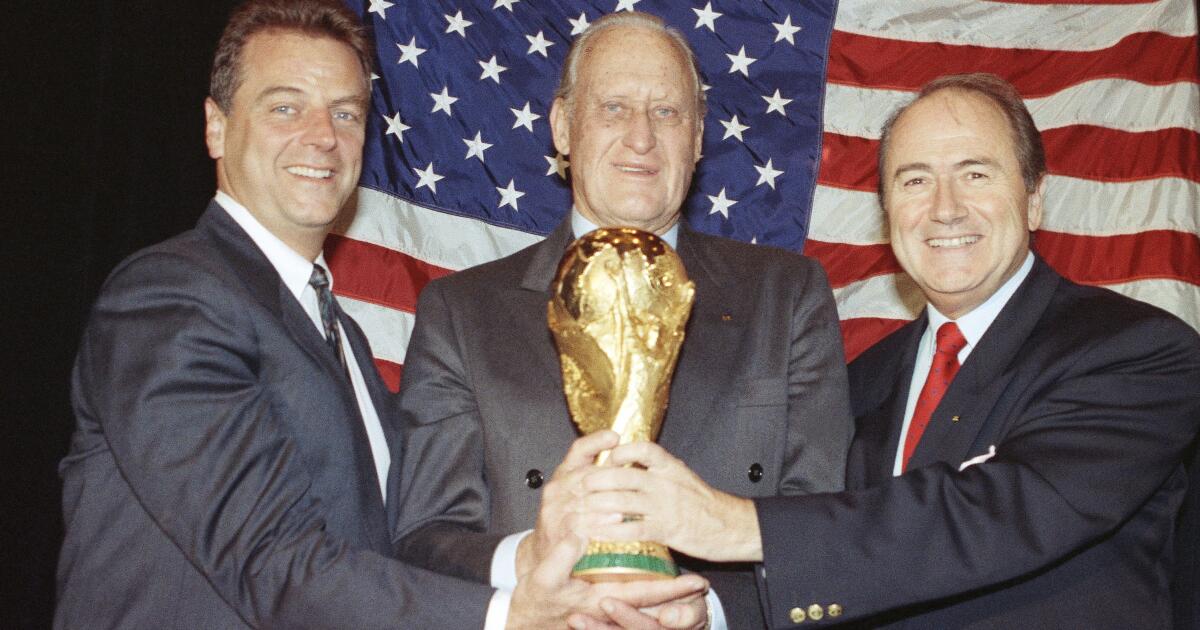
Alan Rothenberg has a story to tell you. Lots of stories actually; enough to fill a book.
So he wrote one.
But this is not the first memorable work he has written. As the man behind the 1984 Los Angeles Olympics soccer tournament and the 1994 World Cup, still the most successful in history, Rothenberg arguably had more than anyone to do with writing the history of American soccer in the modern era.
And you can draw a straight line from this chapter to the one that will be written this summer when the World Cup returns to the United States.
“The turning point was really the Olympics,” he said last month over brunch at a crowded Sherman Oaks restaurant. “Football was so successful at the Olympics that that’s when FIFA thought maybe we could bring our crown jewel to the United States without being embarrassed.
“So the 1984 Olympics. It’s a crucial part of history. I doubt we would be where we are today without it.”
This story can be found in “The Big Bounce: The Surge That Shaped the Future of US Soccer,” available February 10. In fact, the book starts there.
But that’s not the case for Rothenberg’s career. Before changing the face of American football, he first changed the sporting landscape of his adopted city, playing a key role in bringing the Clippers to Los Angeles, in brokering the trade that made Kareem Abdul-Jabbar a Laker, and in bringing the Kings to the Forum.
As an attorney who began his career as legal counsel to Jack Kent Cooke when Cooke owned the Lakers, the Kings, the then-Washington Redskins and pitching the Wolves of the nascent NASL, Rothenberg has been involved in some of the most significant events in four sports during a career that is nearing the end of its sixth decade. Yet he knew little about football when Peter Ueberroth, president of the Los Angeles Olympic organizing committee, put him in charge of the sport for the 1984 Games.
“Peter assumed that with this background I must know a lot about football,” writes Rothenberg. “It was wrong.”
What he lacked in football knowledge, he more than made up for in creativity and organizational skills, and the Olympic tournament proved to be one of the most successful in history, with the finale at the Rose Bowl drawing a crowd of 104,098, an American record for a football game that stood for 30 years.
But his name will forever be synonymous with the World Cup.
The 1994 tournament was the first to take place in a country without a top division championship and there were widespread fears that it would be a disaster. Instead, it drew an average of 69,174 fans to each of 52 games, an attendance record that still stands. It also generated a surplus of more than $50 million – also a record – which was donated to the US Soccer Foundation to promote the growth of the sport in the United States.
Two years later, Major League Soccer began; 30 years later, it is the sixth most profitable football league in the world.
“It all stems from 1994,” Rothenberg said. “If 1994 had not been a success, including if our [U.S.] Had the team not been credible, I’m not sure how quickly things would have evolved. We certainly wouldn’t have been able to launch Major League Soccer at that time if the World Cup hadn’t been a success.
Another rarely talked about – but extremely important – legacy of this tournament is the foundation it created in terms of experience and expertise. The United States had never hosted a major soccer competition before 1994, and the learning curve was steep. Among those who worked under Rothenberg and achieved great success in the sport were Sunil Gulati, three-term president of US Soccer; Nelson Rodriguez, now executive vice president of MLS; Marla Messing, who led the 1999 Women’s World Cup organizing committee and later served as interim commissioner of the NWSL; Tom King, longtime chief administrative officer of US Soccer; Kathy Carter, former executive vice president of Soccer United Marketing and general manager of US Olympic and Paralympic Properties; and Charlie Stillitano, a former MLS general manager who pioneered the idea of inviting major European clubs to play summer friendlies in the United States.
“It’s not just that the event [came] disabled. Look what came out of it,” said Scott LeTellier, who as general manager and chief operating officer was responsible for the day-to-day operations of the 1994 World Cup organizing committee. “Everyone who worked on our committee, who played a role, is now general manager of MLS teams. The league itself which came from it. The number of football facilities. We did not have a single stadium dedicated to football in the country.
“You could say that the 1994 World Cup was really the pivot of this whole explosion of sport.”
This tournament was ahead of its time in other ways as well. It was the first to organize fan parties in the host cities, the first to include musical artists in the final and the first to offer hospitality packages with the price of a ticket. There was also a lavish opening ceremony, attended by Diana Ross, Oprah Winfrey and President Clinton, transforming what was just a soccer tournament into a global spectacle.
The World Cup hasn’t been the same since, with FIFA’s revenue reaching a projected $13 billion for the 2026 cycle. There are more than 40 country who do not have such a big economy.
As Rothenberg notes in his book, FIFA initially rejected many of the innovations he proposed, including a half-time show during the final, eventually adopting these ideas as its own. Rothenberg also wanted to charge $1,000 per ticket for the 1994 final, arguing that fans would pay that on the secondary market, so why let scalpers make a profit?
“They were horrified,” he said. “Do you realize how dramatic it would be if you had a $100 million gate?
They do it now; the cheapest regular tickets to this summer’s tournament final start at $2,000.
Rothenberg said he was still thinking about other ways to improve the tournament, such as expanding the field to 64 teams and eliminating the group stage, making the World Cup an NCAA basketball tournament.
“I know I’m out of the ordinary on this one,” he said. “Simple elimination. It’s exciting from start to finish.”
At 86, Rothenberg is still active and regularly visits his office at 1st Century Bank, the community bank he founded in 2004, at an age when most people were retiring. And he promises to be present at the World Cup this summer.
As for whether he gets the credit he deserves for making this tournament possible, Rothenberg is hesitant.
“I didn’t do it on merit,” he says, speaking both about the World Cup and the book that explains how it happened. “All I can say is I’m proud of what I did.”
⚽ You’ve read the latest opus of On Soccer with Kevin Baxter. The weekly column takes you behind the scenes and highlights unique stories. Hear Baxter in this week’s episode of “Podcast “Corner of the Galaxy”.


