Sea turtle hatchlings struggle through a smelly seaweed maze


Sargasse. Brown and smelly algae can put a day to the best day at the beach and bother baby’s turtles on the worse ocean path. Only about one new new in 1000 of the Turtles on Survit in adulthood, and Sargasse could be added to their already long list of challenges.
New detailed results in a study published in the Journal of Coastal Research Explore the role that this brown algae plays on vulnerable sea turtle populations.
“For the newborns of the sea turtle, reaching the ocean is already a breed against time-and survival. Now, the increasingly large sargassum carpets add new challenges to this critical journey,” the co-author of the study and biologist of the Florida Atlantic University Biologist Sarah Milton said. “As these accumulations of algae become higher and more widespread, they may block the newborns entirely, draining their limited energy or leaving them failed. Beyond the empire of movements, the sargasse can also reduce the nesting space and modify the conditions of incubation. ”
What is Sargasse?
Sargasse is a kind of large brown algae. It floats along the ocean in masses islands and does not attach itself to the seabed as the Varech does. It is abundant in the oceans of the world and has many green appendages, branches and its signature berry structures. These round “bays” are in fact structures filled with gas called pneumatocysts which allow them to float on the surface of the water, similar to a life jacket.
Although considered a nuisance for many, Sargasse Provides food and floating habitat for several marine species, including various species of fish, sea turtles, sea birds, crabs and shrimp.
Sargasse Flowers also increase. In June 2025, a record of 38 million tonnes of algae was measured in the Caribbean Sea, with huge heaps on beaches in Florida. These tufts can put already vulnerable newborns in a sea turtle in difficulty.
“The more a newborn remains on the beach, the more risk it becomes – not only of predators such as birds and crabs, but also overheating and dehydration, especially after sunrise,” said Milton. “When the heaps of sargasse are higher – some may be above one meter [about 3 feet] On the beaches of southern Florida in summer and extend over hundreds of meters on the beach – we can expect more unsuccessful attempts, especially when newborns have to cross several strips of algae just to reach the ocean. »»
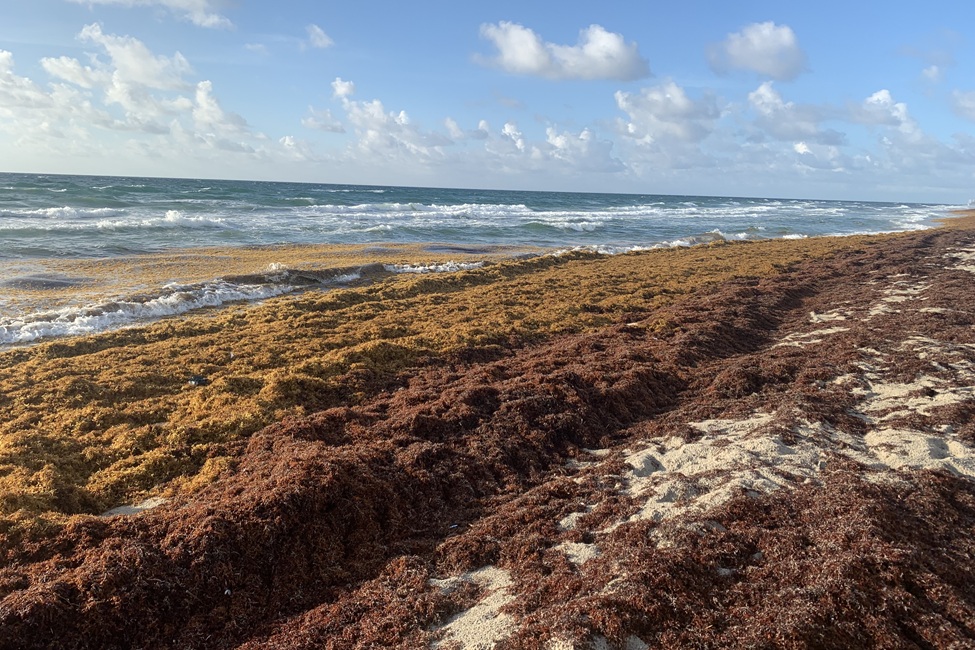
A Sargasse obstacle course
The study focused on three species of common marine turtles found in Florida: leather (Coriacea dermochelys), Newspaper recording (Caretta Caretta) and green turtles (Chelonia Mydas) from three beaches of the Atlantic Ocean in front of the Southern Florida (Juno Beach, Jupiter and Boca Raton). From March to October, sea turtles lay their eggs in the sand of these beaches. They generally pose between four and 10 clutches, each clutch containing between 70 and 140 eggs, depending on the species of turtles. It can usually take baby turtles from 10 to 30 minutes to reach the ocean.
The researchers have created controlled ramps on the sand as a way to simulate the natural path of a newborn to water, adding bulk mats Sargasse at different heights up to 7.5 inches high at the end of a 49 -foot path. A weak light was placed at several feet in front to guide the newborns forward. This light was supposed to simulate natural light on the ocean that they instinctively follow. In this way, the team could directly measure the physical assessment of crawling through the sargasse remotely and avoid interfere with its natural behavior. They also tested several turtles on a noSargasse Filled path as a control group.
After finishing the Sargasse Obstacle race, the team measured the blood sugar levels of newborns to assess their energy consumption. They also tested how fast each turtle could stand up when placed upside down in the water to assess their physical condition after the ramp. The temperature of the sand at the start, in the middle and at the end of each ramp was also measured.
The newborns of the three species took much more time to finish their ramp when the sargasse was present. The additional time spent climbing and above the piles of algae was the main reason for the slowdown.
The newborns also overturned when they try to climb the algae, with a newborn baby more than 20 times on a single test. These flips – called inversions – extended dangerous newborns spent on the beach and increased their risk of being eaten and being exposed to the stifling summer heat.
However, despite these travel delays and the challenges of algae navigation, the team found no significant difference in blood sugar between the newborns who crawled through the Sargasse and those who did not do so. Glucose concentrations on all species have remained in the expected beaches.
According to the team, this suggests that if the additional algae increased effort and risk, this has not immediately exhausted the measurable energy stores of turtles. The only group to see significantly higher glucose was the newborns of the leather of the control group without crawl. The act of crawling in general, and not the Sargasse He himself has a stronger physiological impact, at least in the short term.
Understand how it affects sea turtles could lead to more reactive beaches management strategies to help sea turtles in their trip to the ocean.
[ Related: 7 wild photos. 40 years of data. 1 smelly seaweed story. ]
Sea Turtle nest season and not do
Florida Atlantic University has a list of best practices if you were to meet newborn sea turtle during the nesting season.
If you see a turtle lays eggs, leave it alone. In addition, contacting the Florida Fish and Wildlife Commission of the police commission of the police if you see an injured or blocked sea turtle. It is also important to keep dogs on a leash and far from turtle nests.
As much as you may want to help a newborn baby, do not touch it. State and federal laws prohibit the withdrawal of the newborn from its natural environment.
Guided “turtle walks”, participation in beach cleaning and minimizing the use of single -use plastics are also easy ways to get involved in the conservation of sea turtles.

More offers, reviews and purchasing guides


