Marjorie Taylor Greene to quit Congress after Trump feud


Kwasi Gyamfi Faciledu,in Washington, And
Anthony Zurcher,North America correspondent, in Washington
Marjorie Taylor Greene announced she would resign from office, an unexpected turn for the prominent Republican.
One of Donald Trump’s Maga superstars and staunchest defenders, the Georgia congresswoman’s incessant calls for the release of files linked to the late pedophile Jeffrey Epstein and recent criticism of some of her policies have led to a bitter public feud.
After the US president called her a “traitor”, she said in a video announcing her departure: “I refuse to be a ‘beaten wife’ and hope that everything goes away and everything gets better.”
Trump, who had threatened to support a Republican challenger to unseat Greene, called her resignation “good news for the country” in an ABC News interview.
“For some reason, mainly because I refused to answer her incessant barrage of phone calls, Marjorie became BAD,” he later wrote on Truth Social.
“Nevertheless, I will always appreciate Marjorie and thank her for her service to our country!”
Greene said in her video statement, posted on social media, that she will leave the US Congress on January 5, 2026.
She said she “did not want my sweet district to have to endure a hurtful and hateful primary against me from the president we all fought for, only to fight and win my election when the Republicans will likely lose the midterm elections.”
She had been one of the most demanding people to release documents related to Epstein, an issue that once united Trump and his base but has since become divisive.
Trump had spent months claiming that the issue was just a red herring concocted by his political critics to distract from his administration’s accomplishments.
“Standing up for American women who were raped at age 14, trafficked and used by rich and powerful men, should not lead to me being called a traitor and threatened by the President of the United States, for whom I fought,” Greene said in her resignation letter.
In recent months, she has appeared on a number of high-profile news shows and criticized Trump and his fellow Republicans.
She disputed that the president was not doing enough to lower voters’ cost of living and criticized his policy of introducing tariffs on imports. But she especially criticized her administration for not releasing documents related to Epstein.
Trump responded last week in a series of social media posts, calling Greene a “traitor” and “wacky.” He said she should be ousted and pledged to support a challenger for her place in Congress.
Days after their feud boiled over, as a growing number of Republicans called for their release, Trump reversed course and said he would support their release. He signed a bill this week that requires the U.S. Department of Justice to release the documents within 30 days.
Greene was elected to Congress in 2020 amid headlines about her support and promotion of QAnon conspiracies, including claims that the 9/11 school shootings and terrorist attacks were staged. She has since apologized and sought to distance herself from the comments.
In the video announcing her resignation, Greene rattled off a list of political accomplishments. She noted in her resignation letter that Trump’s comments were “hurtful.”

 AFP via Getty Images
As she announced her departure from the House of Representatives, US media reported that Greene had expressed interest in running for state office – either as governor of Georgia or for a Senate seat.
The president has commented publicly on these ambitions, writing on Truth Social during their public feud that he had previously told her she should not run for either office due to poor public polling.
Greene has since said she has no plans to run for either position.
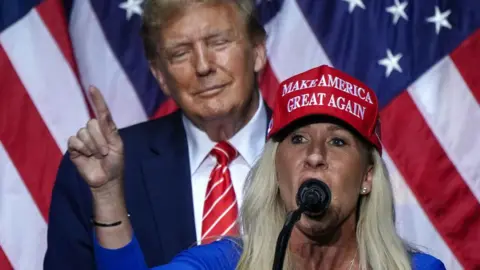
Before their public feud, Trump and Greene were close allies in advocating the “America First” agenda. She joined him on the campaign trail and was one of the most vocal Republicans about Trump’s false claims that he won the 2020 presidential election against Joe Biden.
His departure will further narrow the gap in the Republican-led House of Representatives, where the party holds only a handful of seats more than Democrats. Control of the House will be at stake in the 2026 midterm elections this November.


:max_bytes(150000):strip_icc()/Health-GettyImages-2078604079-f6d4e0bbb19d44b6aad76f5d08dd4195.jpg?w=390&resize=390,220&ssl=1 "5 Signs Your IgA Nephropathy May Be Getting Worse")
