All around us and inside us


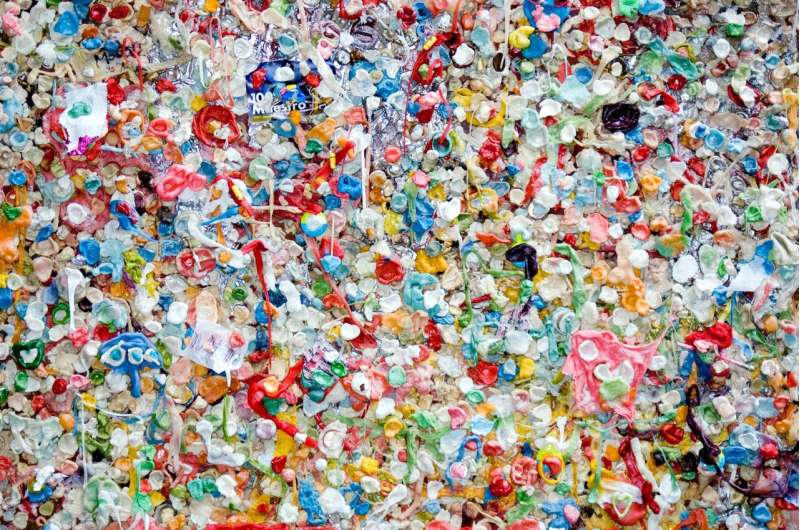
Credit: UNSPLASH / CC0 public domain
Plastic is one of the most remarkable materials ever created. It’s cheap, light and constantly versatile. It can be shaped in all, provisions for rescue tools in hospitals, and it is clean, safe and can be sterilized. Depending on its objective, it can be used only once – for example, in medical environments where hygiene is critical – or in service for years.
Perhaps surprisingly, plastic can even have environmental advantages thanks to its light weight, which reduces the use of fuel in transport. But we have become so dependent on plastic that world production reached around 414 million tonnes in 2023 – a figure that continues to increase each year.
Plastic is part of countless everyday objects. Take a toothbrush: the hairs are generally nylon, while the handle is often made from light polyethylene or polypropylene. A manual toothbrush can have a volume of 8.5 to 19 cc. Imagine now that over time, it breaks down into microplastics – fragments less than five millimeters – or even nanoplastics, which are a thousand times smaller.
If microplastics can be as small as 1 micrometer (roughly the size of a bacteria) – or even 0.1 micrometer (roughly the size of the Sars -Cov -2 virus) – a single toothbrush could theoretically break in microplastics from 8.5 to 19 Billions. And these particles are small enough to be inhaled or ingested.
Plastics do not “disappear” in the environment: they fragment. Sunlight, in particular ultraviolet-b radiation (UV-B), makes plastic brittle; Physical stress – Waves, wind, abrasion – breaking in ever dirty pieces. Even the state of the stratospheric ozone layer, which controls the amount of UV-B reaches the earth, can influence the speed with which plastics degrade. Some bacteria and fungi can also help decompose certain plastics, but this is slow and often incomplete.
The result? Most plastic waste ends up as a micro and nanoplastic soup deriving in our environment.
Although the largest plastic debris can cause obvious damage, such as entanglement of fauna or being swallowed by sea birds, microplastics are a quieter but potentially more insidious problem.
Plastic everywhere
Microplastics have now been found in 1,300 species of invertebrates and are present at all levels of the food chain. These particles are in the shape of oil (hydrophobic), which helps them to cross the biological membranes and enters the cells of living organisms – unlike the particles that love water (hydrophilic) such as sand grains, which follow a different biological path.
Their size also counts. Smaller particles can move more easily in the body, reaching the organs far from their entry for the first time. Exposure can occur by swimming in polluted water or via food and drinks, either because food itself contains plastic particles (such as seafood contaminated waters), or because it was contaminated during packaging or industrial treatment.
Micro and nanoplastics can also be inhaled in the dust suspended in certain workplaces, such as textile manufacturing or sandblasting with plastic -based materials. In daily life, we can breathe synthetic fibers loss of our clothes or tiny particles released from tire wear.
Once inside, microplastics have proven to move – a process called translocation – in animals, a phenomenon that has not yet been found in humans.
The evidence now shows that micro- and nanoplastics are present in the human liver, kidneys, lungs, spleen, blood, heart and brain. In a study, nanoplastic polyethylene shards were detected in the human brain, at higher concentrations than in the liver and kidneys. They were found in the fat plate in the arterial which is linked to cardiovascular problems. They were also found in placenta and breast milk, which suggests that these particles can be transferred through generations.
Given how plastics are common in food and drinks, their presence in the human body is not surprising, but detecting them is technically difficult. Samples are often taken from hospital environments where plastics are everywhere, creating a high risk of contamination.
Are they harmful?
Researchers are starting to study associations between plastic particles and human health problems, including cardiovascular disease, pulmonary fibrosis – a pulmonary disease in which tissues become marked and stiff, which makes it more difficult to breathe, as well as liver and intestine diseases.
But science is still young. Large -scale epidemiological studies, which could take years, will be necessary to determine whether plastics directly cause these diseases.
The emerging image is not reassuring. While scientists still discover the complete scope of risks, the precautionary principle suggests that we should act now to reduce exposure. This means continuing to follow how plastics decompose, how they enter our body and what they could do once inside.
Microplastics are no longer “simply” an environmental problem: they are a public health problem. And because plastic production is still increasing, the scale of the problem is likely to grow before shrinking.
Supplied by the conversation
This article is republished from the conversation under a Creative Commons license. Read the original article.
Quote: Plastics: All Autound US and Inside US (2025, August 20) Recovered on August 21, 2025 from https://phys.org/news/2025-08-plastics.html
This document is subject to copyright. In addition to any fair program for private or research purposes, no part can be reproduced without written authorization. The content is provided only for information purposes.