ALMA Captures Spiral-Shaped Gas Streamer Guided by Magnetic Fields in Star-Forming Region


This gas flow channels material from the surrounding cloud of a star-forming region of Perseus directly into a new binary star system called SVS 13A.
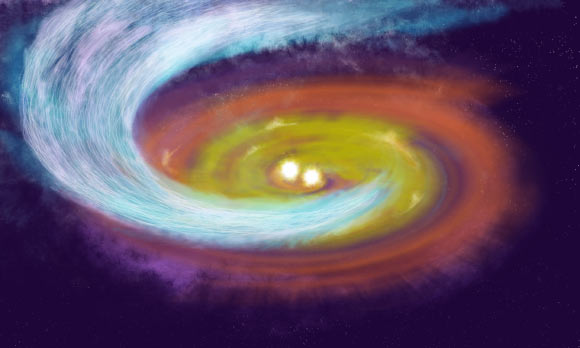
Artist’s impression of the SVS 13A system. Image credit: NSF / AUI / NRAO of NSF / P.Vosteen.
Stars are born from clouds of gas and dust, but recent observations show that star birth is much more dynamic than previously thought.
New data from the Atacama Large Millimeter/submillimeter Array (ALMA) captured both dust and molecules swirling around the SVS 13A system, revealing that magnetic fields don’t just pass through these stellar nurseries: they actively direct the flow of matter, providing a preferred path for gas to move across the disk where new stars are forming and planets.
“Imagine a garden hose, but instead of water, it smoothly transports star-building materials through a winding path carved by invisible forces,” said Dr. Paulo Cortes, an astronomer at the NSF National Radio Astronomy Observatory and ALMA Joint Observatory.
“This is the image that emerges from the ALMA observations: a gas channel, nicknamed sub-Alfvénic streamer, regulated by spiral magnetic field lines.”
“These new data give us a new window on star formation.”
“This banner shows how magnetic fields can regulate star formation by shaping the influx of matter, like a highway dedicated to moving cars.”
ALMA images and data reveal two arms of spiraling dust surrounding the stars, with a streamer of gas following closely the same path.
This remarkable alignment suggests that the gas in the streamer is moving slowly compared to previously believed, supporting the idea of a magnetized channel rather than a turbulently collapsing cloud.
The fact that such a streamer exists and connects the cloud to the disk – feeding the material in a controlled manner – means that gravity and magnetism both play crucial roles in building stars and shaping the planets that could eventually form around them.
This pioneering result marks the first time astronomers have directly mapped both the streamer and its guided magnetic field in a single observation.
“The sub-Alfvénic streamer suggests a new role for the magnetic field when gravity dominates, where it acts as a ‘guide’ facilitating the entry of material from the envelope onto the disk,” the astronomers said.
The results appear this week in the Astrophysical journal letters.
_____
PC Cortés and others. 2025. First results from ALPPS: A Sub-Alfvénic Streamer in SVS 13A. ApJL 992, L31; doi: 10.3847/2041-8213/ae0c04

:max_bytes(150000):strip_icc()/Health-GettyImages-470438747-b4530fd478de417099db1558db7a396d.jpg?w=390&resize=390,220&ssl=1 "What Happens to Your Blood Pressure When You Eat Cheese Regularly")