‘I can’t drink the water’


Commercial correspondent in North America and sales journalist
When Beverly Morris retired in 2016, she thought she had found her dream house – a peaceful section of rural Georgia, surrounded by trees and calm.
Today is anything but.
Only 400 meters (366 m) of its front porch in Mansfield, in Georgia, is a large window without window filled with servers, cables and flashing lights.
It is a data center – one of the many emerging across America from small towns and worldwide, to feed everything, online banks with artificial intelligence tools like Chatgpt.
“I can’t live at home with half my house and no water,” said Morris. “I can’t drink the water.”
She thinks that the construction of the center, which belongs to Meta (Facebook’s parent company), disrupted its private well, causing excessive accumulation of sediments. Ms. Morris is now cutting water in buckets to rinse her toilet.
She says she had to repair the plumbing in her kitchen to restore water pressure. But the water that comes from the tap still contains residues.
“I’m afraid of drinking the water, but I always cook with it and I brush my teeth,” explains Morris. “Am I worried about it? Yes.”
Meta, however, says that the two are not connected.
In a declaration to the BBC, Meta said that “being a good neighbor is a priority”.
The company commissioned an independent underground water study to investigate Morris’ concerns. According to the report, its functioning of the data center has “not negatively affected the conditions of groundwater in the area”.
Although Meta challenges that he caused the problems with Ms. Morris’s water, there is no doubt, in her estimate, that the company has exhausted his welcome as a neighbor.
“It was my perfect place,” she said. “But it’s no longer.”

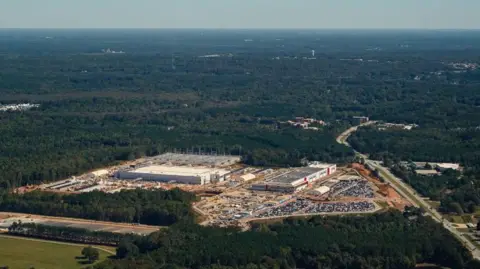
We tend to consider the cloud as something invisible – floating above us in digital ether. But the reality is very physical.
The Cloud lives in more than 10,000 data centers around the world, most of them located in the United States, followed by the United Kingdom and Germany.
The AI now leading to an increase in online activity, this number is increasing rapidly. And with them, more complaints from neighboring residents.
The American boom is disputed by an increase in local activism – with $ 64 billion (47 billion pounds Sterling) in delayed or blocked projects, according to a report by the Pressure Group Data Center.
And concerns are not only a question of construction. It is also the use of water. Keeping these servers cool requires a lot of water.
“These are very hot processors,” said Mark Mills of the National Center for Energy Analytics before the congress in April. “It takes a lot of water to cool them.”
Many centers use evaporation cooling systems, where water absorbs heat and evaporates – similar to the way perspiration evacuates the heat of our body. On hot days, only one installation can use millions of gallons.
A study estimates that AI -based data centers could consume 1.7 Billion of water gallons in the world by 2027.
Few places illustrate this tension more clearly than Georgia – one of the fastest growth data centers markets in the United States.
Its humid climate provides a natural and more profitable source of water for the cooling of data centers, which makes it attractive for developers. But this abundance can have a cost.
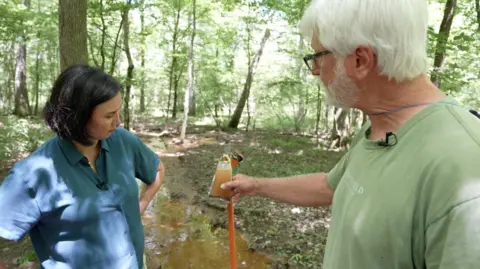
Gordon Rogers is the executive director of Flint Riverkeeper, a defense group for non -profit defenders who monitors the health of the Georgie Flint river. It takes us into a stream down a new construction site for a data center built by the quality technology services of the United States (QTS).
George Dietz, a local volunteer, picks up a water sample in a transparent plastic bag. It’s cloudy and brown.
“It shouldn’t be this color,” he said. For him, this suggests a runoff of sediments – and perhaps floculants. These are chemicals used in construction to link the soil and prevent erosion, but if they escape in the water system, they can create sludge.
QTS claims that its data centers meet high environmental standards and provide millions of local tax revenues.
Although construction is often carried out by third -party entrepreneurs, local residents are those who have remained to meet the consequences.
“They shouldn’t do it,” said Rogers. “A richer owner of ownership has no more property rights than a smaller and less rich property owner.”
Technology giants say they are aware of the problems and act.
“Our goal is that by 2030, we will put more water back in watersheds and communities where we are exploiting data centers, which we delete,” explains Will Hewes, leading water stewards on Amazon Web Services (AWS), which manages more data centers than any other company on a global scale.
He says that WESS is investing in projects such as leaks, harvesting rainwater and the use of wastewater treated for cooling. In Virginia, the company works with farmers to reduce nutrient pollution in Chesapeake Bay, the largest estuary in the United States.
In South Africa and India – where AWS does not use water for cooling – the company still invests in access to water and quality initiatives.
In the Americas, says Mr. Hewes, water is only used on approximately 10% of the hottest days each year.
However, the figures add up. Only one request in AI – For example, a request from Chatgpt – can use as much water as a small bottle as you buy in the corner shop. Multiply this by billions of requests per day, and the scale becomes clear.
Professor Rajiv Garg teaches Cloud Computing at Emory University in Atlanta. He says that these data centers do not disappear – if anything, they become the backbone of modern life.
“There is no step back,” said Professor Garg.
But there is a path to follow. The key, he maintains, is long-term reflection: smarter cooling systems, rainwater harvesting and more effective infrastructure.
In the short term, data centers will create “enormous pressure”, he admits. But the industry is starting to move towards sustainability.
And yet, it is little consolation for owners like Beverly Morris – wedged between yesterday’s dream and the infrastructure of tomorrow.
Data centers have become more than just industry trend – they are now part of national policy. President Donald Trump recently promised to build the biggest AI infrastructure project in history, calling him “a future fueled by American data”.
Back in Georgia, the sun beats through thick humidity – a reminder of the reason why the state is so attractive for data centers developers.
For the inhabitants, the future of technology is already there. And it’s noisy, thirsty and sometimes difficult to live next to it.
As AI develops, the challenge is clear: how to feed the digital world of tomorrow without drainage of the most basic resource of all – water.
Fixed: This article originally said that Beverly Morris lives in the county of Fayette, in Georgia, and has been modified to explain that she lives in Mansfield, Georgia.

Get our flagship newsletter with all the titles you need to start the day. Register here.


