Americans stranded as Middle East airspace closures disrupt travel


Americans stranded in the Middle East
The US State Department is looking for ways to help Americans evacuate from the Middle East. The department says that over the past few days, more than 9,000 Americans have returned safely from the region. Of these 9,000, only 300 come from Israel.
NEWYou can now listen to Fox News articles!
Phoenix, Arizona – The U.S. State Department is urging Americans in the Middle East to immediately leave the region, as escalating conflict and widespread airspace closures disrupt travel and evacuation efforts. However, Iranian attacks, embassy closures and airspace closures have created difficulties for Americans who find themselves stuck with few options.
Shanice Day was among thousands of Americans who said they found themselves stranded in the Middle East after the conflict began. She and her best friend had gone to Dubai to celebrate her 30th birthday.
“We loved a whole day in the desert,” Day said. “They started calling me their ‘habibi’ and they let me play with the hawk.”
Once the airspace was closed, only a limited number of flights began to leave the region as safety allowed.
STATE DEPARTMENT USES TEAM PATRIOTS PLANE TO EVACUATE AMERICANS FROM MIDDLE EAST
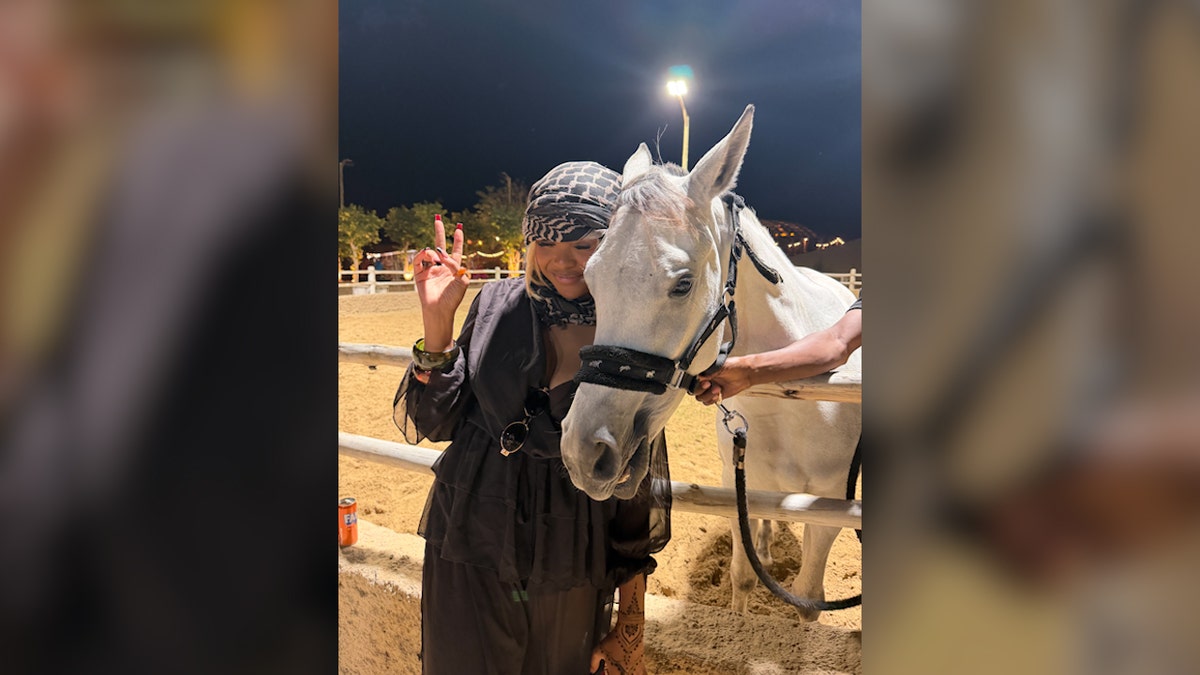
Shanice Day was among thousands of Americans who found themselves stranded in the Middle East after the conflict with Iran began. Once the airspace was closed, only a certain number of flights began to leave the region as safety permitted. (Courtesy of Shanice Day)
Day had only a few days of vacation before the United States and Israel struck Iran on February 28. Even though the airstrikes began that Saturday morning, Day didn’t realize there was a problem until that afternoon. By the time Day realized what had happened, Iran was already sending missiles toward the Gulf.
“As soon as I opened my phone, it said, ‘US and Israel strike Iran.’ So, I told my friend that she was back at the hotel and she was at the beach right now. So I’m like, “Hey, did you see what’s happening?” Day said, “She explains that she sees like a missile, almost going through the sky.”
Iran responded almost immediately to the US and Israeli attacks, raining missile and drone strikes on the United Arab Emirates, even hitting Dubai International Airport, one of the busiest in the world. With their flights home canceled as the United Arab Emirates closed its airspace, Day and her friend scrambled to find a way home while trying to understand the severity of the situation.
“We just kind of cried. The first 48 hours were really hard for us. Just having to break the news to our parents, because it was so early here. Hearing my friend’s mom being so devastated, and then hearing my own mom’s voice break like that. I wouldn’t wish that on anyone,” Day said.
AMERICANS STUCK IN DUBAI FACE REPEATED FLIGHT CANCELLATIONS AMID IRANIAN ESCALATION
Emirati airspace would continue to open intermittently to limited flights, but each modified flight would eventually be canceled. Day and her friend eventually returned to Houston, Texas, flying first to Australia.
Unlike the United Arab Emirates, which has long established itself as an oasis of security for foreigners, travel to Israel has always carried the possibility of conflict.
Jenna Fonberg and Jetlyn Toledo landed at Ben Gurion Airport the day before Israel and the United States attacked Iran. The friends had planned to celebrate the Jewish holiday of Purim with Fonberg’s older brother, Blake, who lives in Tel Aviv.
By the time Fonberg and Toledo landed in Israel, there was already talk of conflict breaking out in the region.
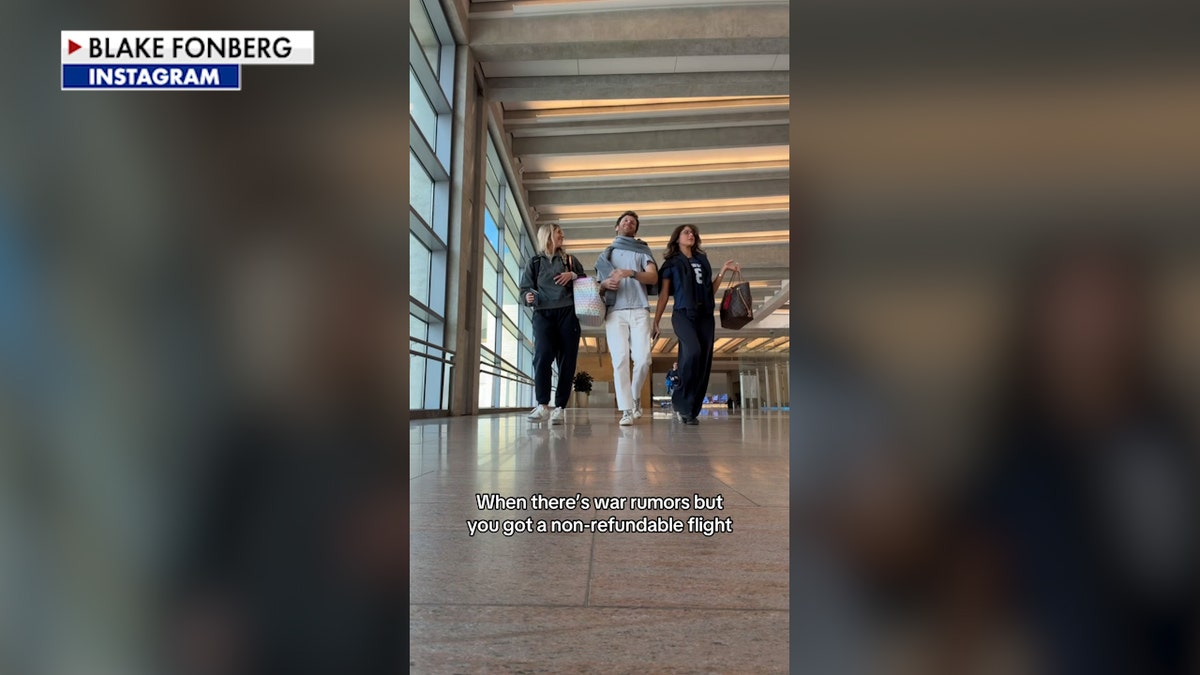
Jenna Fonberg and Jetlyn Toledo landed in Israel the day before the start of the US operation against Iran. Since the threat of attack is a constant presence in the country, Toledo and Fonberg said they do not want to live in fear. (Courtesy of Blake Fonberg)
“The problem with Israel is that there’s always talk of a war or a conflict. So if you cancel every trip because of, I guess, rumors of violence, you’ll almost never come,” Toledo said.
The next day, the trio woke up to sirens telling them to go to the nearest bomb shelter. They said that over time, they became friends with familiar faces who showed up repeatedly at the same shelters.
“There’s a lot of new faces today, because it’s kind of close to the beach, so a lot of people who are just walking on the boardwalk run here,” Fonberg said as he took cover from a missile threat.
Blake said he lost his home to a strike during a 12-day conflict with Iran in 2025. He said this time he was trying to stay positive.
“We have to stay positive. If we’re not, we lose. And I think I really tried to instill that in them. [Fonberg and Toledo] first day. I was like, ‘Everything’s going to be OK,'” Blake said.
Despite the sirens and strikes, the trio said they remained confident that the U.S. and Israeli militaries would keep them safe. They said it was very important to stay calm during all of this.
Fonberg and Toledo considered options for leaving the country, but with Israeli airspace completely closed at the start of the conflict, they were left with few options. Instead of flying to another country with open airspace, they opted to wait to see if the skies would open in time for their scheduled March 8 flight.
STATE DEPARTMENT DEFENDS “PROACTIVE” EVACUATION EFFORTS AGAINST DEMS’ CLAIMS OF DIPLOMATIC CHAOS
“I feel safer near a bomb shelter and being able to run there if I need to. Rather than driving 3 hours, 5 hours to Jordan or Egypt and covering my head if I hear a siren,” Fonberg said.
Israeli airspace slowly began to open on March 4. Fonberg and Toledo returned to the United States on their originally scheduled flights.
Ben Suster and his wife were at the end of their honeymoon in Israel when the United States and Israel struck Iran. Like Fonberg and Toledo, the newlyweds knew there was a possibility of conflict but felt safe in Israel. Suster and his wife arrived in the countryside a few days before the strikes began.
“Our flight was for Saturday night. We woke up Saturday morning, and we literally had a minute of peace, and we thought, ‘Oh my God,’ like we had spent the night, like we were safe and our flights should be good tonight,” Suster said.
The first sirens sounded a few moments later.
Without a bomb shelter in their Airbnb, the couple took up residence in a nearby public shelter.
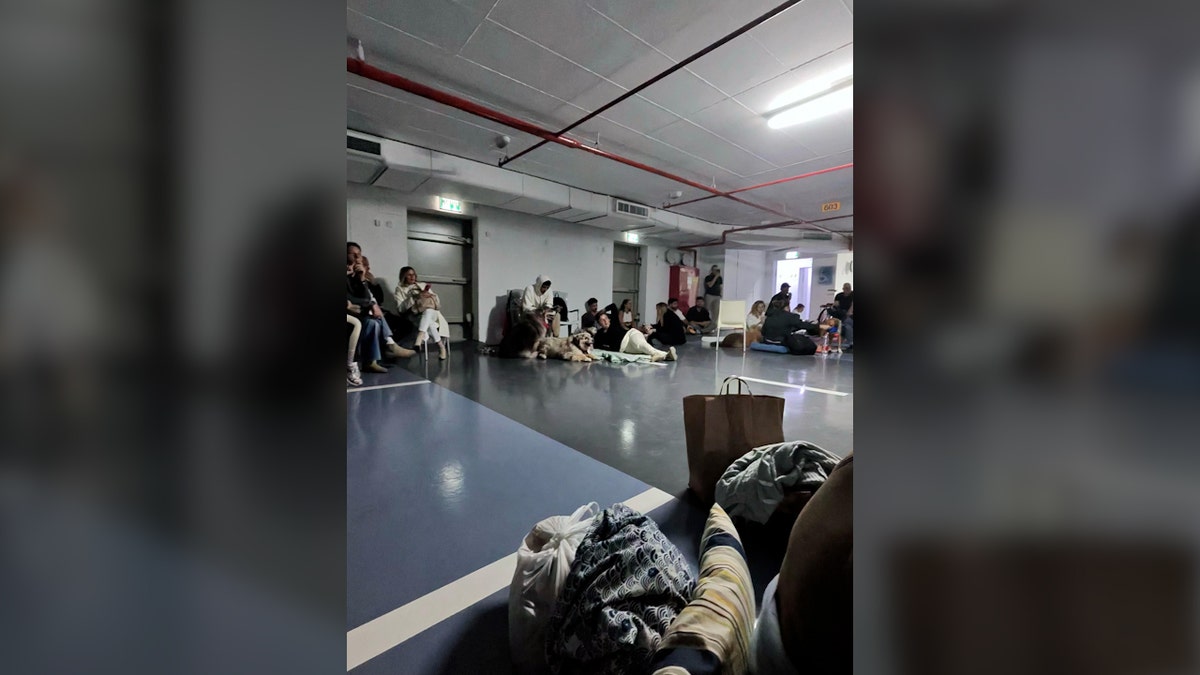
Ben Suster and his wife spent several days in an air raid shelter in Tel Aviv before moving to a family home with a shelter. (Courtesy of Ben Suster)
“Obviously, we weren’t hoping to end our honeymoon by sitting in a dark garage,” Suster said.
They stayed in the garage full time, before meeting friends at another shelter.
“We spent the whole day and night in this garage, making friends, you know, Israelis making the most of the situation,” Suster said.
After a few days, Suster and his wife left Tel Aviv to join their family in Geva Binyamin, an Israeli settlement in the West Bank near Jerusalem. The couple was eventually evacuated with the non-profit Gray Bull Rescue. For security reasons, Suster could not share details of the operation.
“We don’t even know what tomorrow will look like. We’ve been told what the final destination will be, but when it happens, how we get there, we have no idea,” Suster said.
Similar to Fonberg and Toledo, Suster said he felt safe and was sad to leave. He left only because they were running out of time, returning to Florida in time for his sister’s wedding.
CLICK HERE TO GET THE FOX NEWS APP
According to the State Department, more than 32,000 Americans have returned to the United States since U.S. strikes against Iran began on February 28.


