An explosion 92 million miles away just grounded Jeff Bezos’ New Glenn rocket


A series of solar flares, known as coronal mass ejections, triggered dazzling auroral light shows Tuesday evening. The flares sent a blast of material from the Sun, including charged particles with a strong localized magnetic field, toward Earth at more than a million mph, or more than 500 kilometers per second.
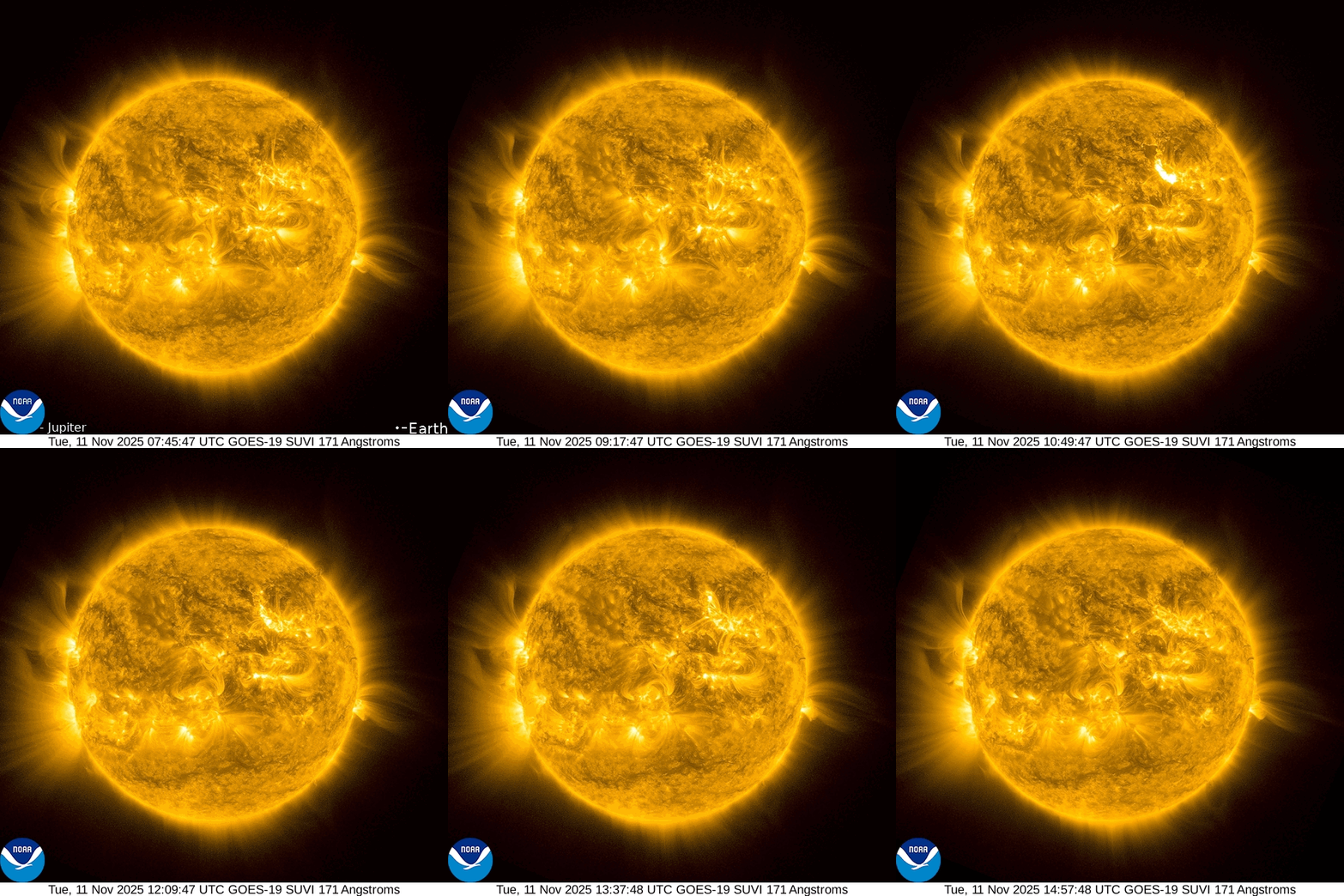
An ultraviolet solar imager on one of NOAA’s GOES weather satellites captured this view of a coronal mass ejection from the Sun early Tuesday.
Credit: NOAA
Satellites detected the most recent strong coronal mass ejection, accompanied by a bright solar flare, early Tuesday. He was scheduled to arrive on Earth on Wednesday.
“We’ve already had two of the three expected coronal mass ejections here on Earth,” said Shawn Dahl, a forecaster at NOAA’s Space Weather Prediction Center in Boulder, Colorado. The first two waves “were very powerful,” Dahl said, and were “profoundly stronger than expected.”
The storm unleashed northern lights that were visible Tuesday evening as far away as Texas, Florida and Mexico. Another set of northern lights could be visible Wednesday evening.
The storm that arrived Wednesday was the “most energetic” of all the recent coronal mass ejections, Dahl said. It’s also moving at a higher speed, fast enough to span the 92 million kilometer chasm between the Sun and Earth in less than two days. Forecasters are predicting a G4, or severe, geomagnetic storm Wednesday through Thursday, with a slight chance of a rarer G5 extreme storm, which has only happened once in the past two decades.

The Northern Lights light up the night sky over Monroe, Wisconsin, on November 11, 2025, during one of the most powerful solar storms in decades.
Credit: Ross Harried/NurPhoto via Getty Images
The sudden arrival of an influx of charged particles from the Sun can create disturbances in the Earth’s magnetic field, affecting power grids, degrading GPS navigation signals and disrupting radio communications. A G4 geomagnetic storm can trigger “potential widespread voltage control problems” in terrestrial power grids, according to NOAA, as well as potential surface charging problems on satellites flying above the protective layers of the atmosphere.
It is not easy to predict the precise impacts of a geomagnetic storm until it arrives at Earth’s doorstep. Several satellites positioned a million kilometers from Earth towards the Sun are equipped with sensors to detect the speed of the solar wind, its charge and the direction of its magnetic field. This information helps forecasters know what to expect.
“These types of storms can be very variable,” Dahl said.