Ancient Tooth Proteins Rewrite the Rhino Family Tree—Are Dinosaurs Next?


Ancient dental proteins rewrite the family tree of rhinos – are dinosaurs next?
The 20 million -year -old teeth molecules of a parent of rhinoceros are among the oldest sequenceds, opening attractive possibilities for scientists
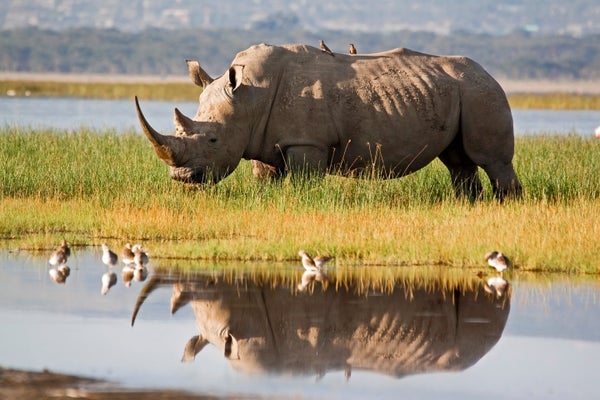
The evolutionary relationships of Rhinos have become a little clearer with the sequencing of the oldest proteins to date.
Researchers have described proteins which they believe are among the oldest ever sequenced. Two teams, who analyzed the molecules of parents extinct from rhinos and other major mammals, pushed the genetic fossil file over 20 million years.
Studies – In Nature Today – suggest that proteins survive better than researchers thought it. This raises the possibility of glean molecular ideas on evolutionary relationships, biological sex and food of even older animals – perhaps even dinosaurs.
“You just open a whole new set of questions that paleontologists have never thought of being able to get closer,” explains Matthew Collins, specialist in paleoproteomics at the University of Cambridge, in the United Kingdom, and at the University of Copenhagen.
On the support of scientific journalism
If you appreciate this article, plan to support our award -winning journalism by subscription. By buying a subscription, you help to ensure the future of striking stories about discoveries and ideas that shape our world today.
Preserved in the teeth
The ability to obtain DNA from remains that have revolutionized biology, revealing previously unknown human groups such as Denisovans and rewrites the history of the human population and other animals. The oldest sequenced DNA comes from mammothos of a million years and from Arctic sediments of two million years.
Proteins – Organic construction blocks coded by the genome – are more resistant than DNA and can push researchers to use molecules to understand the old species deeper in the past. How far is controversial. In 2007 and 2009, researchers described bursts of dinosaurs’ fossil proteins aged 68 million and 80 million years respectively, but many scientists doubt affirmations.
A 2017 effort to redo the 2009 work was more convincing, explains Enrico Cappellini, a biochemist at the University of Copenhagen. However, he only obtained a limited number of sequences – the list of amino acids which describes the composition of a protein – providing only temporary information on evolutionary relationships, he says. He and his colleagues consider that the current reference for the oldest evolutionary informative protein ever discovered like collagen extracted from a relative of camels of 3.5 million 3.5 million people from the Canadian Arctic.
To postpone this limit, in one of the last two studies, the Cappellini team extracted the proteins from the enamel – the mineralized external layer – of a rhinoceros parent of 23 million 23 million. The fossil was found on an island in the Arctic Region of Canada in 1986 and stored in an Ottawa museum. A pre -impression in 2024 attributed it to a new species of extinguished rhinos called Epiaère Itjilik.
Using mass spectrometry – which detects the weight of a protein fragment, allowing its composition to be deduced – the researchers have identified partial sequences of 7 enamel proteins, constituting at least 251 amino acids in total.
An evolving tree incorporating these sequences into the data of the genome of living rhinoceros and their two parents of the ice age revealed a surprise. THE Epiaère The sample belonged to a branch of the Rhino family tree which separated earlier than any other: between 41 million and 25 million years. Previous studies have placed this group among modern rhinos. “It really changes the way we have to think about the evolution of rhinos,” said Ryan Paterson, a biomolecular paleontologist at the University of Copenhagen, who co-directed the study.
Next step, dinosaurs
Proteins deteriorate in heat. The sample of rhinos that Paterson and his colleagues analyzed came from a polar desert where the average temperatures are well below the frost, “the ideal place” for the preservation of proteins, he says.
The Turkana basin in Kenya could be considered one of the worst – and yet it is the source of fossils as old as 18 million years, a second team of which sequenced enameled proteins. The ground surface temperatures can reach 70 ° C, and climate records suggest that the Turkana basin has been “one of the hottest places in the world for a very long time,” said Daniel Green, isotope geochemist from Harvard University in Cambridge, Massachusetts, who co-directed the study.
The Kenyan -Protein Kenyan sequences – Parents extinct rhinoceros, elephants, hippopotams and other creatures – adapt to classifications made by paleontologists based on the bone anatomy of fossils. But Green hopes that future Studies of Old Protein of Turkana will be able to resolve certain evolutionary mysteries, such as the origins of hippopotams. He and his colleagues also hope that ancient proteins can be obtained from the first hominines that have remained in the Turkana basin.
“Being able to show that we can return to 18 million years in this kind of really warm and hard environment, really shows that the world is open to work on paleoproteomic,” explains Timothy Cleland, physical scientist at the Smithsonian Museum Science Conservation Institute of Suitland, Maryland, who co-directed the Turkana study. It is particularly interested in trying to remove proteins from the teeth from the dinosaurs, but it will be a challenge, because their enamel is particularly thin, he says.
Studies are a major technical achievement, explains Deng Tao, paleontologist at the Institute of vertebrate paleontology and paleoanthropology in Beijing. But while researchers look even further in time for old proteins, he hopes that the results will be able to support significant information on the history of life, “rather than a simple competitive pursuit of the oldest records”.
Although studies are focused on evolutionary relationships, Collins is more enthusiastic about the prospects of bringing together other old protein ideas, including data on organic sex – based on the potential presence of enamel proteins that are only found in animals with y chromosomes y – and information on the place where an animal is in the food chain, written in nitrogen isotopes in amino acids. “What can you do with it?” All. It’s like, wow! “
This article is reproduced with permission and was first publication July 9, 2025.


