Animals of the Cambrian Period Experienced a Great Evolutionary Surge, Shaping Life Today


Key Points to Remember About Animals of the Cambrian Period
- Animals of the Cambrian Period experienced one of the greatest evolutionary surges in history, known as the Cambrian Explosion.
- Animals of the Cambrian period probably started out as worms or worm-like organisms. By the end of this period, however, these animals had developed legs, jaws, teeth, a primitive spine, and compound eyes.
- The largest animal from the Cambrian period belonged to the Anomalocaris group. They were fierce predators and could grow to around three feet long. Although there are remains of Cambrian animals today, none of the species that existed then are alive today.
The Cambrian, the first period of the Paleozoic, lasted about 50 million years. That seems like a long time for creatures like us, who live on average about 80 years. But in geological times, this is just an incident. The U.S. National Park Service website puts it this way: If you think of Earth’s geologic history as a calendar year, the Cambrian takes just four and a half days.
During this relatively brief period, life on Earth experienced the greatest evolutionary surge it has ever seen, earning the event the nickname the “Cambrian Explosion,” according to the Natural History Museum. During the three billion years that life existed on Earth, life consisted primarily of single-celled organisms.
Just before the Cambrian explosion, there were probably primitive animals similar to sponges or jellyfish. These eventually evolved into tiny worms, says Erik Sperling, a Stanford University scientist who studies biogeochemistry.
“All the different animals that have appeared in the fossil record evolved from relatively simple worms,” he says.
Learn more: 518 million years ago, the biggest and baddest predators were… worms?
Animals that existed in the Cambrian era
By the end of the Cambrian, the fossil record shows animals with legs, jaws, teeth, a primitive spine, and compound eyes. But these animals have not only developed new anatomical structures. They developed new ways of integrating into the world.
“They were making shells and skeletons out of all kinds of different biomaterials. They were adopting all kinds of lifestyles, living in the sediment, going up and swimming in the water column. It was an ecological explosion as much as it was an explosion of diversity,” says Sperling.
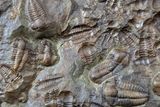
The most common (and famous) animals that appeared during the Cambrian Explosion were trilobites. Trilobites were arthropods, a phylum of invertebrates that includes insects, spiders and crustaceans, such as shrimp and crabs, according to the Natural History Museum. The upper body of a trilobite was armored and well fossilized.
Even amateur fossil hunters can find quantities. Fossils of their soft bellies are not that common. However, scientists do know that they had jointed legs and compound eyes.
Learn more: The sharp-toothed worm and other creatures lived in the Grand Canyon 500 million years ago
The largest animal of the Cambrian period
For the most part, Cambrian animals were small creatures, but a group called Anomalocarisa type of arthropod, measured about 60 centimeters (about 23 inches) long, possibly up to about 3 feet (1 meter), according to the Natural History Museum. They were the giants of the Cambrian world, says Sperling.
A formidable predator, Anomalocaris had good eyesight, which made him a good hunter. It probably caught soft-bodied prey with its spiky arms.
Pikaia, a slender fish-like creature with a primitive backbone, appeared in the Cambrian and may be a distant ancestor of all vertebrates – including us – according to a study published in Cellular biology.
Although all animals alive today are descended from these creatures that appeared in the Cambrian, no species from this period still exists.
What is the Cambrian period known for?
Although scientists have learned much about the Cambrian from the fossil record, they are less sure about the cause of this explosion of evolution.
“There are as many hypotheses about the causes of the Cambrian Explosion as there are areas of research,” Sperling says with a laugh. “It’s one of those events where everyone seems to see their area of research in the answer, a bit like if you have a hammer, everything looks like a nail.”
One of the most common hypotheses is that a sudden increase in oxygen levels may have been the cause of all this new life. However, evidence for a large increase in oxygen is rare. But perhaps it didn’t take a big increase.
In an article published in the journal Natural geosciencesSperling and his colleagues showed that at that time, most animals lived in shallow water where wind and waves could have oxygenated the water, even if oxygen levels at greater depths did not change. Sperling says small increases in oxygenation could have been enough to cause big ecological changes.
Whatever the cause, the Cambrian was an exciting period of evolution, and it has much to teach us about the history of life on Earth – and potentially, says Sperling, about the possibility of life on other planets.
The most interesting questions posed by the Cambrian explosion, he says, are: “Did this have to happen? Were animals inevitable on Earth?” Answering these questions can help us in our search for life on other planets with environments capable of supporting large and complex multicellular life.
Learn more: Scientists discover fossilized arthropod brains 500 million years old
Article sources
Our Discovermagazine.com editors use peer-reviewed research and high-quality sources for our articles, and our editors review the articles for scientific accuracy and editorial standards. See the sources used below for this article:


