Another Severe Weather Outbreak With Widespread Damaging Winds, A Few Tornadoes In Midwest, South, East Sunday and Monday

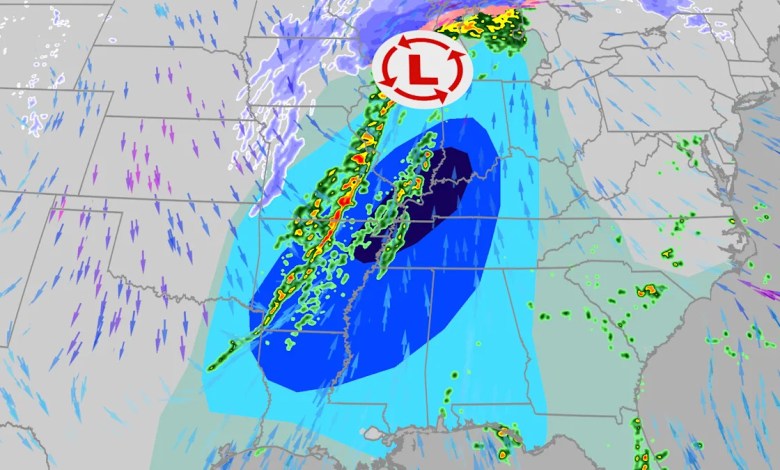
Another round of severe weather is expected across parts of the South, Midwest and East Sunday through Monday, with a threat of widespread damaging winds and a few tornadoes from Texas to the East Coast.
No, it’s not the movie “Groundhog Day.” For the third time this month, a wave of severe thunderstorms is forecast, affecting some areas that were repeatedly hit by severe weather during one or both of the previous outbreaks on March 5-8 and March 10-12.
This latest serious outbreak will occur on the warm side of an upper Midwest blizzard, named Winter Storm Iona by The Weather Channel.
However, this round of severe weather is expected to be somewhat different from the previous two. Instead of strong tornadoes, winds are expected to play a much larger role in this event.
The Storm Prediction Center’s take: “Widespread damaging wind with some tornado threat is likely late Sunday afternoon through Sunday evening from northeast Texas to southwest Lower Michigan.”
(FORECAST: Upper Midwest Blizzard this weekend through Monday)
Sunday
On Sunday morning, at least a few severe thunderstorms could develop over the western and northern portions of the severe area shown below.
By Sunday afternoon, severe thunderstorms will become numerous across parts of the Midwest and south, taking the form of a squall line, a long line of severe thunderstorms. Destructive winds are expected in this squall line, but embedded tornadoes are increasingly likely. A locally higher damaging wind threat exists from Evansville, Indiana, to Memphis.
Sunday evening, this squall line will then track eastward through the Ohio Valley, Lower Mississippi Valley, and Tennessee Valley, through the easternmost areas covered by a severe threat on the map below.

Monday
As the cold front from the intense Great Lakes low tracks eastward, thunderstorms with damaging winds will likely be widespread Monday across much of the East, from northern Florida to the Northeast.
For now, NOAA’s Storm Prediction Center has highlighted the area with the greatest risk of severe weather, from parts of the Mid-Atlantic states to the Carolinas.
However, this damaging wind threat could extend to Appalachia and throughout the Northeast Monday morning through Monday evening. It could accompany the squall line in the Northeast even though this section of the squall line is just a band of heavy rain with no lightning.
Even a few tornadoes are possible Monday, either embedded in the squall line or in discrete rotating thunderstorms that could erupt before the line.
Power outages and tree damage could be widespread across the East Monday and Monday evening.

Prepare now
– Prepare for a possible power outage, especially if it is expected to be cold after the storm.
– Have multiple ways to receive official National Weather Service watches and warnings, including via smartphone and NOAA Weather Radio. Make sure alerts are turned on so you can be woken up if you’re asleep.
– Know where to shelter when a severe thunderstorm or tornado warning is issued. If you live in a manufactured home, a community storm shelter, nearby home, or other large building is the safest choice.
– Take shelter immediately when a warning is issued. Don’t waste precious seconds looking out the window.
– Take severe thunderstorm warnings as seriously as tornado warnings. Winds over 60 mph are capable of blowing trees onto vehicles, homes and buildings, an underestimated danger in high winds.
(MORE: 14 Bad Weather Safety Tips)
Jonathan Erdman is a senior meteorologist at Weather.com and has covered national and international weather since 1996. Extreme and bizarre weather are his favorite topics. Contact him on Blue sky, X (formerly Twitter) And Facebook.