‘One of our most exciting discoveries so far’: Physicists detect rare ‘second-generation’ black holes that prove Einstein right again


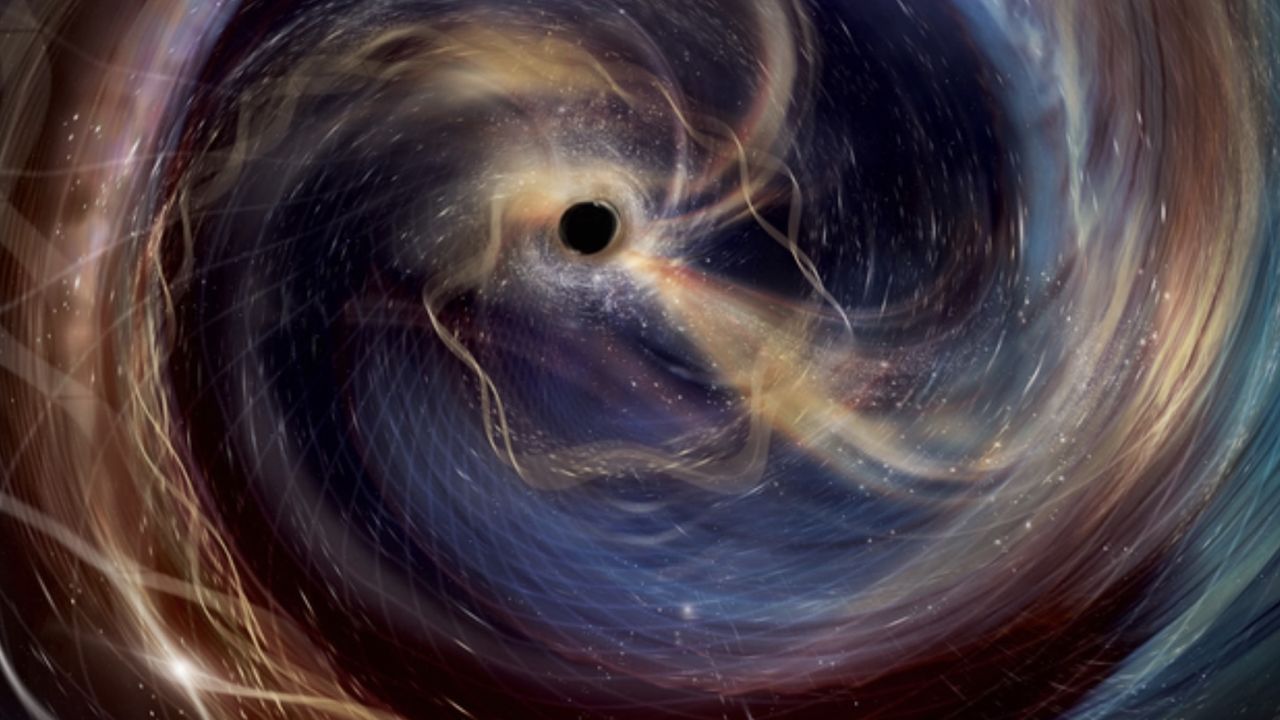
Scientists have found two fusion pairs black holesand they believe that the bulk of each merger is a rare “second generation” veteran of a previous collision.
The unusual behavior of the two largest black holes, observed through ripples in space-time called gravitational waves, was described October 28 in Letters from the astrophysical journal.
The results “provide tantalizing evidence that these black holes were formed from previous black hole mergers,” study co-author Stephen Fairhurstprofessor at Cardiff University in the United Kingdom and spokesperson for the LIGO scientific collaboration, said in a statement statement.
Consecutive mergers
The study relied on two recently detected mergers, which occurred just a month apart. Analyzing the gravitational wave signatures of these events allowed the researchers to infer the mass, rotation and distances of the black holes involved.
In the first event, on October 11, 2024, scientists spotted two black holes – measuring six and 20 times the mass of the sun, respectively – colliding in a merger known as GW241011, about 700 million light-years from Earth. The largest black hole was one of the fastest black holes never discovered.
The second merger, GW241110, was discovered on November 10, 2024, with black holes whose masses were eight and 17 times that of the sun. This merger was further away, 2.4 billion light years away. The larger black hole was also rotating opposite its orbit, which has never been seen before.
Scientists say each of these mergers had new properties, including that the largest black hole in each merger was almost twice as large as the smallest, and that the largest black holes were spinning strangely compared to hundreds of other mergers observed by gravitational waves since the first historic detection by LIGO (Laser Interferometer Gravitational Wave Observatory) in 2015.
The scientists suggested that the largest black hole in each merger had previously merged in a process called “hierarchical merger,” which would occur in dense environments like star clusters, where black holes would frequently come close to each other.
“This is one of our most exciting findings so far,” study co-author Jess McIverastrophysicist at the University of British Columbia, said in the release. “These events provide strong evidence that there are very dense, very active pockets in the universe that collect some dead stars.”
Besides the possible discoveries of second-generation black holes, scientists said the two mergers validate laws of physics predicted by Albert Einstein more than a century ago and these events help scientists learn more about elementary particles.
For example, GW241011 generated a clear signal that allowed scientists to see the larger black hole distort as it rotated, due to the black hole’s rapid rotation. The resulting gravitational wave signature matches Einstein’s theories, as well as the mathematician Roy Kerrregarding rotating black holes.
This same event also generated a “buzz” in the gravitational wave signal, created because the larger black hole was much larger than the smaller one. (The hum is similar to the harmonics of musical instruments, the collaborators said.) This observation also helped confirm Einstein’s predictions.


