Antarctica has lost 5,000 square miles of ‘grounded ice’ in the last 30 years, satellite images reveal

When you purchase through links on our articles, Future and its syndication partners may earn a commission.

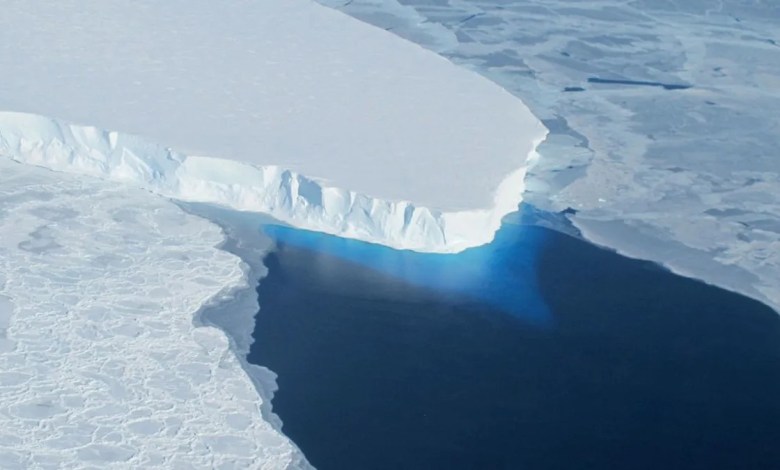
The Thwaites Glacier in West Antarctica. | Credit: NASA
A large new satellite analysis shows that Antarctica has lost nearly 5,000 square miles (12,950 square kilometers) of ground ice over the past three decades – an area about twice the size of Delaware – as warming ocean waters erode the continent’s most vulnerable edges.
Led by scientists at the University of California, Irvine, the study traces how Antarctica’s “anchor line” — the boundary where ice anchored to bedrock begins to float on the ocean — shifted between 1992 and 2025. Because this boundary marks where land ice begins to directly contribute to sea level rise, its retreat signals ice sheet instability and future loss of ice mass.
“We’ve known it’s critically important for 30 years, but this is the first time we’ve comprehensively mapped it across all of Antarctica over such a long period of time,” said study lead author Eric Rignot of UC Irvine. statement.

Scientists studying Antarctica have gained new insights into how the world’s largest ice sheet responds to warming sea temperatures. The study used three decades of satellite radar observations to map changes in “anchor lines” – the boundary between ice resting on land and that floating in the ocean – across the Antarctic continent from 1992 to 2025. | Credit: ESA (data source: Rignot et al, 2026)
Rignot and his colleagues analyzed data from a wide range of satellite missions operated by European, Canadian, Japanese, Italian, German and Argentinian space agencies. Using radar instruments, the researchers tracked the vertical movements of floating ice shelves caused by ocean tides. The stranded ice remained attached to the bedrock, allowing them to pinpoint changes in the grounding line over three decades with unprecedented precision.
The results show that approximately 77% of Antarctica’s coastline has experienced no detectable stranding line migration since 1996, suggesting high stability across much of the continent. But in vulnerable regions, particularly parts of West Antarctica, the Antarctic Peninsula and parts of East Antarctica, the study finds “significant decline“.
The largest changes were detected along the coast of the Amundsen Sea in West Antarctica and in the Getz sector, where the grounding line receded in some places by up to 42 km during the study period.
The shrinkage was most pronounced where deep submarine pathways channel warm ocean water toward the base of glaciersaid Rignot. This warmer water melts the ice from below, thinning the floating shelves and weakening their ability to support the glaciers behind them.
“It’s like the balloon which is not pierced everywhere, but where it East punctured, it’s punctured deeply,” Rignot said.
The study also highlights a puzzling trend along the northeast Antarctic Peninsula. In this area, several ice shelves collapsed before the study period and several glaciers have since retreated significantly, but researchers lack clear evidence that warm ocean water is driving this change.
“Something else is acting up, that’s still a question mark,” Rignot said in the statement.
Beyond documenting what has already happened, the researchers say the new record provides a crucial real-world test for computer models used to project the future. sea level rise.
“Models must demonstrate that they can match this 30-year record to claim credibility for their projections,” Rignot said in the release. “That’s the real value of this observational record: knowing that this migration of the anchor line took place.”
Even if much of Antarctica remains stable, Rignot warned that the current balance may not hold indefinitely.
“The flip side is that maybe we should feel lucky that the whole of Antarctica isn’t reacting right now, because we would have a lot more problems,” he said. “But that could be the next step.”
This research is described in a paper published March 2 in the journal Proceedings of the National Academy of Sciences.


