Antarctica Is Losing Ice the Size of Los Angeles Every Three Years


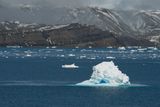
Thirty years of using radar from satellites circling the globe now gives scientists the first comprehensive map of the Antarctic grounding line, the thin boundary where land ice begins to float. The picture they uncovered is a mix of stability and retreat: About 77 percent of the continent’s edges have barely moved since 1996, but vulnerable areas of West Antarctica, along the Antarctic Peninsula and parts of East Antarctica, are losing their land ice at a surprising rate.
Over the past three decades, these losses total approximately 4,942 square miles (12,800 square kilometers), an area comparable to ten residents of Greater Los Angeles, or the equivalent of Greater Los Angeles every three years. The results appear in Proceedings of the National Academy of Sciences.
“Where warm ocean water is pushed by winds to reach glaciers, that’s where we see the greatest injuries in Antarctica,” lead study author Eric Rignot said in a press release. “It’s like the ball that is not pierced everywhere, but where it is pierced, it is pierced deeply.”
Learn more: Iceberg the size of Chicago breaks away from the ice sheet, revealing a thriving ecosystem
A 30-year record of ice loss in Antarctica equal to 10 LA
This is the first time scientists have mapped the movement of stranding lines along the entire Antarctic coast over such a long period. The researchers combined radar data from several satellite missions to track the changing contact of the ice sheet with the ocean.
On average, land ice has retreated about 162 square miles (442 square kilometers) per year. But the changes are not evenly distributed.
The greatest losses occurred in the Amundsen and Getz Sea areas of West Antarctica. The Pine Island Glacier retreated approximately 20.5 miles (33 kilometers) during the study period. The Thwaites Glacier has retreated by approximately 26 kilometers. Smith Glacier has retreated 42 kilometers (26 miles).
Elsewhere, notably along much of East Antarctica, the stranding line largely remained in place.
Why some Antarctic glaciers are retreating
In many of the most rapidly changing regions, it’s the ocean that does the work. Winds can push relatively warm water beneath floating ice shelves, thinning them from below. As this support weakens, the ice anchored upstream begins to retreat.
This trend explains much of what researchers are seeing in West Antarctica, but it doesn’t explain everything.
Along the northeast Antarctic Peninsula, grounding lines also moved inland, although researchers found no clear signs of warm water reaching the base of these glaciers. Several ice shelves in the region collapsed before this study began, and glaciers such as Edgeworth, Boydell, Sjogren, Bombardier, and Dinsmoor continued to retreat. The Hektoria Glacier alone has retreated more than 20 kilometers since 1996.
Something else may be contributing. For now, the exact trigger remains unclear.
A test for future sea level projections
The new map’s value isn’t just in showing where changes have happened. This also constitutes a reference.
Ice sheet models used to estimate future sea level rise will need to replicate this 30-year record if they are to be taken seriously. The observations provide a clear measure of Antarctica’s behavior over a significant period of time.
If a model fails to reflect both the stability along a large part of the coastline and the sharp retreat of vulnerable sectors, researchers will know that adjustments are necessary.
This long record also helps sort out conflicting measurements of the overall mass balance of Antarctica, particularly East Antarctica. Confirming that most of the coastline has remained in place helps explain why some studies report relative stability, while others highlight concentrated losses.
The map ultimately shows a continent that does not change everywhere at once. Large areas remain stable.
“The other side of the coin is that maybe we should feel lucky that the whole of Antarctica is not reacting right now, because we would be in a much more difficult situation,” Rignot said. “But that could be the next step.”
Learn more: A saltier Southern Ocean could cause more ice melt in Antarctica
Article sources
Our Discovermagazine.com editors use peer-reviewed research and high-quality sources for our articles, and our editors review the articles for scientific accuracy and editorial standards. See the sources used below for this article:


