Ants Make Individuals Weaker to Build Bigger Societies


Biology is full of tradeoffs, and one of the best known is whether success comes from quality or quantity – from building stronger individuals or producing more of them.
A study published in Scientific advances shows how this compromise played out in ants. Comparing hundreds of species, the researchers found that ants with particularly large colonies tend to build workers with thinner exoskeletons, investing less in individual protection to support many more workers overall. The results suggest that as societies become more complex, evolutionary pressure may shift away from individual sustainability and toward systems that succeed through numbers and coordination.
“There is this question in biology of what happens to individuals as the societies in which they evolve become more complex. For example, individuals may themselves become simpler because the tasks that a solitary organism should perform can be handled by a collective,” said lead author Evan Economo, in a press release.
How Ant Colonies Trade Strength for Numbers
Ant colonies range from a few dozen individuals to societies with millions of workers. As colonies grow, the tasks that would overwhelm a solitary insect—foraging, nest defense, and curbing disease—can be spread across many bodies.
To see how this change might reshape individuals, the researchers focused on the cuticle, the hardened outer layer of the exoskeleton. It helps protect ants from predators, dehydration and infection, and promotes movement – but it’s also nutritionally expensive to build, because it uses nitrogen and minerals that can be in short supply.
Measuring the Cost of Ant Protection
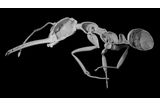
Using high-resolution 3D X-ray scans, the team measured the cuticle and body volumes of more than 500 ant species. Investment in cuticles varied: in some species it represented only 6% of total body volume; in others, up to 35 percent.
When the researchers compared these measurements to colony size and their evolutionary history, they found that species investing less in the cuticle tended to host much larger colonies. Rather than maximizing protection on a worker-by-worker basis, these ants appear to rely more on collective strategies to protect weaker individual armor.
“Ants reduce the investment per worker in one of the most nutritionally expensive tissues for the good of the collective,” said the study’s lead author, Arthur Matte. “They are moving from self-investment to a distributed workforce, resulting in more complex societies. It’s a model that echoes the evolution of multicellularity, where cooperative units can be individually simpler than a solitary cell, but collectively capable of much greater complexity.”
Learn more: Bumblebees and ants fight in violent nectar wars, leading to death and food shortages
When numbers beat strength
Thinner armor seems risky, but in a large colony the risk is spread. Losses are absorbable, dangerous tasks can be shared, and defense can emerge from coordination rather than tenacity.
This colony-level resilience may help explain another pattern: Ants with lower investment per worker also tend to show higher diversification rates, meaning they split into new species more frequently during evolution. One hypothesis is that colonies with lower nutritional requirements may expand into nutrient-limited habitats, opening new ecological opportunities that accelerate diversification.
What Ant Colonies Reveal About Tradeoffs Everywhere
The model discovered by the researchers is not limited to insects. Similar trade-offs between quality and quantity appear throughout human history, from military organization to everyday decisions – cases where scale and coordination can matter as much as individual strength.
“The trade-off between quantity and quality is ever-present. It lies in the food you eat, the books you read, the offspring you want to raise,” Matte said. “It was fascinating to trace how ants managed it over their long evolution. We could see lineages take different directions, be shaped by different constraints and environments, and ultimately give rise to the extraordinary diversity we see today.”
Learn more: Our ancestors made yogurt with live ants – and the recipe still works
Article sources
Our Discovermagazine.com editors use peer-reviewed research and high-quality sources for our articles, and our editors review the articles for scientific accuracy and editorial standards. See the sources used below for this article:


