Archaeologists Find 2.75-Million-Year-Old Stone Tools in Kenya


Archaeologists have discovered Oldowan stone tools in three distinct archaeological horizons, spanning approximately 300,000 years (2.75 to 2.44 million years ago), at the Namorotukunan site, part of the Koobi Fora Formation in the northeastern part of the Turkana Basin in Kenya’s Marsabit District. The discovery suggests continuity in tool-making practices over time, with evidence of systematic selection of rock types.
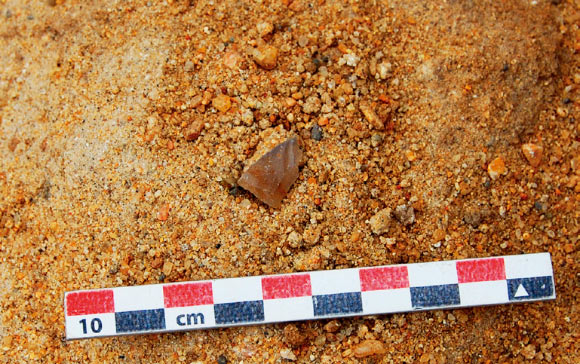
The 2.58 million year old stone tool from the Namorotukunan site in Kenya. Image credit: Braun and others., doi: 10.1038/s41467-025-64244-x.
The earliest phases of tool making, dating back more than 3 million years, highlight percussion technology, ubiquitous in the hominid record and shared with other primates.
Tool use, associated with extractive foraging, is a recurring trait in some extant primates.
The earliest systematic production of sharp stone artifacts, known as Oldowan, is found in hominid behavioral records at sites in East Africa: Ledi-Geraru and Gona in the Afar Basin (2.6 million years ago), Ethiopia, and Nyayanga in western Kenya (2.6 to 2.9 million years ago).
Professor David R. Braun, an anthropologist at George Washington University and the Max Planck Institute for Evolutionary Anthropology, and colleagues discovered several stone tool assemblages from three horizons, with estimated ages of 2.75, 2.58, and 2.44 million years, at the Namorotukunan site.
“This site reveals an extraordinary history of cultural continuity,” Professor Braun said.
“What we are seeing is not a one-off innovation, but a long-standing technological tradition.”
“Our results suggest that tool use may have been a more widespread adaptation among our primate ancestors,” said Dr Susana Carvalho, scientific director of Gorongosa National Park in Mozambique.
“Namorotukunan offers a rare perspective on a changing world long gone – the moving rivers, the raging fires, the approaching aridity – and the tools, unwavering.”
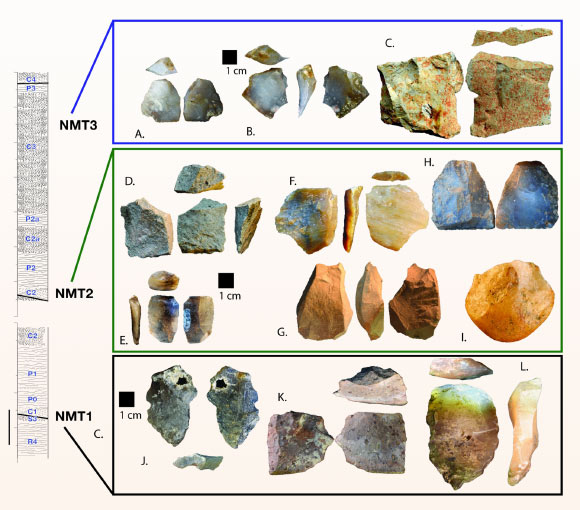
Stone tools recovered from three horizons at the Namorotukunan site in Kenya. Image credit: Braun and others., doi: 10.1038/s41467-025-64244-x.
“For 300,000 years, the same profession has persisted, perhaps revealing the roots of one of our oldest habits: using technology to protect us from change,” said Dr. Dan V. Palcu Rolier, a researcher at GeoEcoMar, Utrecht University and the University of São Paulo.
“Early hominids made sharp stone tools with extraordinary consistency, demonstrating advanced skills and knowledge passed down through countless generations.”
Using the dating of volcanic ash, magnetic signals frozen in ancient sediments, chemical signatures of rocks and microscopic plant remains, researchers have pieced together an epic climate saga that provides context for understanding the role of technology in human evolution.
These toolmakers experienced radical environmental upheavals. Their adaptable technology has unlocked new diets, particularly meat-based ones, turning hardship into a survival advantage.
“These findings show that by about 2.75 million years ago, hominids were already skilled at making sharp stone tools, suggesting that the beginning of Oldowan technology is older than we thought,” said Dr. Niguss Baraki, a researcher at George Washington University.
“At Namorotukunan, carvings link stone tools to meat consumption, revealing an expanded diet that persisted across changing landscapes,” added Dr. Frances Forrest, a researcher at Fairfield University.
“The fossil plant record tells an incredible story: the landscape changed from lush wetlands to dry, fire-swept grasslands and semi-deserts,” said Dr. Rahab N. Kinyanjui, a researcher at the National Museums of Kenya and the Max Planck Institute for Geoanthropology.
“As the vegetation changed, toolmaking remained stable. That’s resilience.”
The results appear today in the journal Natural communications.
_____
DR Braun and others. 2025. Early Oldowan technologies flourished during Pliocene environmental changes in the Turkana Basin, Kenya. Commune Nat 16, 9401; doi: 10.1038/s41467-025-64244-x


