Arrow tips found in South Africa are the oldest evidence of poison use in hunting

The oldest evidence for the use of arrow poison in the world has long been thought to come from Egypt, dating back 4,000 years ago. It was a black, toxic residue on bone arrowheads from a tomb at the Naga ed Der archaeological site.
New evidence from southern Africa calls this reality into question.
New research has discovered poison on stone arrowheads from South Africa, dating back 60,000 years ago. This is the oldest direct evidence of hunting with poisoned arrows.
This adds to what is already known about the skills of ancient African bowhunters. These abilities may have contributed to the long and flourishing evolution of our species in the region and, ultimately, the successful spread of Homo sapiens outside Africa.
Hunter-gatherers in southern Africa
The evidence comes from the Umhlatuzana rock shelter in South Africa’s KwaZulu-Natal province. The site was partly excavated in the 1980s to preserve archaeological material that may have been damaged during the construction of the N3 highway between the cities of Durban and Pietermaritzburg.
Umhlatuzana is recognized as an important Stone Age site where hunter-gatherers lived at least 70,000 years ago. It is one of the rare sites in southern Africa where humans continued to live until a few thousand years ago.
In southern Africa, people have long hunted with poisoned arrows. For example, a team of South African and Swedish archaeologists found residue on arrowheads dating from a few centuries to 1,000 years ago, revealing how different recipes for arrow poison were used.
Recently, three bone arrowheads stored in a bone container filled with poison were reported from Kruger Cave in South Africa, dating back almost 7,000 years ago. This pushed direct molecular evidence for the use of arrow poisons back to around 3,000 years before the Egyptians poisoned arrows.
Traces of the poison were previously found on a stick and in a piece of beeswax dating between 35,000 and 25,000 years ago at Border Cave in KwaZulu-Natal. These were considered indirect suggestions of early hunting poisons.
As a researcher in cognitive and Stone Age archaeology, I studied some artifacts from Umhlatuzana almost 20 years ago, finding traces of use and adhesive residue on some of the quartz-backed microliths (small shaped stone tools) dating back to 60,000 years ago. This shows that they were probably used as arrowheads.
Now Sven Isaksson of Stockholm University’s Archeology Laboratory has been able to identify molecular traces of toxic plant alkaloids (chemicals), known to be arrow poison, on a handful of these artifacts.
Poison from native plants
This latest research revealed the presence of toxic alkaloids buphandrine and epibuphanisine on five out of ten analyzed arrowheads from Umhlatuzana. The same alkaloids were also found on bone arrowheads collected by Swedish travelers to the region 250 years ago. This tells us that the same arrow poison has been used for millennia in southern Africa.
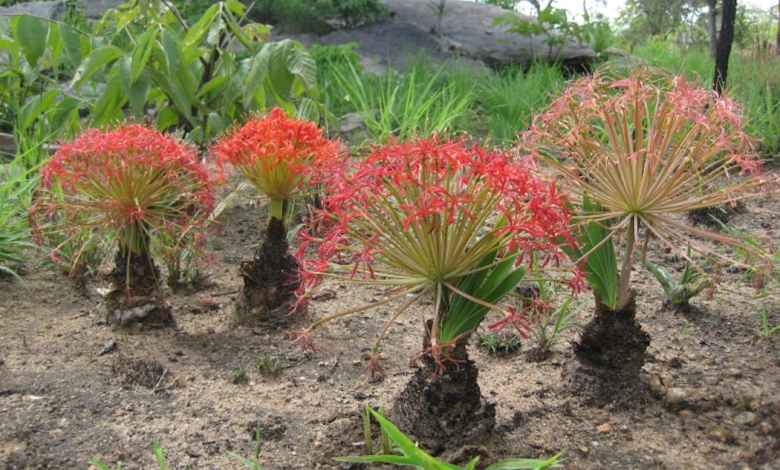
Both alkaloids can be found in several species of southern African Amaryllidaceae, a family of flowering plants growing from bulbs. But only what is colloquially called gifbol (poisoned bulb, disticha boophone) is well documented as the source of an arrow’s poison. The bulb of the plant contains toxic juice (exudate).
The discovery of these specific alkaloids on five of the ten quartz arrowheads studied cannot be a coincidence. Ancient hunter-gatherers likely knew of the toxic properties of gifbol exudates. For example, around 77,000 years ago, people in the same region also knew of the insecticidal and larvicidal properties of certain aromatic leaves used for litter. They would therefore probably not have kept the gifbol substance in their living space.
Substances containing buphandrin and epibuphanisin molecules are not used commercially or in archaeological conservation, which rules out accidental modern contamination of arrowheads.
Gifbol bulbs can survive for a century or more, despite drought cycles and fire regimes. The plant is native to South Africa and thrives in grassland, savannah and Karoo vegetation. It is widespread throughout southern, eastern and northern parts of South Africa, growing today within a day’s walk of the Umhlatuzana rock shelter. For various reasons, it is likely that it was also accessible to the site’s inhabitants thousands of years ago.
The toxic chemicals in the bulb last a long time. They do not break down easily, even in humid environments, and interact well with mineral surfaces like stone arrowheads. This is probably why they survived 60,000 years in Umhlatuzana.
Implications of the world’s oldest known poisoned arrowheads
The quartz arrow points with gifbol The poison now represents the first direct evidence of hunting with poisoned arrows in southern Africa and around the world – 60,000 years ago.
It demonstrates that these ancient bowhunters possessed a knowledge system that allowed them to effectively identify, extract, and apply toxic plant exudates. They also need to have an understanding of prey ecology and behavior to know that the delayed effect of injected poison on an animal would weaken it after a while. This would make it easier to burn out, a technique known as persistence chasing.
Such remote, out-of-sight action is a compelling indicator of complex cognition that requires response inhibition (being able to delay an action for a reason). Because poison is not a physical force, but works chemically, hunters also had to rely on advanced planning, abstraction, and causal reasoning.
Thus, in addition to providing the first direct evidence of hunting with poison arrows, the results contribute to the understanding of human adaptation, techno-behavioral complexity and modern human behavior in southern Africa.
This article is republished from The Conversation, an independent, nonprofit news organization that brings you trusted facts and analysis to help you make sense of our complex world. It was written by: Marlize Lombard, University of Johannesburg
Learn more:
Marlize Lombard works for the University of Johannesburg


:max_bytes(150000):strip_icc()/Health-RecallRoundup6.27-540021ae3f0d470d8e059839d7c2e740.png?w=390&resize=390,220&ssl=1 "Chocolate and Cheese Pulled From Shelves This Week")