Artemis Accords nations grapple with how to handle emergencies and ‘harmful interference’ on the moon

When you purchase through links on our articles, Future and its syndication partners may earn a commission.

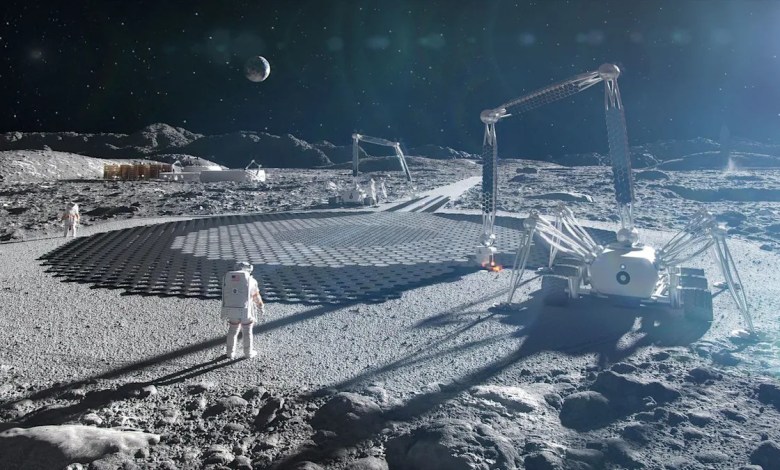
Artist’s illustration of a lunar base under construction. | Credit: NASA
Five years after the establishment of the Artemis Accords, key rules for operations on the Moon remain unresolved, including how to respond to emergencies and define “safe zones” around lunar activities.
As NASA prepares to launch its Artemis 2 mission – which will bring the astronauts back to the vicinity of the moon For the first time in more than half a century, presaging the eventual return of humans to the lunar surface, efforts continue on the ground to determine how to deal with the dangers inherent in lunar exploration.
At a press conference at the International Astronautical Congress in Sydney, Australia last September, Chords of Artemis Members from the United Arab Emirates, Australia and the United States presented the latest results of the signatories’ workshops on key issues, including the question of emergencies and safe zones.
“In a lunar scenario, if there is an emergency, whether or not it is a [Artemis Accords] signatory or not, how do you behave in this scenario?” said Ahmad Belhoul Al Falasi, UAE Minister of Sports and Chancellor of Higher Technological Schools. The results of the discussions were not shared, although details are expected to follow as the signatories continue their work.
Signatories to the Artemis Accords adhere to key principles, including interoperability. This means that NASA partners Artemis Program should aim to develop and provide support for systems that can operate in conjunction with existing infrastructure, with the aim of increasing the security of space operations.
Cooperation between signatories to the Artemis Accords and non-participants in emergencies can be much more complicated politically, in terms of communications and technological compatibility.
He was asked if there had been any approaches to other lunar actors such as China and Russia regarding joining the Artemis Accords, NASA Associate Administrator Amit Kshatriya said there had been none, citing constraints under which NASA operates regarding engagement with these parties.
Another area of interest and complexity concerns security zones. Under the Artemis agreements, security zones are the de facto mechanism to avoid interference. These propose establishing buffer zones around lunar operations, such as landers, habitats or resource extraction sites, to avoid harmful interference. But defining a safety zone and its size is a challenge.
“What a security zone is is not very well defined,” Al Falasi said. “[They] could be small, could be big. We have to be very specific about this. »

To date, more than 60 countries have signed the Artemis Accords. | Credit: NASA
As the United States and China seek to send manned and robotic missions to the lunar south pole, which has notable key locations in terms of solar illumination and access to potential sheltering areas. water iceThese questions will need to be answered to avoid problems and disagreements or worse.
The safe zone concept would help avoid “harmful interference,” Al Falasi noted, and it is difficult to define this. “There is interference every day, but what is harmful interference?” Safety zones and the definition of harmful interference provide the “basis for ensuring non-interference,” Al Falasi said.
Al Falasi said the meetings included exploring potential scenarios involving countries and private companies, both within the Artemis agreements and outside. The specifics of the scenarios were shared, with the exception of one of the scenarios simulating an emergency situation.
This lack of precision comes after years of work on the Artemis agreements, which more than 60 signatories. And a big question is whether these zones are temporary buffers and whether they would actually confer something equivalent to property rights on the moon.
Other parties outside the Artemis Accords – for example China and Russia, who joined forces to create the International Lunar Research Station (ILRS) and coordinating bodies – could argue that these could become disguised territorial claims, especially since the 1967 Outer Space Treaty prohibits the appropriation of territory on celestial bodies. However, as activities on the Moon accelerate, Artemis Accord participants and non-signatories alike will need to find common ground.