Artemis II is set to launch into space next week. Meet the astronauts’ rescue crew


Artemis II’s four-person crew is at the Kennedy Space Center in Florida getting ready to blast off and head to the moon as early as Wednesday – and prepare for any obstacles space might throw at them.
The astronauts round trip space travel will travel nearly half a million miles in nine days. They will reach the Moon, circle its far side and return to Earth. This will be the first crewed lunar launch since 1972.
But space is inherently risky – and this is a test flight.
NASA plans for every scenario, and a global team of Air Force rescuers is ready to help. The crew of Artemis II if circumstances require it. Air Force Detachment 3 has coordinated emergency plans and astronaut rescue for NASA since 1959. Members of the unit train hard for a time they hope never sees.
“We absolutely never want this to happen,” said Lt. Col. Kevin Pieper, who oversees the unit.
On Saturday morning, CBS watched members of the unit perform a simulation to recover astronauts after a mid-launch abort. Here’s what the simulation looks like: A C-17 military plane carrying 15,000 pounds of rescue equipment heads toward the landing site. The plane drops jet skis, inflatable boats and medical supplies, and a team of parachutists, or pajamas, heads for the water.
CBS Saturday morning 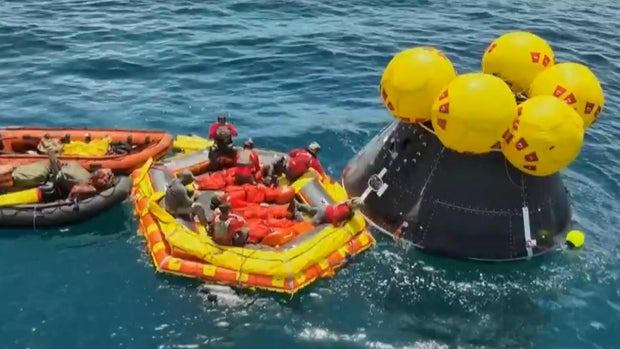
The PJs gather the equipment, then take it to the capsule itself and begin extricating the crew onto the life raft, which contains food, water, survival gear, and medical equipment.
Jason Dykstra, a member of the rescue team, said jumpers have no idea what they will find with the capsule or crew, so they must prepare for each scenario and the days aboard the life raft.
“We have enough supplies to sustain these astronauts, medically speaking, until help arrives, until we can get them out of there and get them to a higher level of care,” Dykstra said. “We are wired to survive in this environment for about 72 to 96 hours.”
Several teams will be waiting when the The Artemis II crew is finally launched. Unit Chief Pieper said there were several unknowns to prepare for, so every rehearsal was helpful. Supporting the Artemis II crew is a “huge responsibility,” he said.
“We’re here to make sure they get home safe and sound, if, God forbid, something like this were to happen,” Pieper said. “Everyone understands how important what we do is, not only for the safety of the crew, but also for the mission.”


:max_bytes(150000):strip_icc()/Health-GettyImages-1500520087-74b849e7d7e14dd3983ec8a49f0276c0.jpg?w=390&resize=390,220&ssl=1 "Long-Term Cannabis Use Can Lead to This Lesser-Known Syndrome")
