April 1, 2026
2 min read
 Add Us On GoogleAdd SciAm
Artemis II’s journey to the moon, day by day
The four astronauts aboard the Orion spacecraft will carry out a packed schedule during their trip around the moon’s far side
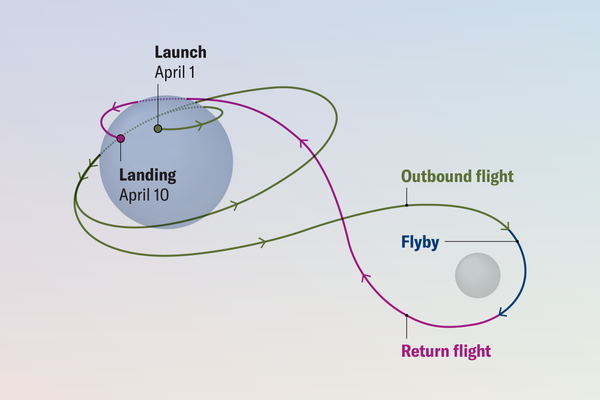
Amanda Montañez; Source: NASA (reference)
NASA is gearing up to launch four astronauts on a pioneering journey around the moon—the Artemis II mission. Follow our coverage here.
Launching as early as this evening, Artemis II’s astronauts are in for an epic 10-day odyssey around our closest cosmic neighbor.
Riding in the Orion spacecraft, the crew’s there-and-back-again voyage will trace out a figure-eight-like path around Earth and the moon, arcing about the lunar far side at the journey’s midpoint before being pulled back earthward by our planet’s gravity. Along the way, the four astronauts have a packed schedule of scientific activities and tests of Orion’s life-support systems.
After the launch and separation from the immense Space Launch System rocket, the crew will spend their first day in space positioning Orion in a high Earth orbit for its subsequent long-haul trip to the moon.
On supporting science journalism
If you’re enjoying this article, consider supporting our award-winning journalism by subscribing. By purchasing a subscription you are helping to ensure the future of impactful stories about the discoveries and ideas shaping our world today.
On day two, Orion will perform its “translunar injection burn,” firing its main engine to propel the craft all the way around the moon and back. The crew will perform smaller burns over the following two days to correct their path as needed while practicing the highly choreographed program for their short sojourn on the lunar far side.
On day five, Orion will slip into the moon’s gravitational sphere of influence, but it will not actually enter lunar orbit. Day six will take the Artemis II crew to the far side—and briefly outside of radio contact with Earth. Depending on the exact timing of the launch itself, the crew may also break the record for the farthest anyone has traveled from Earth, which was previously set in 1970 by the crew of Apollo 13. They’ll spend day six making naked-eye observations and taking photos of the moon, which at closest approach will appear as large as a basketball held at arm’s length. They’ll also try to capture new images of “Earthrise,” a view of our planet cresting like a shimmering jewel over the desolate lunar surface.
After their lunar encounter, the astronauts will spend the next few days prepping for their homecoming, especially atmospheric reentry, which will heat the spacecraft’s exterior to a blistering 3,000 degrees Fahrenheit (1,650 degrees Celsius) on day 10. Then the smaller crew module will detach from the rest of Orion, and a sequence of parachutes will deploy to slow their descent for a tranquil 17-mile-per-hour plunge to splashdown in the Pacific Ocean—where U.S. ships will be eagerly awaiting the astronauts’ safe return.
It’s Time to Stand Up for Science
If you enjoyed this article, I’d like to ask for your support. Scientific American has served as an advocate for science and industry for 180 years, and right now may be the most critical moment in that two-century history.
I’ve been a Scientific American subscriber since I was 12 years old, and it helped shape the way I look at the world. SciAm always educates and delights me, and inspires a sense of awe for our vast, beautiful universe. I hope it does that for you, too.
If you subscribe to Scientific American, you help ensure that our coverage is centered on meaningful research and discovery; that we have the resources to report on the decisions that threaten labs across the U.S.; and that we support both budding and working scientists at a time when the value of science itself too often goes unrecognized.
In return, you get essential news, captivating podcasts, brilliant infographics, can’t-miss newsletters, must-watch videos, challenging games, and the science world’s best writing and reporting. You can even gift someone a subscription.
There has never been a more important time for us to stand up and show why science matters. I hope you’ll support us in that mission.