Knee-replacement implant used on thousands of NHS patients known to be faulty for years


Place on 4 surveys

 Bbc
BbcA knee replacement implant, used in thousands of British operations, was known to have a failure rate concerning eight years before being finally withdrawn, discovered the BBC.
The patients said that the file in 4 investigates how they were left motionless or dependent to the pain relievers after receiving the Nexgen knee implant, as it ended up slipping out of words. Hundreds of people have now had to undergo a second corrective operation.
The knee surgeons say that the American manufacturer of the implant, Zimmer Biomet, took too long to recognize that there was a problem with a particular component.
Zimmer Biomet says that patient safety is his “top priority” and that his products are approved in accordance with relevant regulations.
Debbie Booker of Southampton had an operation to replace his left knee in 2016.
Although at the start, he seems to have succeeded, she began to feel intense pain a year later on vacation in Mallorca.
“I put a bag of ice on my knee and for four days, I had to do it every few hours because I was agony,” she said.
A replacement of the knee consists in eliminating the damaged surfaces of the femur (thigh bone) and tibia (tibia) and replacing them with artificial components.
Debbie says that the pain results from the tibia slippery knee implant and wore the bone.
In the coming months, she says that she became a prescription analgesics: “I was on fentanyl and morphine. It took me a long time to get out of morphine because I was addicted.”
Since then, she has undergone a second replacement of the knee, but the problems caused by the initial implantation have caused sustainable health problems, she said.
“It put my whole body on alignment, I walk with a soft,” explains Debbie. As a result, it is now awaiting a hip replacement.
Another patient, “Diana” (not his real name), had a knee implant installed in 2021 which also slipped and began to wear her tibia, leaving her practically motion.
“The consultant told me every time I got up, I was standing on a broken leg. It was absolute agony,” she said.
Diana asked to be anonymous because she worked in the NHS.
As part of their knee advantages, Debbie and Diana had received a specific implant section, known as “tibial component of upper option”, also known as “Tibial plateau”.
In general terms, this section had no layer of plastic contained in previous and renowned versions of the Nexgen replacement knee.
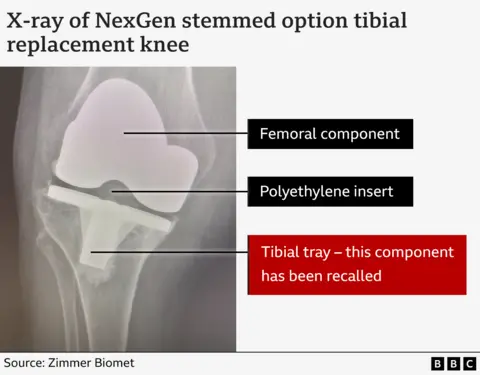
Zimmer Biomet began to market this modified version in 2012. It was cheaper than the previous model, so it had a financial meaning for the NHS, according to Professor David Barrett, a knee specialist at the University of Southampton.
“”[The NHS] were justified by saying: “We have every reason to think that it will go,” he says.
During the decade that followed, more than 10,000 patients were equipped with this version of the implant.
However, the file on 4 surveys discovered that the concerns were reported for the first time in 2014 by the National Joint Registry (NJR) which maintains an implant surgery file in England, in Wales and Northern Ireland.
At this point, there were insufficient data to draw reliable conclusions, the NJR told us. It is not an easy task to isolate a specific component that does not work as it should, he added.
Other concerns concerning the implant were raised in Ireland two years later, in 2016, by Professor Eric Masterson, knee surgeon in Limerick.
Professor Masterson’s corrective surgery rate has soaked after starting to use Nexgen implants in 2012 and he found his professional competence called into question.
“It was a lonely place,” he told File on 4 surveys. “You spend a life for a career and a reputation, and it is very easy to have this jagged career.”
When he raised questions from the representatives of Zimmer Biomet, they assured him that there was no general problem, he says – a story taken up by the NHS surgeons who told us that they had found themselves in similar situations.

Professor Masterson asked to be put in contact with surgeons in the United Kingdom to compare the notes. However, the confidential documents of the internal company seen by file on 4 surveys reveal that the company was not prepared to contact surgeons on its behalf only if they were considered “friends of Zimmer Biomet” and “satisfied with their patients Nexgen”.
Zimmer Biomet did not act quickly enough after the identification of the problem, according to Professor Leila Biant, one of the main surgeons of the United Kingdom’s knee. She says that the concerns were raised by herself and other colleagues in 2017.
“The problem is [the company’s] Initial reluctance to recognize a problem and not to really engage in a process to assess these patients until [Zimmer Biomet] came to a situation where they had to do it, “she tells us.

In 2022, the NJR estimated that patients were almost twice as likely to need corrective surgery after receiving the Nexgen implant, compared to the average knee implant.
The same year, Zimmer Biomet recalled any unused implant on the British market.
Estimates the failure rates of the component of the Tibial plateau in this implant Nexgen vary from 6% (twice as much as what should be expected) to 19%, according to academic studies evaluated by peers.
In a press release, the company said to the BBC: “Zimmer Biomet is attached to the highest safety, quality and transparency standards of patients. When new data becomes available, we act appropriately, responsible and in accordance with applicable regulatory requirements.”
The 10,000 patients equipped with problematic implants should have been recalled for a review by hospitals where they had their initial operations. Hundreds have already had to have a second operation, and others are likely to follow as the problems are revealed.
The cost of rectifying the problem is not cheap. Each revision costs between 10,000 and 30,000 £ because the implant is very specialized, explains Professor Barrett of the University of Southampton.
“Patients are in hospital longer and they require more support. It is therefore a very important expenditure,” he said.
Consequently, the total bill is estimated at millions of pounds.
Zimmer Bionet did not respond when the file on 4 surveys asked if this would contribute to the cost of these operations. However, we saw a confidential email of the company, sent in 2022, telling sales staff to say that “Zimmer Biomet will not cover the diagnostic, monitoring or revision costs in advance”.
The NHS in England told us that it “currently examined the case involving knee implants from Zimmer Biomet Nexgen”.

Get our flagship newsletter with all the titles you need to start the day. Register here.


