Asteroid 2024 YR4 Won’t Strike the Moon in 2032, Negating the Chance of a Violent Lunar Impact


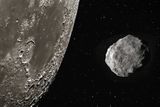
The commotion surrounding asteroid 2024 YR4 hitting the Moon may finally die down, as it has been announced that the Moon is officially safe from any impact. Observing the asteroid over the past year has been a roller coaster ride, as estimates of the impact have wavered time and time again. It appears, however, that 2024 YR4 will simply pass by the moon and continue on its merry way.
The lunar impact was canceled thanks to new data collected by NASA’s James Webb Space Telescope (JWST) in February. NASA scientists now say that 2024 YR4 will pass close to the Moon at a distance of 13,200 miles. This updated verdict highlights the importance of continuously observing near-Earth objects, as impact probabilities tend to decrease once enough data is available.
Learn more: Samples from asteroid Bennu contain mysterious space gums, sugars and a ton of stardust
Panic over asteroid 2024 YR4
2024 YR4 surprised everyone when the NASA-funded Asteroid Land Impact Warning System station in Chile discovered it on December 27, 2024. At first, scientists estimated it had a little more than a 1% chance of hitting Earth on December 22, 2032. That probability steadily climbed to 3.1% by February 2025.
Fears have also intensified due to 2024 YR4’s more sinister nickname: the “city killer.” While this name is no longer as apt as it once was, it doesn’t lie about the destructive potential of 2024 YR4. The asteroid measures between 174 and 220 feet (about the size of a 15-story building) and if it were to impact Earth, it would be capable of inflicting devastating damage on population centers.
Protected from impacts
We no longer have to worry about an impact with Earth, since scientists announced last April that 2024 YR4 would miss our planet. But as the risk of impact with Earth decreased completely, the likelihood of it hitting the Moon increased. In June, scientists said that 2024 YR4 had a 4.3% chance of reaching the Moon, and for months that number didn’t change.
Today, based on JWST observations, experts from NASA’s Center for Near-Earth Object Studies have confirmed that the asteroid will pass in front of the Moon in 2032. It was previously assumed that 2024 YR4, which disappeared last spring, would not be visible until 2028, but scientists found two narrow opportunities to observe the asteroid, on February 18 and 26, 2026.
According to a statement from the European Space Agency, this is because JWST could detect a faint spot (representing 2024 YR4) “against a sparse background of stars whose positions are very well known.”
Scientists were able to rule out the risk of impact on the Moon thanks to a better understanding of where the asteroid will be in 2032, rather than a change in its orbital trajectory, according to a NASA press release.
Finally, everyone can relax: Earth and Moon are safe from asteroid 2024 YR4.
Go down to zero
The 2024 YR4 observations brought many ups and downs last year, but why has the impact risk continued to change so often?
According to NASA scientists, this is a completely normal result when monitoring near-Earth objects (NEOs). In a Planetary Society statement last January, Bruce Betts, chief scientist of the Planetary Society, wrote that it is common for “the chance of impact to increase before dropping to zero.” As more data is collected for asteroids like 2024 YR4, scientists can fill in the gaps and prove that no impacts will occur.
As of December 2025, NASA is monitoring more than 40,000 near-Earth asteroids of various sizes. The agency also maintains a webpage dedicated to sharing information on the most recent near-Earth object approaches to Earth. For example, nine objects will come closer between March 7 and 9, 2026. While this may sound scary, the reality is that these objects will typically still be millions of miles from Earth.
Learn more: Microbes could survive an asteroid impact and hitch a ride on debris between planets, including Mars and Earth
Article sources
Our Discovermagazine.com editors use peer-reviewed research and high-quality sources for our articles, and our editors review the articles for scientific accuracy and editorial standards. See the sources used below for this article:


