Astronauts head home early after medical issue

Four space station crewmates boarded their Crew Dragon the ferry on Wednesday and the undocked ferry kick off an accelerated return to Earth on Thursday, shorten their mission due to an undisclosed medical condition.
Crew 11 commander Zena Cardman, co-pilot Mike Fincke, Japanese astronaut Kimiya Yui and Russian cosmonaut Oleg Platonov bid farewell to the three remaining crew members and floated away in their Crew Dragon capsule, closing the ferry’s hatch at 3:29 p.m. ET on Wednesday.

The Crew Dragon capsule carrying Crew 11 commander Zena Cardman, co-pilot Mike Fincke, Japanese astronaut Kimiya Yui and Russian cosmonaut Oleg Platonov departs from the International Space Station, launching a 10-hour flight back to Earth. / Credit: NASA
“What an adventure we had together,” Fincke said over the radio. “I think what I’ll remember most is the camaraderie we had across the planet that is really symbolic of 25 years of continuous habitation aboard the space station. I’m glad we can all work together in space.”
Still operating the International Space Station are Soyuz 28 Commander Sergey Kud-Sverchkov and his two crewmates, cosmonaut Sergey Mikaev and NASA astronaut Chris Williams.
Speaking to her Expedition 74 teammates, Cardman said she knows the space station is in good hands. She told ground controllers: “Your International Space Station is a testament to the power of cooperation, and it has been an absolute privilege to participate in this endeavor…Crew 11 is returning home.”
After completing final preparations, the Crew Dragon undocked and slowly moved away from the space-facing port of the station’s Harmony module at 5:20 p.m. Wednesday.
If all goes as planned, the capsule’s braking rockets will fire for 13 minutes and 15 seconds starting at 2:51 a.m. Thursday. The rockets will slow the ship by about 300 km/h, just enough to drop the other side of the orbit into the atmosphere on the planned re-entry trajectory. After a northwest-to-southeast dive across the Pacific Ocean, the crew is expected to splash down off the coast of Southern California at 3:41 a.m., capping a 167-day stay in space.

A camera aboard the Crew Dragon looks over the shoulders of Cardman, left, and Fincke, right, as they monitor the cockpit screens during their departure from the International Space Station. / Credit: NASA
Once the Crew Dragon is hoisted aboard a SpaceX recovery ship, the crew will be helped off the cramped ferry for initial medical checks before being transported to shore by helicopter and ultimately back to the Johnson Space Center in Houston.
It is unclear whether an examination or diagnosis will first be carried out in California, after one of the crew members experienced a medical problem last week. NASA officials decided the problem was serious enough to bring the crew home early for further diagnostic evaluation. The astronaut in question has not been identified and no details about the medical problem have been revealed due to NASA’s strict medical confidentiality guidelines.
NASA’s chief medical officer said it was not an emergency return in the normal sense, but the move marked the first time in NASA history that a spaceflight was aborted due to a medical issue.
Cardman and his crewmates, who launched into space on August 1, 2025, were originally scheduled to return to Earth around February 20 to conclude a 202-day mission.

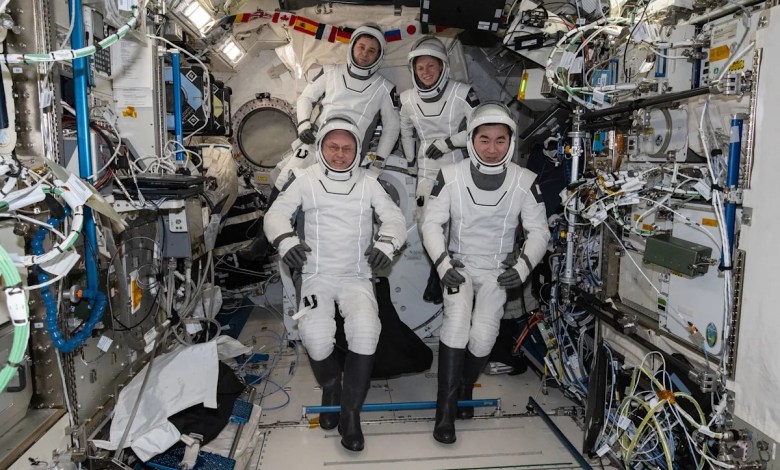
Crew 11 posed for a photo in Japan’s Kibo research module last week after checking out the pressure suits they will wear during re-entry on Thursday. Back row, left to right: Cosmonaut Oleg Platonov and Crew 11 Commander Zena Cardman. Front row, left to right: NASA astronaut Mike Fincke and Japanese astronaut Kimiya Yui. / Credit: NASA
In a lengthy LinkedIn post, Fincke said the crew was in good shape, but he added the decision was “the right decision.” The four astronauts appeared in good spirits during a change of command ceremony Monday when Fincke officially handed over the space station to cosmonaut Kud-Sverchkov.
In a post Wednesday on X, Yui sent photos of snow-capped Mount Fuji, with the caption: “Hello! The day has finally arrived for our departure to Earth.”
“I haven’t had a chance to photograph Japan during the day recently, but at the very last moment we flew over the Pacific coast of Japan,” he said. “Mount Fuji bid us farewell, adorned with a touch of crimson makeup from the setting sun.”

A photo of Japan’s snow-capped Mount Fuji, photographed from the International Space Station by Japanese astronaut Kimiya Yui. / Credit: NASA
The space station is permanently staffed by a crew of seven: three people launch and return to Earth aboard the Russian Soyuz spacecraft and four fly to and from the laboratory aboard NASA-run SpaceX Crew Dragon ferries.
Both spacecraft serve as lifeboats during a crew’s long-term stay at the space station. If a Soyuz or Crew Dragon pilot becomes ill or seriously injured aboard the station, that person is joined by all of their crewmates for the flight back to Earth.
With this possibility in mind, NASA and Roscosmos, Russia’s federal space agency, agreed to fly a NASA astronaut aboard each Soyuz and a Russian cosmonaut aboard each Crew Dragon. The seat swap agreement ensures that at least one Russian and one American will still be on board the station to operate equipment in their respective modules in the event of a crewed vessel’s early departure.

The Soyuz MS-28 crew (left to right): NASA astronaut Chris Williams, Soyuz commander Sergey Kud-Sverchkov, and flight engineer Sergey Mikaev. With Crew 11 departing, they will have the International Space Station to themselves until four replacement crew members arrive aboard the Crew 12 Dragon next month. / Credit: NASA
With the departure of Crew 11, Williams will manage the U.S. segment of the space station alone until Crew 12 arrives in February.
Crew 12 Commander Jessica Meir, a space station veteran, recruits Jack Hathaway and European Space Agency astronaut Sophie Adenot, along with veteran cosmonaut Andrey Fedyaev, are scheduled to officially begin their launch on February 15. However, NASA and SpaceX are considering moving that launch up a few days, as part of work to prepare for the launch of a Space Launch System rocket as early as Feb. 6 to send four astronauts in a combat loop around the moon.
The high level Artemis 2 This mission will be the first to send astronauts near the Moon in more than 50 years.
Preview: Blackout’s Murder of Livye Lewis
Civil rights icon Claudette Colvin dies at 86
Chicago still believes in it as the Bears catch fire


