Astronomers Directly Image Brown Dwarf around Nearby Red Dwarf Star


Using a combination of the Subaru Telescope, the WM Keck Observatory and ESA’s Gaia mission, astronomers have imaged a brown dwarf around the M dwarf star LSPM J1446+4633.
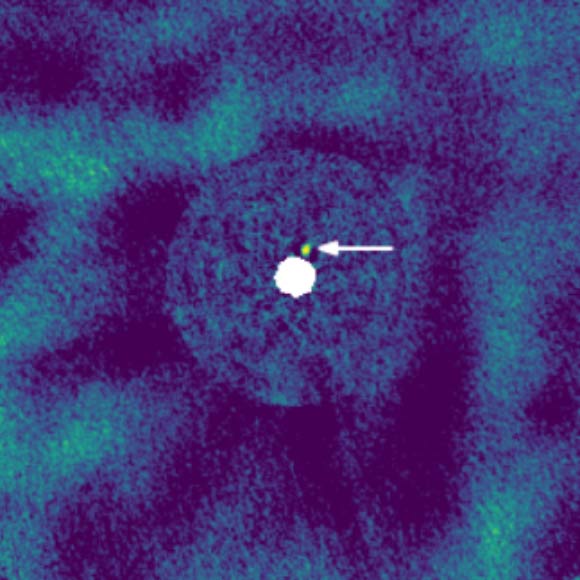
NIRC2 image of J1446 taken in August 2023; the white arrow indicates the location of the new companion J1446B. Image credit: Uyama and others., doi: 10.3847/1538-3881/ae08b6.
LSPM J1446+4633 (hereinafter J1446) is one of the closest mid-M dwarfs, at a distance of 17 parsecs (55 light years).
The newly discovered brown dwarf orbits the star at a distance of about 4.3 times the Earth-Sun separation, completing one orbit in about 20 years.
Named J1446B, the object has a mass between 20 and 60 times that of Jupiter.
“Key to this discovery was the combination of three complementary observational techniques: (i) radial velocity (RV) measurements from long-term infrared spectroscopic monitoring with Subaru’s IRD instrument, (ii) high-resolution near-infrared imaging with the WM Keck Observatory using advanced adaptive optics with a pyramid wavefront sensor, and (iii) acceleration precise astrometry. measurements from ESA’s Gaia mission,” said Taichi Uyama, an astronomer at California State University, and colleagues.
“By integrating these data sets and applying Kepler’s laws, we were able to determine the dynamic mass and orbital parameters of J1446B with unprecedented precision.”
“Radial velocity data alone cannot break the degeneracy between mass and orbital inclination, but the addition of direct imaging and Gaia astrometry resolves this ambiguity.”
“The Subaru IRD-SSP program provided critical data on the RV, while Keck’s cutting-edge adaptive optics enabled direct detection of the companion at a very small separation from its host star.”
“Previous studies have demonstrated the power of combining astrometric acceleration of Hipparcos and Gaia with direct imaging to detect and characterize companions.”
“However, Hipparcos was unable to measure the position of faint red dwarfs like J1446.”
“Our study is the first to apply Gaia-only acceleration data to such a system, thereby successfully constraining the orbit and dynamic mass of a brown dwarf.”
Near-infrared observations of J1446B revealed brightness variations of around 30%, suggesting dynamic atmospheric phenomena such as clouds or storms.
“This discovery provides an essential benchmark for testing brown dwarf formation scenarios and atmospheric models,” the astronomers said.
“Future spectroscopic observations may even allow researchers to map the weather patterns of this intriguing object.”
“The result highlights the power of combining ground and space observatories to discover hidden worlds beyond our solar system.”
The team’s paper was published in the Astronomical Journal.
_____
Taichi Uyama and others. 2025. Direct Imaging Explorations for Subaru/IRD Strategic Program II Companions; Discovery of a brown dwarf companion around a medium M dwarf nearby LSPM J1446+4633. A.J. 170, 272; doi: 10.3847/1538-3881/ae08b6


