Astronomers discover monster exoplanet hiding in ‘stellar fog’ around young star


Astronomers have spotted a planet the size of a monster that could be up to ten times the size of Jupiter emerging from stellar fog surrounding a young star.
The previous observations of the star deputy of approximately 13 million people MU (also known as PDS 66) located at around 280 light years have failed to distinguish the characteristics of the swirling cloud of gas and dust, or protoplanetary disc, which surrounds it.
However, when astronomers re -examined the apparently unreported protoplanetary disk of this star using combined data of cheer atacamagame millimeter / submillimetric (Alma) and the GAIA mission of the European Space Agency (ESA), they found that it was not as lonely after all.
The team detected a huge gas giant home in the protoplanetary disk of the MU deputy, who had previously been hidden. This represents the first time that Gaia has identified an extraness planet or “exoplanet” seated in a protoplanetary disc, the equipment discs around the young stars that harm.
Such detections have generally been difficult due to the interference of the gas and dust of the protoplanetary disk. Until now, astronomers have only made three strong detections of planets in protoplanetary discs.
This new discovery could help astronomers more recently hunt planets that have formed infant stars.
Young exoplanets enter the groove
The planets are formed in protoplanetary discs through a process called central accretion, when more and more gravity particles, forming planetsimals, asteroidsand possibly planets.
As the equipment of the protoplanetary disk is swallowed by this process, the planets created are starting to sculpt the channels in the disc, similar to the grooves in a vinyl recording.
When this team initially observed the protoplanetary disc around MP Mus in 2023 with Alma, it was the kind of structures they expected to see. Structures that were missing.
“We first observed this star when we learned that most of the discs have rings and gaps, and I hoped to find features around MP Mus which could refer to the presence of a planet or planets,” said team leader Álvaro Ribas de Cambridge’s Institute of Astronomy’s said in a press release.

What the team has found in the place was an apparently lonely star surrounded by a disc of gas and dust without business that had no characteristic of form planets.
“Our previous observations have shown a flat and boring disc,” said Ribas. “But it seemed strange to us because the disc has between seven to ten million years.
“In a disc of this age, we would be able to see evidence of the planet’s formation.”
With their pricked curiosity, the team again put the release to MP Mus using Alma, but in longer light wavelengths. This allowed them to probe more deeply in the disc, revealing a cavity in the disc near the young star and two “holes” further, which were all absent in previous observations.
Additional evidence of a planetary companion to the MP deputy were about to be delivered.
More than just first for Gaia
While Ribas and his colleagues examined MP MU with Alma, the European researcher of the Southern Observatory (ESO), Miguel Vique, looked at the young star using the space monitoring space now retired Gaia.
What Vique has discovered is that this young star is “flickering. “It is something that would generally be the effect of a planet in orbit firing gravitationally on a star, but Vique was aware that the protoplanetary disc of MP Mus had, until this moment, to be empty in terms of planets.
“My first reaction was that I had to have made a mistake in my calculations, because the MUS deputy was known to have a disc without business,” said Vioque. “I revised my calculations when I saw Álvaro give a conference presenting the preliminary results of an inner cavity newly discovered in the disc, which meant that the vacant I detect was real and had a good chance of being caused by a forming planet.”
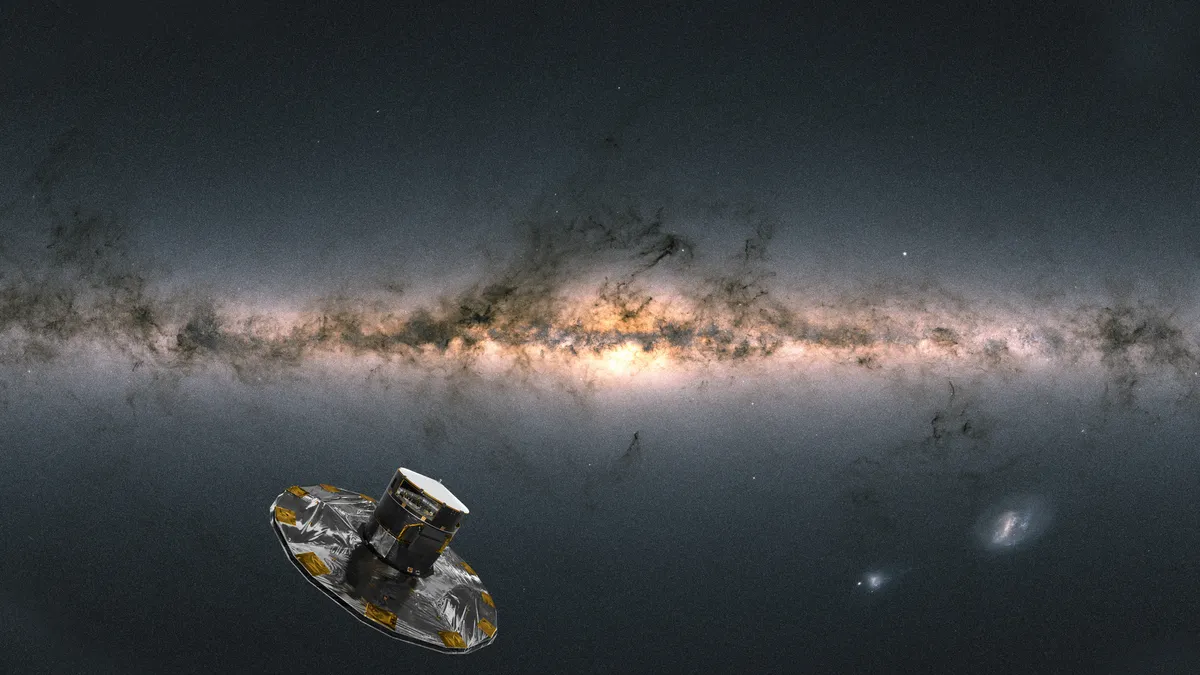
The researchers gathered, combining the Gaia and Alma data with a certain help for computer modeling to determine that the oscillation is probably caused by a gas giant with a mass between three and ten times that of Jupiter.
This giant planet seems to orbit MP Mus at a distance between one and three times Distance between earth and sun.
“Our modeling work has shown that if you put a giant planet inside the new cavity, you can also explain the Gaia signal,” said Ribas. “And the use of Lumant Alma wavelengths allowed us to see structures that we could not see before.”
In addition to being the first time that Gaia has spotted a planet in a protoplanetary disc, it is the first time that an incorporated exoplanet has been indirectly discovered by combining precise star movement data from Gaia with deep observations of the Alma graceful disc.
“We think this could be one of the reasons why it is difficult to detect young planets in the protoplanetary discs, because in this case, we needed the Alma and Gaia together data,” said Ribas. “The longest Alma wavelength is incredibly useful, but observing at this wavelength requires more time on the telescope.”
Ribas hopes that future Alma upgrades, in addition to future telescopes, could be used to probe even more deeply in the protoplanetary discs.
This would not only reveal a population hitherto unknown to young integrated exoplanets, but it could help us understand how the solar system came to around 4.5 billion years.
Team research was published on July 14 in the journal Natural astronomy.
This article was initially published on Space.com


