Astronomers Discover Most Massive Black Hole Yet


Astronomers have identified and measured the most massive black hole to date, which is leading to a mass of 36 billion solar masses. This ultramassive black hole is close to the theoretical upper limit of what is possible in the universe and is about 10,000 times heavier than Sagittarius A *, a supermassive black hole in the center of Milky Way.
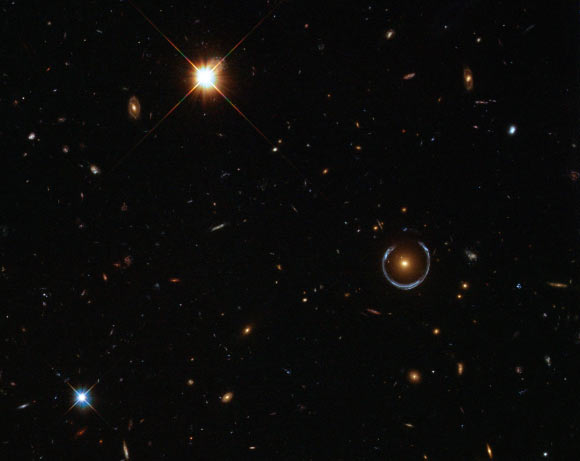
This Hubble image shows the cosmic gravitational lens (right of the center): the newly discovered ultra -global hole is in the center of the orange galaxy; Far behind it is a blue galaxy which is distorted in the ring in the shape of a horse by horse by distortions in the space-time created by the immense mass of the Orange Galaxy of the leading. Image credit: NASA / ESA / Hubble.
The newly discovered ultramasse black hole lies in the cosmic gravitational gravitational lens system, where the lens galaxy is one of the most massive gravitational lenses known to date.
Also known as SDSS J1148 + 1930 and CSWA 1, this lens system is located 5 billion light years in the Leo constellation.
“As a rule, for such remote systems, mass measurements of black hole are only possible when the black hole is active,” said Carlos Melo, a doctorate. candidate for the federal universidade do rio large do sul.
“But these estimates based on accretion are often contained with important uncertainties.”
“Our approach, combining a strong lens with a stellar dynamic, offers a more direct and robust measurement, even for these remote systems.”
“The newly discovered black hole is among the most massive 10 black holes ever discovered, and most likely the most massive,” said Professor Thomas Collett, of the University of Portsmouth.
“Most of the other mass measurements of black hole are indirect and have fairly important uncertainties, so we really do not know with certainty what is the biggest. However, we have much more certainty on the mass of this black hole thanks to our new method.”
The authors detected the black cosmic horseshoe hole using a combination of gravitational lens and stellar kinematics.
The latter is considered to be the gold stallion to measure the masses of black holes, but does not really work outside the very similar universe because the galaxies seem too small on the sky to solve the region where a supermassive or ultramassive hole is located.
“The addition of gravitational lens helped us push much further into the universe,” said Professor Collett.
“We have detected the effect of the black hole in two ways – it modifies the path that the light takes when it passes in front of the black hole and that makes the stars move in the interior regions of its host galaxy extremely quickly (almost 400 km / s).”
“By combining these two measures, we can be completely convinced that the black hole is real.”
“This discovery was made for a” sleeping “black hole- which does not actively accumulate at the time of observation,” said Melo.
“Her detection was based solely on her immense gravitational traction and the effect she has on her environment.
“What is particularly exciting is that this method allows us to detect and measure the mass of these ultramassive black holes hidden through the universe, even when they are completely silent.”
An interesting feature of the Cosmic Horseshoe system is that host galaxy is a so-called fossil group.
Fossil groups are the final state of the most massive structures linked to gravitation in the universe, occurring when they collapsed in a single extremely massive galaxy, without brilliant companions.
“It is likely that all the supermassive black holes that were originally in the companion galaxies also merged to form the ultramassive black hole that we detected,” said Professor Collett.
“We therefore see the final state of the formation of the galaxy and the final state of the formation of black holes.”
The team’s article was published today in the Monthly opinion from the Royal Astronomical Society.
_____
Carlos R Melo-Carneiro et al. 2025. Unscrewing a black hole of 36 billion solar mass in the center of the cosmic gravitational lens in horseshoe. Mnras 541 (4): 2853-2871; DOI: 10.1093 / Mnras / Staf1036