A clever math shortcut could reveal your problem-solving superpower


How much is 29 + 14?
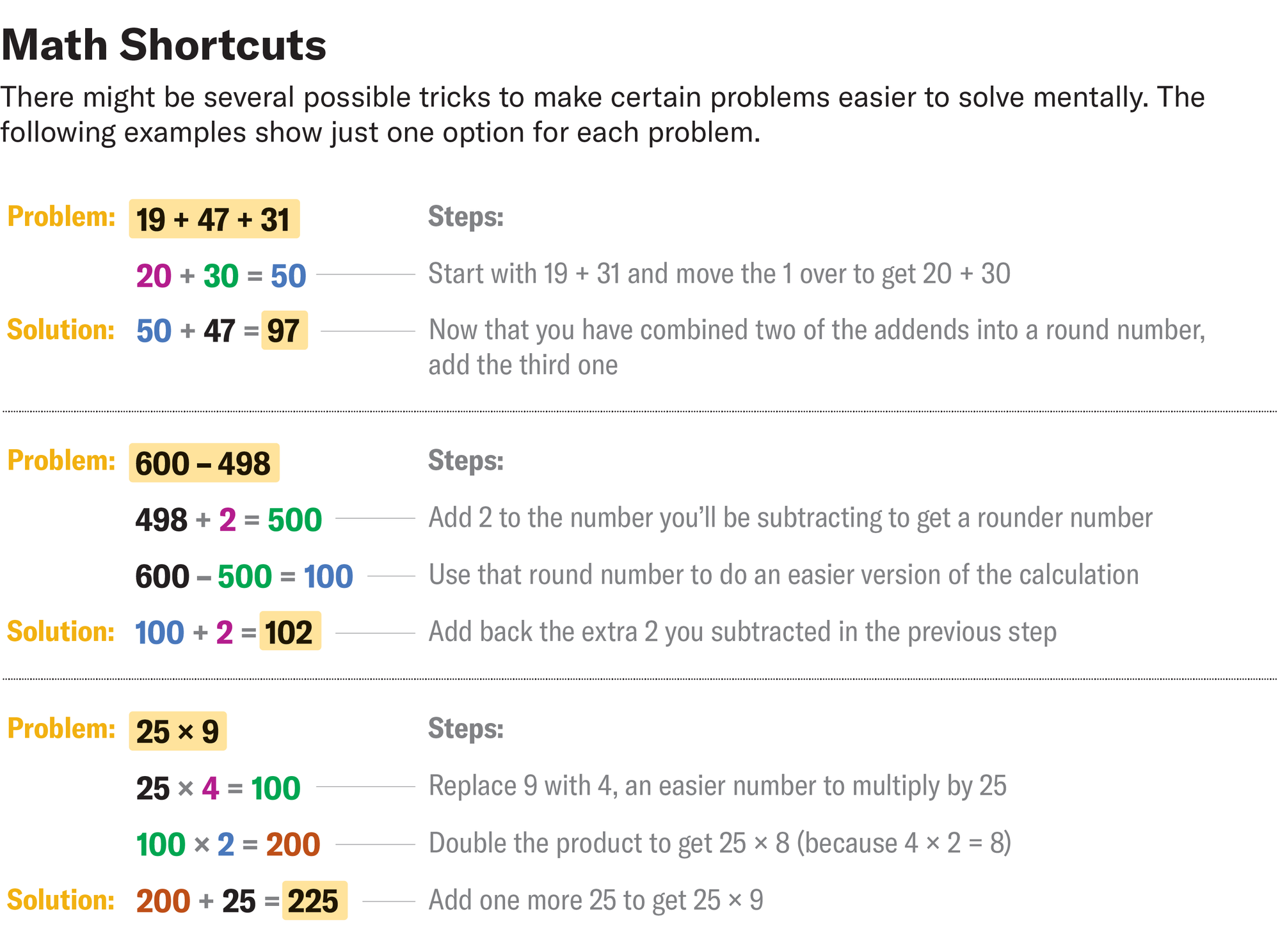
Some readers may solve the problem procedurally: line up the two numbers, add the ones column, carry that, and add the tens to get 43. Others might instead notice a creative shortcut: 29 + 14 is the same as 30 + 13, a much easier sum to calculate. Recent studies show that the less likely a person is to use procedural solutions, the more successful they tend to be at solving more abstract problems – and gender is an important predictor.
In a new study, researchers asked a group of 213 students from a high school in the American Midwest to solve three arithmetic problems. Only 18 percent of boys used the procedural method for all three questions, compared to 52 percent of girls. And those who rarely used a procedural algorithm were much more likely to succeed in problem solving.
On supporting science journalism
If you enjoy this article, please consider supporting our award-winning journalism by subscription. By purchasing a subscription, you are helping to ensure the future of impactful stories about the discoveries and ideas shaping our world today.
“Honestly, [the results] blew me away,” says Sarah Lubienski, a mathematics education researcher at Indiana University in Bloomington who co-authored the study, published in the British Journal of Educational Psychology. These are “the most interesting discoveries of my career,” she adds. And that was before Lubienski and one of his co-authors realized that another group had reached almost identical conclusions in a similar study of 810 American adults. The researchers decided to team up to carry out two studies. “Together, we felt this presented a pretty compelling argument that we need to pay more attention to how people approach computing from a young age,” Lubienski says.
The team found that students who reported a greater desire to please their teachers, an overwhelmingly female trait, were more likely to solve problems procedurally, that is, in the way the teacher asked them to. This trend could explain a long-standing paradox in math education: Girls often get better grades in math than boys, and girls and boys perform similarly on national assessments, but girls lag behind on high-stakes tests such as the SAT and beyond, especially on tasks that involve solving problems they’ve never seen before. The same zeal that helps girls progress in school can hold them back later. Researchers also found that creative problem solving correlated with stronger spatial skills, particularly the ability to rotate objects in the mind, an ability that Lubienski says can be learned.
[Test your calculation creativity with this math puzzle.]
“What I find fascinating is that [the paper] “The problem may not be one of ability, but rather the interaction between teaching, classroom norms, anxiety and what students think is expected of them.”
Even if you’re out of high school, it’s never too late to improve your problem-solving skills and practice thinking outside the box, says Lubienski. “Try to solve math puzzles in Scientific American”, she suggests.
It’s time to defend science
If you enjoyed this article, I would like to ask for your support. Scientific American has been defending science and industry for 180 years, and we are currently experiencing perhaps the most critical moment in these two centuries of history.
I was a Scientific American subscriber since the age of 12, and it helped shape the way I see the world. SciAm always educates and delights me, and inspires a sense of respect for our vast and magnificent universe. I hope this is the case for you too.
If you subscribe to Scientific Americanyou help ensure our coverage centers on meaningful research and discoveries; that we have the resources to account for decisions that threaten laboratories across the United States; and that we support budding and working scientists at a time when the value of science itself too often goes unrecognized.
In exchange, you receive essential information, captivating podcasts, brilliant infographics, newsletters not to be missed, unmissable videos, stimulating games and the best writings and reports from the scientific world. You can even offer a subscription to someone.
There has never been a more important time for us to stand up and show why science matters. I hope you will support us in this mission.


