Astronomers Spot Mysterious Bar-Shaped Cloud of Iron Inside an Iconic Nebula


January 15, 2026
2 min reading
 Add us on GoogleAdd SciAm
Astronomers Spot Mysterious Bar-Shaped Iron Cloud Inside Iconic Nebula
A particular nebula inside the constellation Lyra is home to a never-before-seen cloud of iron atoms, and researchers aren’t sure why.
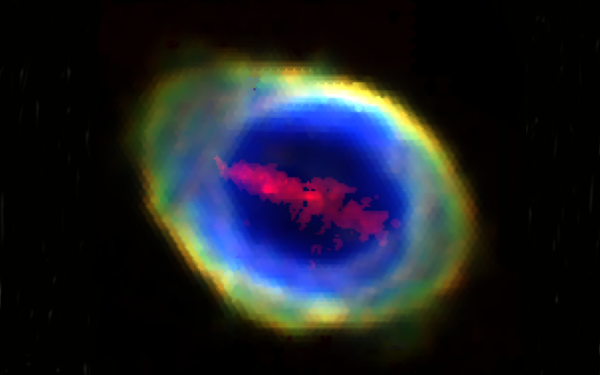
The Ring Nebula is a sight to behold. Located in the constellation Lyra, this kaleidoscopic donut of gas is the dying echo of a star not unlike our sun. And according to a new study, it also hosts a massive never-before-seen cloud of iron atoms. Astronomers don’t know why.
The bar-shaped cloud has a mass slightly greater than that of Mars. Astronomers spotted it using the William Herschel Telescope (WHT) in Spain using an optical spectrometer called the WHT Enhanced Area Velocity Explorer (WEAVE). The results are detailed in a new article in the Monthly Notices of the Royal Astronomical Society.
“As we processed the data and scrolled through the images, one thing became as clear as anything: this previously unknown bar of ionized iron atoms, in the middle of the familiar and iconic ring,” Roger Wesson, an astronomer at Cardiff University in Wales and lead author of the new paper, said in a statement.
On supporting science journalism
If you enjoy this article, please consider supporting our award-winning journalism by subscription. By purchasing a subscription, you are helping to ensure the future of impactful stories about the discoveries and ideas shaping our world today.

How the bar got there is a mystery. The bar is located somewhere in the middle of the nebula and is approximately as long as 500 times Pluto’s orbit around the sun. It’s possible the bar could tell scientists more about how the nebula formed. The researchers plan to conduct a follow-up study with WEAVE to try to answer some of these questions.
Astronomers don’t know why it exists, but it’s probably not the only one of its kind. “It would be very surprising if the iron bar of the Ring was unique,” Wesson said in the same statement. “So I hope that as we observe and analyze more similarly created nebulae, we will discover more examples of this phenomenon, which will help us understand where the iron comes from.”
It’s time to defend science
If you enjoyed this article, I would like to ask for your support. Scientific American has been defending science and industry for 180 years, and we are currently experiencing perhaps the most critical moment in these two centuries of history.
I was a Scientific American subscriber since the age of 12, and it helped shape the way I see the world. SciAm always educates and delights me, and inspires a sense of respect for our vast and magnificent universe. I hope this is the case for you too.
If you subscribe to Scientific Americanyou help ensure our coverage centers on meaningful research and discoveries; that we have the resources to account for decisions that threaten laboratories across the United States; and that we support budding and working scientists at a time when the value of science itself too often goes unrecognized.
In exchange, you receive essential information, captivating podcasts, brilliant infographics, newsletters not to be missed, unmissable videos, stimulating games and the best writings and reports from the scientific world. You can even offer a subscription to someone.
There has never been a more important time for us to stand up and show why science matters. I hope you will support us in this mission.


