Astronomers witness the birth of a new solar system


March 24, 2026
2 min reading
 Add us on GoogleAdd SciAm
Astronomers witness the birth of a new solar system
The decades since scientists confirmed the first planet orbiting another star have been full of discoveries, but it is rare to observe a new solar system as it forms.
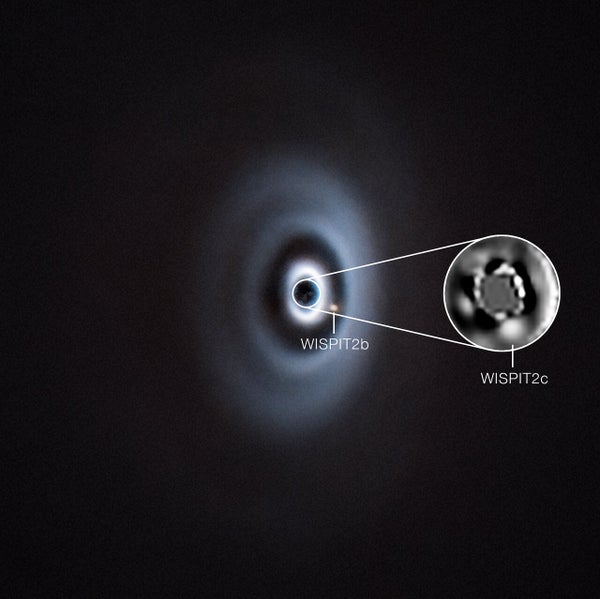
An image of WISPIT 2 taken by the Very Large Telescope in Chile. Astronomers have just discovered a second gas giant recently formed from the star’s protoplanetary disk.
ESO/C. Lawlor, RF van Capelleveen et al.
Planets around other stars can help answer one of the biggest mysteries: how did we get here? How did the rotating disk of matter left by the birth of our sun form our planet and its seven neighbors? Typically, astronomers find planets of similar ages to those in our solar system, but that is starting to change.
In a study published today in the Astrophysical journal lettersastronomers reveal a baby solar system forming around a star some 437 light-years from Earth – only the second to be confirmed. The first, PDS 70, was discovered in 2018.
“This is a really exciting discovery,” says Jason Wang, an astronomer at Northwestern University who was not involved in the research. “In astronomy, we often joke that when we have a sample of one, we have an anomaly, but when we have a sample of two, we have a population.”
On supporting science journalism
If you enjoy this article, please consider supporting our award-winning journalism by subscription. By purchasing a subscription, you are helping to ensure the future of impactful stories about the discoveries and ideas shaping our world today.
Some of the astronomers behind the new study revealed last year that the star, called WISPIT 2, was surrounded by a protoplanet, WISPIT 2b. It was the first time that a baby planet had been photographed in a protoplanetary disk. They now think there are two gas giant planets, the second being about 10 times larger than Jupiter.
And the authors think there are more protoplanets to be found around WISPIT 2. The star appears to be surrounded by a ring of material more extensive and structured than PDS 70. And further into the disk, astronomers spotted a third, smaller break in the material, a tantalizing indication that the material may have already collapsed into a planet closer to the size of Saturn. The new discovery was made using the European Southern Observatory’s Very Large Telescope in Chile’s Atacama Desert, and the authors hope its successor, the Extremely Large Telescope, will be able to take photos of the hypothetical third baby.
“These structures suggest that more planets are forming now, which we will eventually detect,” says Chloe Lawlor, a Ph.D. student at the University of Galway in Ireland and lead author of the study. By studying this new planetary nursery and others like it, astronomers hope to better understand how our own solar system came to be.
For her part, Lawlor is surprised to have conducted such a groundbreaking study as a young scientist. “A lot of times people at my career stage have a lot of self-doubt,” she says. “I hope this discovery will help others realize that even if they don’t know everything yet, they still know enough to accomplish great things.”
It’s time to defend science
If you enjoyed this article, I would like to ask for your support. Scientific American has been defending science and industry for 180 years, and we are currently experiencing perhaps the most critical moment in these two centuries of history.
I was a Scientific American subscriber since the age of 12, and it helped shape the way I see the world. SciAm always educates and delights me, and inspires a sense of respect for our vast and beautiful universe. I hope this is the case for you too.
If you subscribe to Scientific Americanyou help ensure our coverage centers on meaningful research and discoveries; that we have the resources to account for decisions that threaten laboratories across the United States; and that we support budding and working scientists at a time when the value of science itself too often goes unrecognized.
In exchange, you receive essential information, captivating podcasts, brilliant infographics, newsletters not to be missed, unmissable videos, stimulating games and the best writings and reports from the scientific world. You can even offer a subscription to someone.
There has never been a more important time for us to stand up and show why science matters. I hope you will support us in this mission.


