Attacks on Higher Education Are Attacks on All Americans


Attacks against higher education are attacks on all Americans
If the Americans do not fight against efforts to dismantle higher education, the United States will lose vital medical research, innovation that stimulates our economy and the ability to freely study science and society
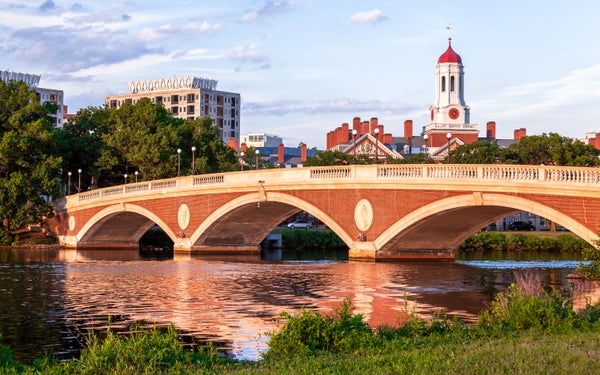
The John W. Weeks bridge at Harvard University in Cambridge, Massachusetts.
The cancellations of subsidies and budgetary reductions of the National Institutes of Health have put millions of dollars in research to promise new treatments against cancer, therapies of tuberculosis and much more in danger. Our elected officials could intervene if all Americans, not only academics, should send a clear signal that they should.
Instead, a large part of the public raised the shoulders.
Since January, the US government has frozen billions of dollars in federal research funding for establishments such as Harvard University, Columbia University and Princeton University. The Ministry of Education has opened surveys on 60 universities on anti -Semitism allegations, using these requests to justify financing cuts and impose policy mandates. The administration also placed international students under control, threatening the revocations of visas and deportations for those who participate in campus demonstrations deemed hostile to government interests. The administration arrested academics born abroad such as Kseniia Petrova, researcher at Harvard, who was recently released after being placed in police custody for not having declared customs research equipment.
On the support of scientific journalism
If you appreciate this article, plan to support our award -winning journalism by subscription. By buying a subscription, you help to ensure the future of striking stories about discoveries and ideas that shape our world today.
Collectively, we are witnessing unprecedented attempts to intimidate academic institutions with the ideological objectives of the administration. These attempts question the long-standing standards of academic freedom, that is to say the capacity of a teacher or a researcher in higher education to investigate and discuss matters without fear of political interference. Our elected officials should defend scientific research and those who produce it in the face of political motivation attacks. But public apathy allows legislators to more easily ignore the problem.
At the end of March, we worked with Yougov to conduct an online survey representative at the national level with 1,500 American adults. We found that, even if few Americans support The president’s attacks on science, many others are not pupil by them.

Ripley Cleghorn; Source: Yougov (data))
For example, 65%of Americans have no position (31%) or outright support (34%) the possibility that the Trump administration reveals federal funding for universities that support “pro-Palestine / Anti-Israeli demonstrations”. This possibility became very real on April 21, when the NIH suggested to ensure that Grant Awards conditions compliance with anti-boycott provisions concerning Israeli companies. Likewise, a majority (67%) does not contribute to a problem or support outright revocating funding to universities (as the White House did at the University of Pennsylvania) which allow transgender athletes to compete.
According to our survey, the majority of Americans support or do not oppose the cancellations of funding for political motivation, including efforts to study differences in health results attributable to race and gender (54%) or research on LGBT populations (64%) – mass layoffs (51%) and even prohibited from foreign academic (64%). Although there is a lack of survey on these exact questions, the data accessible to the public suggest that our results reflect those found by pollsters and other researchers of public opinion.
Many of our colleagues initially thought that attacks on academic freedom and scientific research would cause public outcry. After all, American university research establishments are behind the country’s world leadership in terms of innovation, medicine and technological development. American universities organize most of the best -classified research programs in the world, serve engines of regional economic growth and form future leaders in fields such as medicine, public health and technology – in other words, they provide real jobs to people in and outside the academic world. This is why France has already accepted certain “scientific refugees” of the United States and other countries, such as China, try to poach scientists of the best American universities.
More emergency, funding and censorship of science could have radically negative consequences for all Americans. The cancellation of research on vaccine communication not only hinders our preparation for future pandemics, but also our response to seasonal flu and cocoat. The reduction of studies on health disparities weakens efforts to improve maternal mortality rates, especially in colored communities, people with low -income and diversity communities. The reduction of international university exchanges isolates the United States of global scientific collaboration, including partnerships with entities, such as the World Health Organization, which are trying to promote access to medical treatment and vital preventive.
In other words, the costs of academic repression are not limited to elite institutions – they are carried by everyone. However, very few Americans seem to worry.
Why is it like that? Mistrust of political motivation for university establishments, in particular on ideological law, can help explain the attitude and why the Trump administration takes these measures.
Decades of survey show that the perceptions of science are increasingly aligning with political identity. Confidence in science through the American political spectrum has undergone a dramatic reversal. In the 1970s, conservative Americans reported the greatest confidence in scientific institutions. In 2010, however, this relationship had been reversed, the conservatives expressing the lowest levels of confidence in science. This partisan division accelerated considerably in 2018 and has widened more during the cocovio pandemic.
The attacks of the administration against science require a response from the congress, in particular when the appointments try to bypass the law. For example, efforts to retain subsidy funds appropriate by the Congress for Scientific Research may arise at the detention control law, which indicates that the president is legally required to spend money authorized by the congress. The members of the congress could, in theory, modify the law to clearly indicate that the efforts to recover the subsidies of university researchers constitute a violation of the law. They could also introduce legislation to prohibit subsidy agencies from refusing funding to universities that are home to diversity, equity and inclusion programs.
Our Congress leaders can also defend science in the process of assembling a new budget for the coming year. Reductions of enormous proposals at NIH threaten jobs and billions of dollars in government investment in cities and university cities across the country.
But if the Americans of all stripes do not send their representatives of Congress a clear message that they must fight against the cuts of academic sciences and research, our elected officials may not be motivated Do it. Politicians, after all, want to gain a re -election and can feel the need to respond to public opinion to do so. Currently, the Republican-Majjeurité congress seems to fear more Trump than voters, perhaps on a surprise given the disinterest of the voters observed in our survey.
What can transform public apathy into indignation?
A potential answer comes from people who have changed their minds on what science is and can do for them. Think of the famous doctor Mehmet Oz, now administrator of the Centers for Medicare & Medicaid Services, by adopting the measles-Humprus-Rubella vaccine on his television program Dr. Oz’s showIn 2019 despite his past doubts. The skeptics are powerful communicators because they establish confidence with the public who share their previously detained beliefs while nevertheless contesting these points of view.
Another example of this is the Katie Britt senator from Alabama, a supporter of the current administration who nevertheless expressed his concerns concerning the effects that the budget cuts of the NIH could have at the University of Alabama to the Birmingham health care system, one of the greatest employers in the state. Trump supporters can find the credible Senator Britt, and his doubts can help these supporters change their mind and convince her to fight in the name of his voters to save one of the economic powers of his state. His defense of science could walk around other conservative legislators who also think of the interests of their voters and their re -election perspectives.
Institutions such as Ohio State University (OSU) – one of ours – noted what is at stake. The OSU contributes more than $ 19 billion per year to the state economy, supports nearly 117,000 jobs and generates more than $ 650 billion in tax revenue for governments of states and local. These are not abstract issues – they are material, local and immediate. If voters, in particular in politically conservative fields such as Ohio, clearly indicate that the dismantling of science and the academic world undermines their communities, Congress can still act. But without this pressure, the cost of inaction could be catastrophic and durable and will affect people far beyond the walls of higher education.
This is an article of opinion and analysis, and the points of view expressed by the author or the authors are not necessarily those of American scientific.


