The striking Swedish workers taking on carmaker Tesla


Tim ManselBusiness journalist, Malmö, Sweden

 BBC
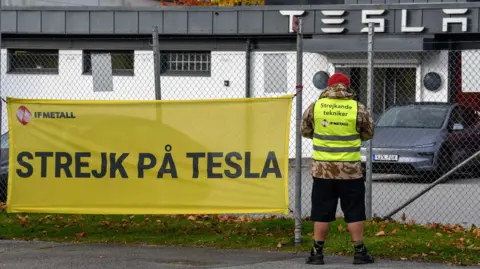
BBCIn Sweden, 70 car mechanics continue to attack one of the richest companies in the world, Tesla. The strike at the American carmaker’s 10 Swedish service centers has now reached its second anniversary and there is little chance of success.
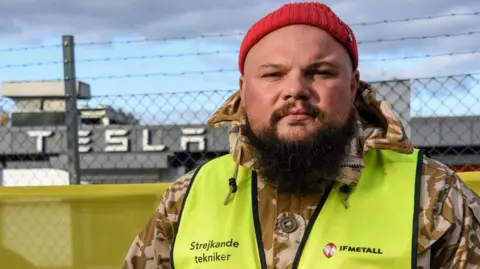
Janis Kuzma has been on the Tesla picket line since October 2023.
“It’s a difficult time,” says the 39-year-old. And as the cold winter sets in in Sweden, the situation is likely to become more difficult.
Janis spends every Monday with a colleague in front of a Tesla garage in an industrial park in Malmö. His union, IF Metall, offers accommodation in the form of a mobile construction van, as well as coffee and sandwiches.
But business continues as usual on the other side of the road, where the workshop seems to be in full swing.
The strike concerns an issue that goes to the heart of Swedish industrial culture: the right of unions to negotiate wages and working conditions on behalf of their members. This concept of collective agreement has underpinned industrial relations in Sweden for almost a century.
Today, around 70% of Swedish workers are members of a union and 90% are covered by a collective agreement. Strikes in Sweden are rare.
This is a welcome arrangement across the board. “We prefer the right to negotiate freely with unions and sign collective agreements,” says Mattias Dahl of the Confederation of Swedish Enterprise.
But Tesla has upset the apple cart. Chief executive Elon Musk said he “disagrees” with the idea of unions. “I just don’t like anything that creates sort of lords and peasants,” he told an audience in New York in 2023. “I think unions are trying to create negativity in a company.”
Tesla arrived in Sweden in 2014 and IF Metall has long wanted to conclude a collective agreement with the company.
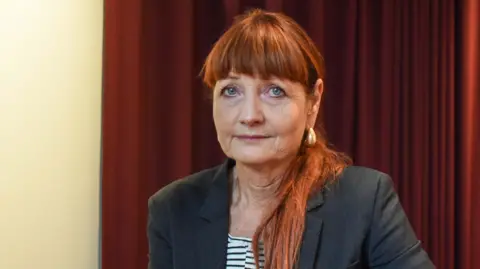
“But they didn’t respond,” says Marie Nilsson, the union’s president. “And we felt like they were trying to hide or not discuss it with us.”
She says the union ultimately saw no other option than to announce a strike, which began on October 27, 2023. “Usually you just need to make threats,” says Ms. Nilsson. “It’s usually the company that signs the deal.”
But not in this case.
Janis Kuzma, originally from Latvia, started working for Tesla in 2021. He says salaries and working conditions often depended on the whims of managers.
He recalls a performance review in which he claimed he was denied an annual salary increase because he was “not meeting Tesla’s goals.” Meanwhile, a colleague was reportedly denied a pay rise due to his “bad attitude”.
However, not everyone went on strike. Tesla employed around 130 mechanics at the time industrial action was taken. IF Metall says that today around 70 of its members are on strike.
Tesla has long replaced them with new workers, which is unprecedented since the 1930s.
“Tesla did it [found replacement staff] openly and systematically,” says German Bender, a researcher at Arena Idé, a think tank funded by Swedish unions.
“It’s not illegal, which is important to understand. But it goes against all established standards. But Tesla doesn’t care about standards.
“They want to break norms. So if someone tells them, hey, you’re breaking a norm, they see that as a compliment.”
The BBC asked to speak to Tesla subsidiary TM Sweden, but the request was refused in an email citing “record deliveries.”
In fact, the company granted only one media interview in the two years following the start of the strike.
In March 2024, Jens Stark, the “country manager” of TM Sweden, told business newspaper Dagens Industri that it was better for the company not to have a collective agreement and to “work closely with the team and offer them the best possible conditions”.
Mr Stark denied that the decision not to enter into a collective agreement was made at Tesla’s headquarters in the United States. “We have a mandate to make our own decisions,” he said.
IF Metall is not entirely alone in its fight. The strike was supported by a number of other unions.
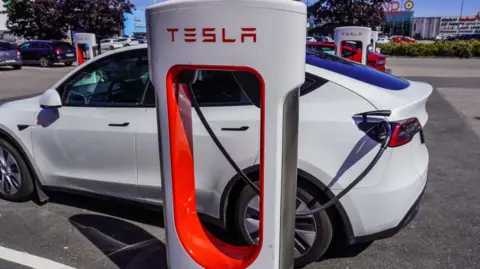
Dockworkers in neighboring Denmark, Norway and Finland refuse to handle Teslas; waste is no longer collected at Tesla’s Swedish facilities; and the newly built charging stations are not connected to the country’s grid.
There is such a facility near Stockholm Arlanda Airport, where 20 chargers remain unused. But Tibor Blomhäll, president of enthusiast group Tesla Club Sweden, says Tesla owners are not affected by the strike.
“There is another charging station 10 km from here,” he says. “And we can still buy our cars, we can service our cars, we can charge our cars.”
 AFP via Getty Images
With the stakes high on both sides, it is difficult to envisage an end to the standoff. IF Metall risks creating a precedent if it concedes the principle of the collective agreement.
“The fear is that this will spread,” says Bender, “and eventually erode the strong support we also have among employers for the labor market model.”
Tesla, on the other hand, might think that conceding this fight in Sweden would strengthen the position of those who want to unionize Tesla at its production plants in the United States and Germany, where it employs tens of thousands of people.
Mr. Bender detects another reason for the position taken by Tesla. “I think it’s important to understand that Elon Musk doesn’t want to be told how to do things,” he says.
“And I think he doesn’t view the industrial action that the union has taken as an invitation to negotiate, but rather as an ultimatum to sign a dotted line that he doesn’t want to sign.”
Mr Blomhäll of Tesla Club Sweden also says he doesn’t see a quick solution. “It will be another Korean War,” he said. “A conflict that drags on.”


