Babies from three people’s DNA prevents heriditary disease


Eight babies were born in the United Kingdom using genetic equipment of three people to prevent devastating and often fatal conditions, according to doctors.
The method, launched by British scientists, combines the egg and sperm of a mom and a dad with a second egg from a donor woman.
The technique has been legal here for a decade, but we now have the first proof that it leads to children born without incurable mitochondrial disease.
These conditions are normally transmitted from mother to child, samping the energy body.
This can cause serious disability and some babies die in the days following their birth. Couples know that they are at risk if the previous children, family members or mother have been affected.
Children born by the technique of three people inherit most of their DNA, their genetic plan, their parents, but also get a small quantity, about 0.1%, from the second woman. This is a change that is transmitted in generations.
None of the families who have gone through the process speaks publicly to protect their privacy, but who have published anonymous statements through the Newcastle Fertility Center where the procedures took place.
‘Overwhelmed with gratitude’
“After years of uncertainty, this treatment gave us hope – then it gave us our baby,” said the mother of a little girl.
“We look at them now, full of life and possibility, and we are overwhelmed with gratitude.”
The mother of a little boy added: “Thanks to this incredible advancement and support that we have received, our little family is complete.
“The emotional burden of mitochondrial disease has been lifted, and in its place is hope, joy and deep gratitude.”

 Getty images
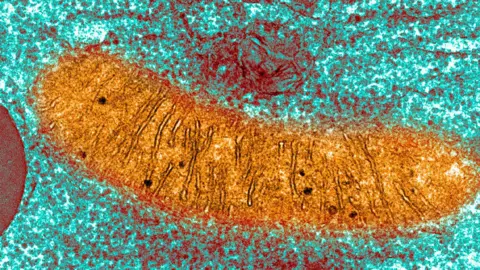
The mitochondria are tiny structures inside almost each of our cells. They are the reason why we breathe because they use oxygen to convert foods in the shape of energy that our body uses as fuel.
Defective mitochondria can leave the body with insufficient energy to maintain the heart heart as well as to cause brain lesions, convulsions, blindness, muscle weakness and insufficiency of organs.
About one in 5,000 baby is born with a mitochondrial disease. The Newcastle team provides that there is a request for 20 to 30 babies born by the three -person method each year.
Some parents faced the agony of killing several children of these diseases.
The mitochondria are only transmitted from mother to child. Thus, this pioneer fertility technique uses both parents and a woman who gives her healthy mitochondria.
Science was developed more than ten years ago at Newcastle University and the Trust of Newcastle Upon Tyne Hospital NHS Foundation and a specialized service opened within the NHS in 2017.
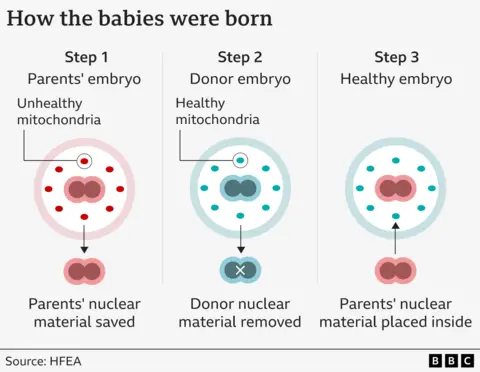
The mother and donor eggs are fertilized in the laboratory with the father’s sperm.
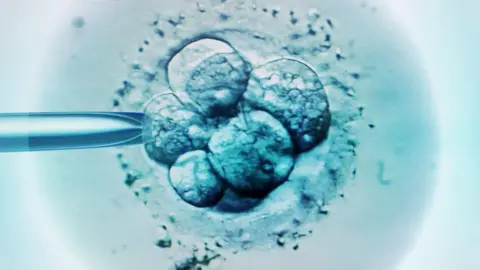
The embryos develop until the DNA of sperm and egg form a pair of structures called pro-nuclei. These contain the plans to build the human body, such as hair color and height.
The pro-nucleis are removed from the two embryos and the DNA of parents is placed inside the embryo filled with healthy mitochondria.
The resulting child is genetically linked to their parents, but should be free from mitochondrial disease.
A pair of reports in the New England Journal of Medicine showed that 22 families have followed the process at the Newcastle Fertility Center.
This led to four boys and four girls, including a pair of twins and a pregnancy in progress.
“To see the relief and joy in the faces of the parents of these babies after such a long wait and such a long fear of the consequences, it is brilliant to be able to see these lively babies, prospered and develop normally,” said Professor Bobby McFarland, director of the NHS Service strongly specialized for rare Mitochondrial disorders at the BBC.
All babies were born without mitochondrial disease and respected their expected development stages.
 Getty images
There was a case of epilepsy, which died by itself and a child has an abnormal heart rate which is successfully treated.
These are not considered linked to defective mitochondria. It is not known if that is part of the known risks of IVF, something specific to the three -person method or something that has been detected only because the health of all babies born by this technique is intensely monitored.
Another key question that weighs on the approach was whether the defective mitochondria would be transferred to the healthy embryo and what could be the consequences.
The results show that in five cases, sick mitochondria were undetectable. In the other three, between 5% and 20% of mitochondria were defective in the blood and urine samples.
This is lower than 80% considered as a disease. It will take more work to understand why it has happened and if it can be avoided.
 Getty images
Professor Mary Herbert, Newcastle University and Monash University, said: “The results give reasons for optimism. However, research to better understand the limits of Mitochondrial Don technologies, will be essential to further improve the results of treatment.”
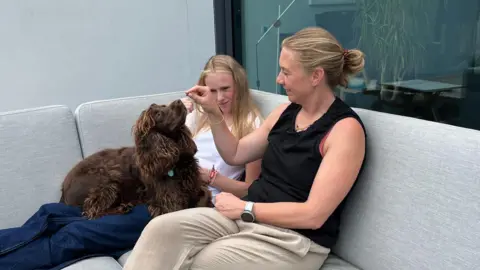
The breakthrough gives hope to the Kitto family.
Kat’s youngest daughter, Poppy, 14, has the disease. His elder lily, 16, can transmit it to his children.
The poppy is in a wheelchair, is not verbal and is powered by a tube.
“It has had a large part of her life,” explains Kat, “we have a good time as she is, but there are the moments when you realize how devastating mitochondrial disease”.
 BBC / Josh Elgin
Despite decades of work, there is still no cure for mitochondrial disease, but the possibility of warning that it is transmitted gives the hope of Lily.
“These are future generations like me, or my children, or my cousins, who can have this vision of a normal life,” she said.
‘Only the United Kingdom could do that’
The United Kingdom has not only developed the science of babies to three people, but it has also become the first country in the world to introduce laws to allow their creation after a vote in Parliament in 2015.
There was a controversy because the mitochondria has their own DNA, which controls their operation.
This means that children inherited the DNA of their parents and about 0.1% of the donor woman.
All the girls born by this technique would pass this to their own children, so it is a permanent impairment of human genetic heritage.
It was a step too far for some when the technology was debated, which makes it fear that it opens the doors to babies “designer” genetically modified.
Professor Sir Doug Turnbull, of Newcastle University, said to me: “I think it is the only place in the world that it could have happened, there has been a first class science to bring us where we are, there was legislation to allow him to go to clinical treatment, the NHS to help support him and now we have eight children who seem to be free of mitochondral disease.
Liz Curtis, the founder of the charity of the Lily Foundation said: “After years of waiting, we now know that eight babies were born using this technique, all showing no signs of mito.
“For many families affected, it is the first real hope of breaking the cycle of this inherited condition.”


