Yoshinobu Yamamoto must remain the calm in the Dodgers’ storm

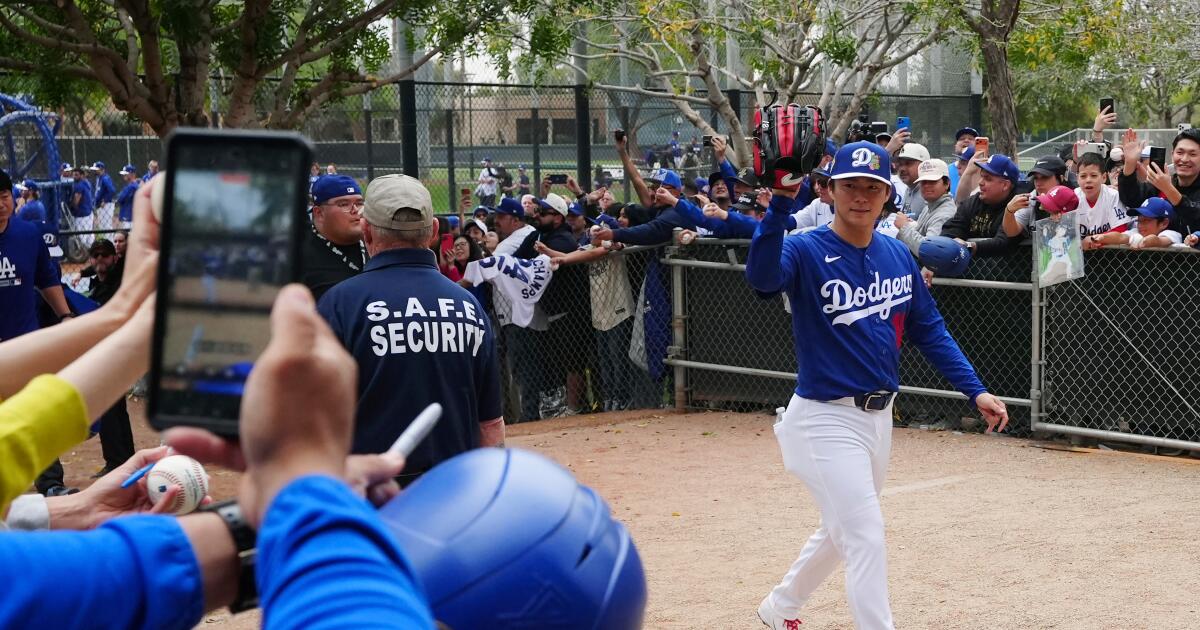
PHOENIX — His smile is so modest, his look so innocent that you have to wonder.
Does Yoshinobu Yamamoto understand that he has become a Dodgers legend?
“No,” he said Saturday, laughing at the idea. “Nothing has changed.”
Ah, but everything has changed, the once overpaid disappointment has transformed into arguably the most important player on the greatest team in baseball.
At just 5 feet 7 inches tall, he looks tiny next to fellow giant Shohei Ohtani, with whom he will always be compared because they joined the Dodgers at the same time with equally historic contracts.
Calm and contemplative, he seems dry next to the charming Ohtani. Employed only as a pitcher, he seems boring next to Ohtani who gives goosebumps.

Dodgers pitcher Yoshinobu Yamamoto raises the MVP trophy as the team celebrates the World Series victory over the Toronto Blue Jays.
(Robert Gauthier/Los Angeles Times)
Struggling at times during his first two regular seasons with the Dodgers as Ohtani was twice voted National League MVP, Yamamoto was originally overshadowed by the greatest player in history.
Until last October, when he became one of the greatest World Series pitchers in history.
Who can forget how he shut down the Toronto Blue Jays in Game 2, shut them down again in Game 6, and then shut them out in relief on zero days’ rest to earn the victory in the deciding Game 7.
It was crazy. It was historic. There were two runs allowed in 17 ⅔ innings with 15 strikeouts and two walks.
In other words: It was more convincing than Sandy Koufax’s three-hit shutout on two days’ rest to win the 1965 World Series against the Minnesota Twins.
It was Yamomania. It was Bulldog 2.0. But if you believe the guy on the mound, it barely made any waves.
Saturday at Camelback Ranch, in his first news conference since his World Series exploits, he shrugged his shoulders and acted like these games were just a walk in the park — except, of course, he hardly took anyone for a walk in the park.
Someone asked, how did the World Series change him?
Um, that’s not the case.
“I was able to approach the offseason with good feelings and I was able to approach the offseason with more calmness,” he said through interpreter Yoshihiro Sonoda.
Someone else asked: Did he have to change his legendary workload this offseason?
Uh, no.
“Actually, the amount of work I did last year was not affected in terms of preparation,” he said. “In November, I took off and then started a gradual ramp-up. It’s like a normal offseason.”
Then someone asked: Did he watch anything from that World Series?
Actually, yes!
“Of course, that moment of the last withdrawal,” he said. “But when I look back on that show, they did so many big plays. There’s also the little play that was very important. So many great scenes.”
One of the best scenes is the one no one saw, after Yamamoto threw 96 pitches in a Game 6 victory.
He was finished. He told his personal trainer he was done. Dave Roberts told the media he was done.
But then, in his own words, he was “cheated.”
According to an article by then-Times columnist Dylan Hernández, manager Osamu Yada told Yamamoto, “Let’s see if you can pitch out of the bullpen tomorrow.” »

Dodgers pitcher Yoshinobu Yamamoto conducts live batting practice during a practice session Friday during spring training at Camelback Ranch.
(Ross D. Franklin / Associated Press)
The manager believed Yamamoto’s mere presence as a potential reliever would inspire the Dodgers and worry the Blue Jays.
Yamamoto thought he was just going to the bullpen for show.
Oh, he put on a show, all right.
After pitching 2⅔ scoreless innings to win the game and the World Series championship for the Dodgers, gamesmanship had transformed into greatness and the crook had become a hero.
“For him to have the same things he did the day before is truly the greatest accomplishment I’ve ever seen on a baseball field,” Dodgers boss Andrew Friedman told reporters after the game.
Yamamoto explained afterward: “I didn’t think I would pitch. But I felt good when I was practicing and the next thing I knew I was on the mound during the game.”
And before he knows it, history.
“I really couldn’t believe it,” Yamamoto said. “I was so excited I didn’t even remember what pitch I threw at the end.”
Now, with the Dodgers chasing a third straight championship and Yamamoto embroiled in a bold run for a Cy Young Award, who will get there first, him or Ohtani? — another kind of question must be asked.
How the hell can he throw better?
“It’s an internal personal question…as far as, can you repeat and continue to improve from where you’ve been,” Roberts said. “Sure the bar is high, but there’s always room for improvement and I can’t think of anything at the moment to be completely honest, but…”
Yamamoto must stay healthy. He made his major league record 30 starts last year after making just 18 the year before. He has to start again to support the other frail Dodgers starters.
Yamamoto also has to take care of himself while playing for Japan in the upcoming World Baseball Classic. Ohtani doesn’t throw, but Yamamoto does, and he doesn’t need to break his arm.
Finally, he must continue to act like the ace he has become, from his uncomplaining leadership to his dazzling arsenal.
“Every time he takes the ball, he expects to win and we expect to win,” Roberts said.
This is the essence of Yoshinobu Yamamoto’s new reality. He was once Ohtani’s sidekick. He is now Ohtani’s partner.
Like it or not, his life has changed. Witness the crowd that screamed for him Saturday at Camelback Ranch like they always scream for Ohtani.
“More calm?”
He will need it.


