Berkeley Hills residents divided over wildfire ordinance of no wooden structures within 5 ft of home

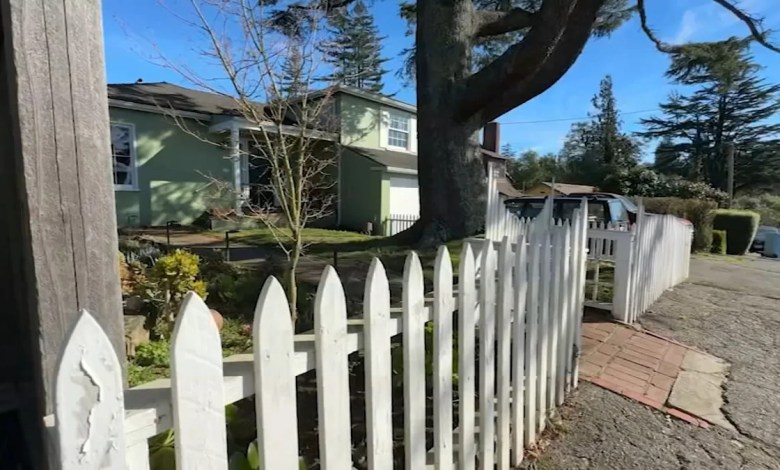
These white picket fences are most often associated with the American dream. Add a warm old tree and life seems very complete.
But today, the Berkeley Hills area is undergoing something of a transformation due to the potential threat of a wildfire sparking in nearby Tilden Park.
“If there’s a wildfire in the park and millions of little pieces of burning material fly around and start landing on roofs and next to houses here in Berkeley, how can we protect the houses so the embers don’t ignite them? asked Berkeley Council Member Brent Blackaby.
Blackaby says the answer is simple. Create a five-foot barrier around homes where nothing flammable is allowed.
As expected, this attracted criticism.
“It’s personal, it’s my garden,” demanded Jane Terjung, a resident of Berkeley Hills.
When you venture into the Berkeley Hills, the word “lush” comes to mind and for some, having to remodel their home is unreasonable.
“You remove plants, what happens in their place? Now you have a problem. As you can see, we’re in the hills, it’s steep. There are potential runoff problems when you remove plants, you lose soil structure,” said Richard Illgen, also a resident.
Others have a different way of approaching it.
“Near the house, we are considering putting large stones which would keep the vegetation away from the house,” explained resident Patrice Ignelzi.
Additionally, she and her husband swapped their wooden fence for a metal fence at a very high price.
Under Berkeley’s new EMBER ordinance, which took effect Jan. 1, no wooden structure can touch or come within five feet of a home.
Almost immediately, entrepreneurs began advertising.
The City of Berkeley helps some of these households and seniors pay part of the landscaping costs.
Let’s take a closer look at what this five-foot barrier looks like. The councilor showed us a tree next to his house that had been cut down.
“We need to do a little more refining. We’ve started that process. This one too, again, we’ve removed some of these branches. We’re directing the growth that way. We’re going to do a little more pruning here,” Blackaby said.
“The bushes against the deck, yes, we have to remove them. We have started to remove a few in the yard so that one is gone,” he added.
Over the past year, firefighters began inspecting homes in an effort to help homeowners understand the ordinance.
“I think EMBER is a great idea because we need to do everything we can to protect our homes throughout the area. To me, it’s not destroying our surrounding yards. It’s just kind of protecting, a little bit of protection,” Ignelzi said.
Terjung says it’s debatable.
“There are studies on the other side, so to speak, because this has turned into a fight, that show that the humidity of plants often saves a house, that some of them filter the embers,” Terjung said.
Let’s stop there because a few months ago, UC Berkeley participated in a simulation testing vegetation during a wildfire.
Michael Gollner is one of the researchers.
“Unfortunately, the conditions are so extreme that after a minute or two the fire dries out these plants and we end up in the same scenario, so any benefit is wiped out before the fire goes out,” concluded Gollner, director of the Berkeley Fire Research Laboratory.
His team also published a study that found a 5-foot fence can reduce home loss by an additional 17 percent.
But not all researchers agree with the so-called benefits of the 5-foot perimeter.
RELATED: Berkeley votes to ban most plants and wooden fences within 5 feet of some homes to prevent wildfires
Travis Longcore of UCLA studied the consequences of larger fires in Southern California.
“There is currently no strong evidence in the literature from post-fire studies demonstrating that complete removal of the plant within five hours is necessary or beneficial,” said Longcore of the UCLA Institute of Environment and Sustainability.
Longcore believes that this type of withdrawal has a negative impact on the environment.
Wildfires in these hills are not uncommon.
The last major fire in the Berkeley Hills was in 1991. It started in the Oakland Hills and spread quickly.
MORE: Oakland Hills Fire Decades Later: Survivors’ Stories Captured in ABC7 Documentary ‘Firestorm’
Wildfires don’t just happen in nature. They can also occur in the middle of cities. And they are terrifying. Look back at the firestorm that ravaged the East Bay hills, streaming now on our ABC7 News Bay Area app.
Before that, 640 houses were destroyed in 1923.
The State of California is finalizing its Zone Zero regulations. Those affected must be compliant by 2029.
“Why wait for the state, which has already taken a long time when we are in danger while we wait? The second point is that home insurers are canceling the insurance of many of my constituents in this area every month. The longer we wait, the more people lose their insurance,” Blackaby insisted.
RELATED: Berkeley May Soon Ban Plants, Wooden Fences 5 Feet From Homes to Prevent Wildfires
Homeowners in parts of Berkeley may have to tear out their landscaping to prevent wildfires. It’s part of a plan the city council will consider next week.
This is the case of Patrice Ignelzi and Bruce Smith. They lost their insurance coverage but eventually found another company at a higher cost.
Jane Terjung and is now covered by the California Fair Plan, which is very expensive.
“Everyone has to do it. If everyone doesn’t do it, it won’t be of any use,” insisted Ignelzi. She and others now belong to a neighborhood group working with firefighters called Firewise.
Those who oppose the ordinance are threatening to recall their council member and are fighting to delay its implementation.

If you’re on the ABC7 News app, click here to watch live


