Threats to the Strait of Hormuz raise concerns about global oil prices : NPR


A photo taken on March 11, 2026 and released by the Royal Thai Navy shows smoke rising from the Thai bulk carrier “Mayuree Naree” near the Strait of Hormuz after an attack.
Handout/Royal Thai Navy/AFP/Getty Images
hide caption
toggle caption
Handout/Royal Thai Navy/AFP/Getty Images
The threat of Iran laying mines in the Strait of Hormuz – the narrow waterway through which about 20% of the world’s oil supply passes – is sparking new fears about global oil prices amid an ongoing conflict with the United States and Israel.
Already, Tehran’s continued drone and missile strikes against oil tankers have reduced the flow of oil to a trickle, according to an International Energy Agency report. The United States further fears that Iran could lay sea mines in the strait, as it has done in past conflicts. Crews of commercial ships fear attacks and marine insurers are reluctant to insure ships that could be hit in the strait, which connects the Persian Gulf to the Gulf of Oman.
This sent the price of oil to its highest level in almost four years, with prices at the pump soaring. Iran’s new supreme leader Mojtaba Khamenei – son of the country’s former leader Ayatollah Ali Khamenei – said on Thursday the Gulf should remain closed due to Tehran’s ongoing strikes on oil tankers. Khamenei’s remarks could lead to a further rise in oil prices.
Meanwhile, President Trump said U.S. warships could begin escorting oil tankers through the Strait of Hormuz and successfully pushed countries to draw on their oil reserves in a bid to curb rising prices.


Earlier this week, US Energy Secretary Chris Wright posted on X that the first tanker had been escorted through the strait by the US Navy. This announcement moved the markets, but it turned out to be wrong. It was quickly removed and the White House said the claim was incorrect. In an interview with Fox News on Thursday, Wright said that as head of the department, he took responsibility for the mistake.
The situation has caused nervousness in the marine insurance industry, prompting some insurers to cancel their war risk coverage. However, Sir Charles Roxburgh, chairman of Lloyd’s of London, said in a statement that the company had “confidence in our marine insurance market, which has remained open and continues to support international trade and shipping during this period of increased risk.” He also promised to work with the United States and the United Kingdom to “ensure a comprehensive response” to the current situation.
“As long as Iran has drones and missiles and continues to fire them, I think many commercial carriers will think it’s just too dangerous, even with an escort, to cross the strait,” according to Matthew Kroenig, senior director of the Atlantic Council’s Scowcroft Center for Strategy and Security.
Experts believe that it is still too early to launch such escort operations, as Iran’s ability to launch weapons and lay mines has not yet been minimized. This poses a risk in the confined waters of the Persian Gulf. The Strait of Hormuz is only about 20 miles at its narrowest point, and the Gulf itself is only a few hundred miles at its widest. This makes defending a ship against incoming attacks difficult.
Two incidents in 1988 probably gave military planners pause: The first occurred in April 1988. The guided-missile frigate USS Samuel B. Roberts struck an Iranian mine in the Persian Gulf while the ship was supporting tanker escorts in Operation Earnest Will during the Iran-Iraq War. The explosion broke the ship’s keel, sending tons of water gushing into the engine room and causing a massive fire that nearly destroyed the ship. More than 60 sailors were injured.

A Kuwaiti minesweeper tugboat tows the crippled USS Samuel B. Roberts toward Dubai after it struck a mine, April 15, 1988.
AP/AP
hide caption
toggle caption
AP/AP
A few months later, the guided-missile cruiser USS Vincennes, also operational in the Persian Gulf during escort operations, fired two missiles at Iran Air Flight 655, a civilian airliner that had been misidentified as a military threat. All 290 people on board the Airbus A300 were killed.
With the addition of Iranian drones and ballistic missiles in the years since, the situation is in some ways even more complicated today than in the late 1980s, according to Rear Adm. Mark Montgomery, who commanded a carrier strike group and is now a senior fellow at the Foundation for Defense of Democracies. On the other hand, Montgomery believes that the Iranian submarine threat has been eliminated and “there will be no Iranian air force or Iranian air defense assets.”
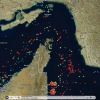
What would a ship escort convoy crossing the Strait of Hormuz look like? With real-time satellite imagery and fighter jets flying over the strait, “I think it would be two tankers and a destroyer transiting at the same time,” Montgomery says.
However, “we cannot prevent all attacks by ballistic missiles, cruise missiles or drones,” explains Michael Connell of the Center for Naval Analyses.
“It’s easier to defend against a drone than against a ballistic missile,” Connell acknowledges. “But also, drones are cheaper. So if you have to defend against hundreds and hundreds of drones, that kind of makes up for the fact that it’s easier to shoot them down.”
But the U.S. Navy also takes the threat of sea mines seriously. This week, US Central Command, which oversees the US Fifth Fleet based in Bahrain, released a video on X showing the strikes against the Iranian navy, including the destruction of 16 mine-laying ships. But experts who spoke to NPR noted that the type of cheap, easy-to-deploy magnetic and contact mines that are in Iran’s inventory can be dropped on the stern of virtually any ship.
Nick Childs, a senior fellow for naval forces and maritime security at the London-based International Institute for Strategic Studies, says the United States “would likely hope to be able to engage in any concerted Iranian effort to exploit the Gulf.” But if Iran were able to lay a large number of mines, he adds, “they could take weeks or even months to clear.”
The United States has at least three littoral combat ships (LCS) in the region equipped for mine clearance operations. These ships, intended for a variety of missions, have faced cost overruns and other structural problems for years.
Montgomery says that for the White House, the situation in the Gulf presents a delicate tradeoff between political and military risk. He told NPR that the political risk is that the longer the strait remains closed, the more global and domestic pressure will be on Trump to do something. But if convoy escort operations start too quickly, “you could lose an oil tanker…or an American ship.”


