Hands-on with Home Assistant’s new long-range Z-Wave adapter


I recently described how a recent wave of shortcomings from smart brine made me go to the home assistant, the intelligent house platform increasingly polite than you can welcome without counting on the cloud. From today, assistant home users have a great great toy with which to play.
The home assistant Connect ZQA-2 ($ 69) is a new smart home adapter with a very high antenna. And before asking, it is not For the material, the newest and most warm thing in Smart Home. Instead, the Connect ZQA-2 is entirely devoted to Z-Wave, an older but widely used smart home technology that draws renewed attention thanks to its new “long-range” capacity, which allows connectivity with LR (long-range) customer devices to a mile-yes, a mile-far.
The home assistant has long supported Z-Wave, in addition to zigbee (the intelligent house standard privileged by Phillips Hue) and the above material. (I just added the integration of the material to my own instant at home.)
But the Connect ZQA-2, which is based on the last chipset in the Z-Wave 800 series, is the first Z-Wave adapter built by and for the home assistant platform, with the group behind the home assistant noting that the equipment was “precisely adjusted to the ideal Z-Wave wavelength.
For those who do not know Z-Wave, it is a radio technology that works in the frequency band of less than 1-1GHz. This low frequency is ideal for penetrating solid barriers, such as walls, but it also avoids interference from Bluetooth, Wi-Fi and ZigBee devices that all work in the frequency spectrum at 2.4 GHz. More than 4,500 smart, Leviton, Shelly, Yale and Vivi devices offer Z-Wave devices, making Z-Wave a key ingredient in any home assistant installation.
Previous generations of Z wave devices use a network network protocol which can take charge of a maximum of 232 knots. The new components supplied at 800 with Z waves are compatible backwards, but they can also use the long-range Z-Wave protocol to operate on a star network which can support up to 4,000 (!) Nodes.
Nabu Casa, the commercial branch of the Open Home Foundation under which the domestic assistant operates, offered me a Connect ZQA-2 sample for the evaluation. Although I have not had time to give him an official exam (I have been playing with the unit for a little less than a week), I can attest that it was easy to install and A – Anyway, worked like a charm.
The Connect ZQA-2 is available in two parts: a 5 x 5 inch plastic base and a 12-inch antenna with a 1.5 inch LED segment which serves as a state indicator. The assembly is easy: screw the antenna in the base, use the USB-C cable provided to connect the base to your domestic assistant server (a Raspberry Pi 5 in my case), and that’s about everything.
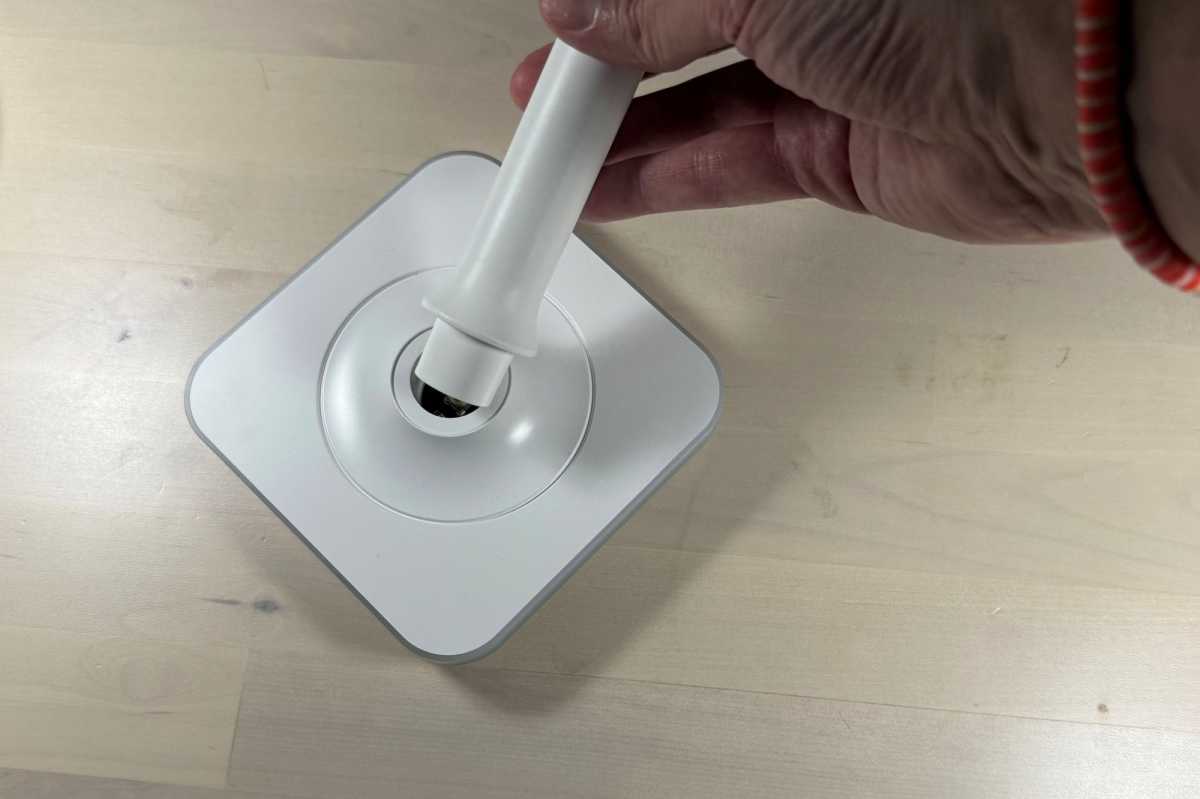
The assembly of the Connect ZQA-2 home assistant is a simple question to screw the antenna with a foot in the 5 x 5 inch base.
Ben Patterson / Foundry
Deciding where to locate the Connect ZQA-2 is a potential problem. The home assistant advises to keep it far from the objects that could cause interference, such as thick brick walls, water bodies (such as fish tanks), other wireless transmitters and metal or metal accessories (such as service carriers).
I admit that I broke the rule and placed the ZQA-2 on the top of the metal mesh wardrobe that houses my collection of Raspberry Pi cards, but a quick diagnostic check showed that radio performance was not unduly hampered. The LED point of the antenna flashes yellow to warn you of a “sub-optimal” connection.
Home assistant people have also thrilled a few Z waves to connect to ZQA-2, all of which take care of both the standard Z wave protocol as well as LR-wave: an intelligent socket, a water leak detector and a smart water valve actuator, all built by the manufacturer of Z-Wave Zooz.
Since I am an apartment, I could not install the intelligent water valve device, but I tried the smart candle and the water leak detector, which I configured via the JS Z-Wave control panel. (I direct the assistant at home in a docker container, so as a new Z-Wave user, I first had to run the integration of the Z wave in a separate container, a process that has taken every 20 minutes.)
I did not carry out formal tests on connectivity between the two zooz devices and the ZQA-2, but they worked perfectly at an anecdotal level. I first connected the water leak sensor via the Z wave LR and the intelligent cap with a standard Z wave, then I exchanged the protocols.
Ideally, I would have done real long -range tests with the new antenna – an excellent example could be to place the water leak sensor in a detached hangar, for example, 100 meters from the main building. The long-range Z-Wave protocol supports a theoretical beach of a mile, a line of view, so we could certainly imagine certain cases of inventive use.
The Connect ZQA-2 home assistant is now available on the home assistant website. I will update my results while I continue to test.


