Betelgeuse’s companion star finally located after years of debate


Humans watched Betelgere for thousands of years. As one of the brightest stars in the night sky, the red supergiant is easily noticeable in its location in the Orion constellation. But for a few months in 2019 and 2020, astronomers thought that the betelge days were counted. A spectacular decrease in brightness led some experts to theorize the star of 10 million years with a 700 -time radius larger than our sun was about to go supernova. In the end, however, the researchers determined that the “large fat” was in fact caused by the star ejecting a large plume of dust.
But all this additional attention has led to another remarkable discovery. It turns out that Betegeuse is not alone – she actually has a nearby companion star. The celestial object never seen before is detailed in two distinct studies which should publish on July 24 Astrophysical newspaper letters.
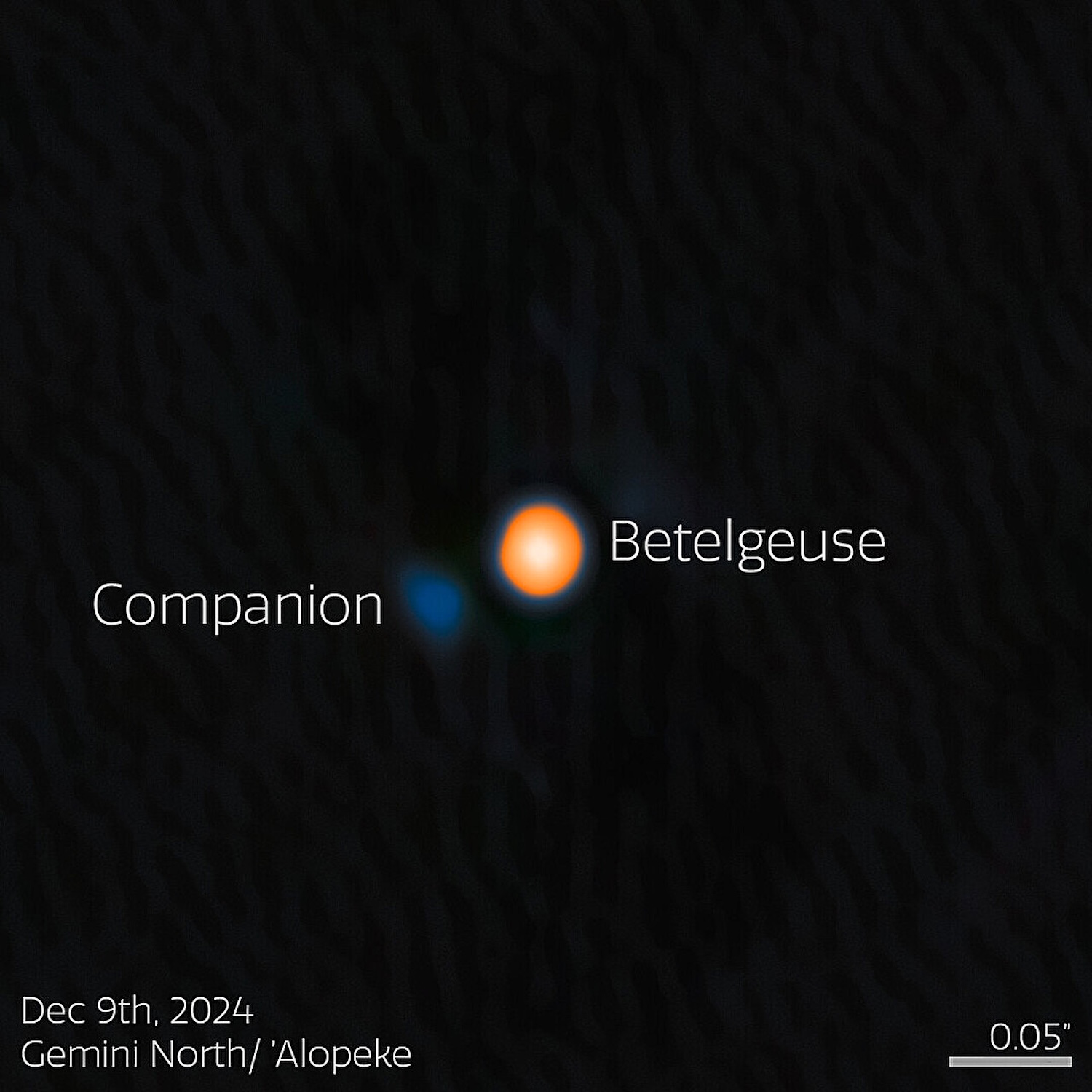
The main index according to which astronomers inclined to the companion star presented themselves in the form of betelgeous brightness intervals, also called variability. The Supergiant Red actually has two periods of variability, which lasts approximately 400 days, and a secondary that lasts about 6 years. After examining the star archive data, the researchers recently proposed that the longer secondary phase can be due to an external influence in the form of a companion star. But even with a first part of research which included the Hubble spatial telescope and the Chandra X -ray observatory, the investigators did not locate any additional stellar object. Some experts were doubtful that anyone who ever locates the star, even if it existed.
“The articles that predicted Betelgeuse’s companion believed that no one would probably be able to imagine,” said Steve Howell, a principal researcher at NASA Ames Research Center and co-author of study, in a press release.
This changed after the team called on a “fox”. Mounted on the northern telescope of the International Gemini Observatory on Hawai’i Mauna Kea is an imagery of spots called “Alopeke – The Hawaiian word for Fox. The spots work work using short exposure time to deny the distortions of the image caused by the atmosphere of the earth. This allows high resolution looks in the cosmos, in this case with a boost of the gemini North 26.5 inch mirror. This method allowed astrophysicists to finally locate an extremely light companion next to Betelgeuse.
A more in -depth analysis indicates that the second star is six amplitudes weaker than betelger with a mass about 1.5 times that of the sun. It is also probably a type A or B pre-sequence star, which means that it is a young hot-white-white star that does not yet burn hydrogen in its nucleus.
Betelgeuse and her companion star were probably born at the same time, but their relationship will not end well. According to the authors of the study, the tidal forces will eventually make this last object in his partner, starting the end of the two. That said, astronomers believe that the pair final will take place over the next 10,000 years.
But before that, the researchers hope to study the two stars even more. Their next chance will start in November 2027, when the orbit of the stellar companion will place it at its distance from Betelgeuse.

More offers, reviews and purchasing guides


