Archaeologists Discover Earliest Evidence of Fire-Making


Archaeologists have unearthed 400,000-year-old heated sediments and fire-cracked flint bifaces, as well as two fragments of pyrite – a mineral later used to produce sparks with flint – at Barnham, Suffolk, UK. The discovery shows that humans were making fire about 350,000 years earlier than previously thought.
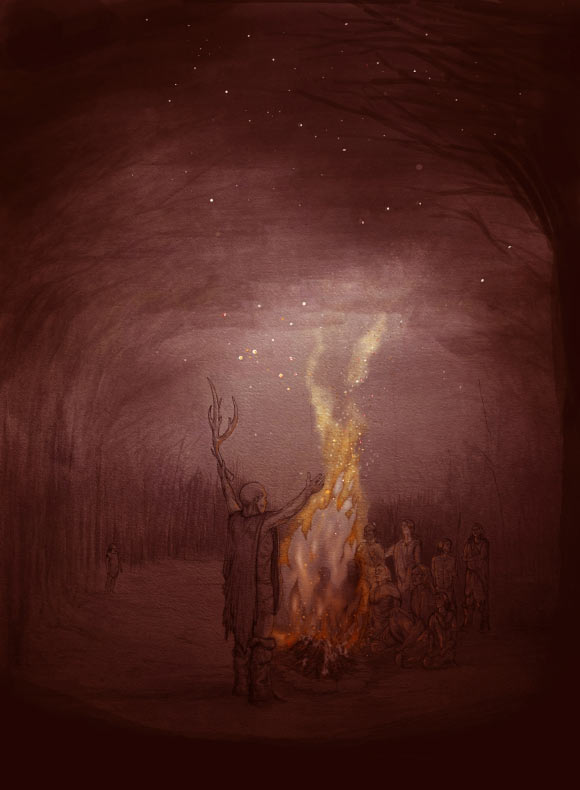
An artist’s impression of a fire at Barnham around 400,000 years ago. Image credit: Craig Williams / The Trustees of the British Museum.
Humans’ ability to start and maintain fires marks an important moment in human development: fires provided heat, offered protection from predators, and allowed cooking, which expanded the range of foods that could be eaten.
Indications of fires at human-inhabited sites date back more than a million years.
However, it is difficult to determine when humans learned to create fire.
The use of fire likely began with the opportunistic harvesting of natural wildfires before our ancestors mastered the art of deliberately starting fires.
Earlier evidence of early fire ignitions has been found at Neanderthal sites in France dating back to 50,000 years ago, where axes that appear to have been used to strike pyrite to create sparks have been found.
New evidence discovered by Professor Nick Ashton, an archaeologist at the British Museum and the Institute of Archeology at University College London, and colleagues suggests that fires may have occurred 400,000 years ago in Barnham, UK.
Archaeologists have discovered heated sediments in ancient soils as well as fire-cracked flint axes.
These features indicate that the fire was controlled in a human settlement, but it is the third discovery that suggests the fire was deliberate.
Two pyrite fragments were discovered on the site; However, this mineral is rare in this region, leading researchers to propose that the pyrite was deliberately brought to the site to be used for starting fire.
Together, the results indicate complex behavior among ancient humans from the Barnham site.
For example, these humans may have understood the properties of pyrite and therefore used it in a kit to start a fire.
The development of this skill would have brought many benefits, including the ability to cook food and could potentially foster the advancement of technologies such as the manufacture of glue for handled tools, which may have contributed to notable developments in human behavior.
“The people who lit the fire at Barnham 400,000 years ago were probably early Neanderthals, based on the morphology of fossils of the same age from Swanscombe, Kent and Atapuerca in Spain, which even preserve DNA from early Neanderthals,” said Professor Chris Stringer, a paleoanthropologist at the Natural History Museum, London.
“This is the most remarkable discovery of my career and I am very proud of the teamwork it took to reach this groundbreaking conclusion,” Professor Ashton said.
“It is incredible that some of the oldest groups of Neanderthals knew the properties of flint, pyrite and tinder so early.”
“The implications are huge,” said Dr Rob Davis, curator of the project at the British Museum.
“The ability to create and control fire is one of the most important turning points in human history, with practical and social benefits that have changed human evolution.”
“This extraordinary discovery pushes back this turning point by some 350,000 years.”
The discovery is reported in a paper published today in the journal Nature.
_____
R.Davis and others. First evidence of fire. Naturepublished online December 10, 2025; doi: 10.1038/s41586-025-09855-6


