Black hole unleashes brightest flare ever—brighter than 10 trillion suns


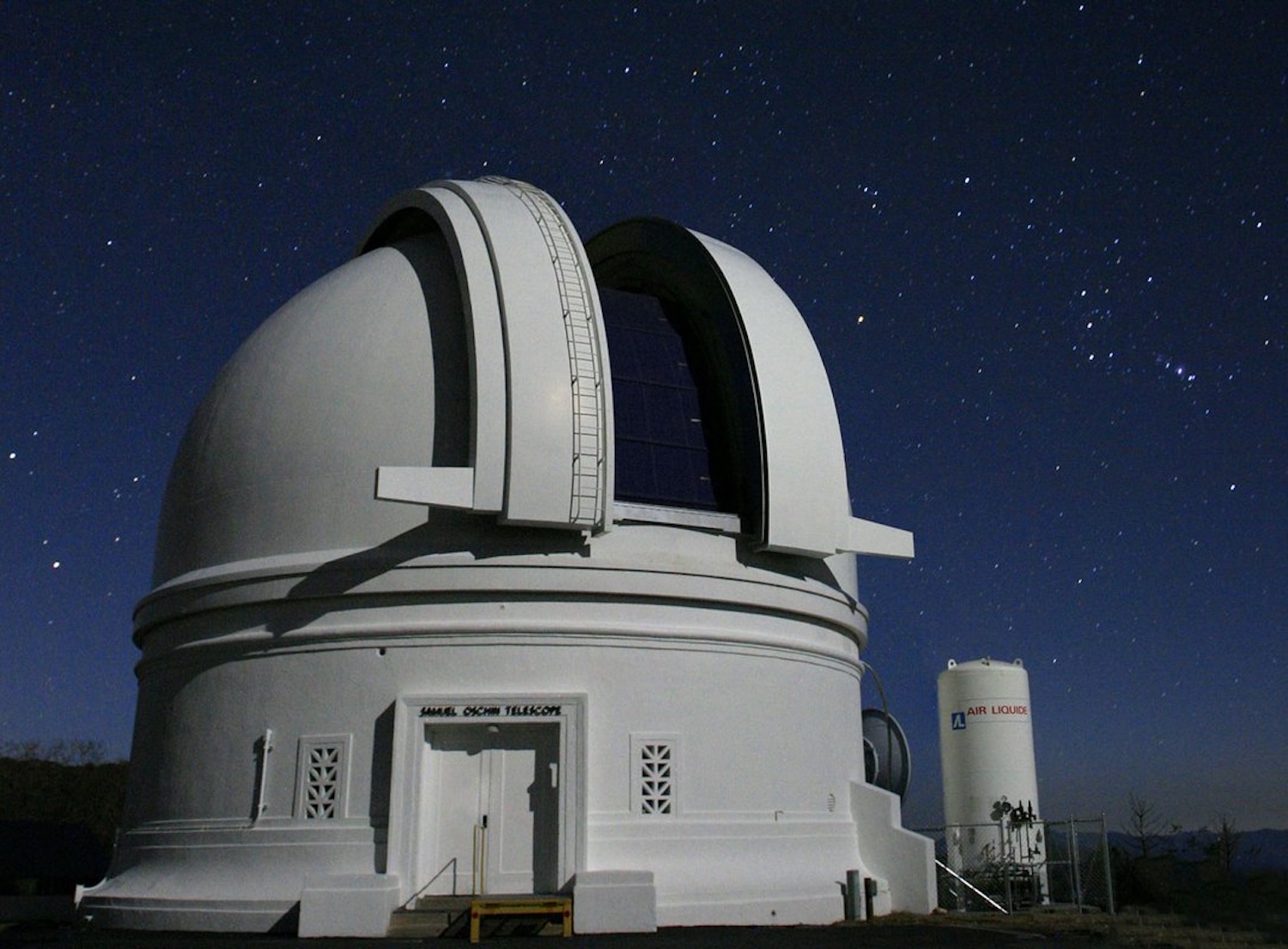
It’s difficult to understand the fundamentals of a black hole. From event horizons to singularity points and the general collapse of spacetime as we understand it, the list goes on. That said, you don’t have to be an astrophysicist to grasp the enormity of the cosmic event recently recorded by researchers at Caltech’s Palomar Observatory.
Using the Zwicky Transient Facility (ZTF) and the Catalina Real-Time Transient Survey, the team witnessed a supermassive black hole approximately 500 million times more massive than that of the sun that could have fed for a month on a nearby star. At one point, the resulting black hole flare was 30 times brighter than any similar scene recorded, producing 10 trillion the value of suns of light. The activities of the active galactic nucleus (AGN) J2245+3743 are detailed in a study published on November 4 in the journal Natural astronomy.
“This is unlike any AGN we’ve ever seen,” Matthew Graham, professor of astronomy at Caltech, ZTF project scientist and co-author of the study, said in a statement.
Brightened by a factor of 40
Graham and his colleagues first noticed an increasing brightness of J2245+3743 on April 2, 2018. However, an initial scan using Palomar Observatory’s 200-inch Hale telescope did not report anything particularly strange. But in 2023, astronomers realized that the flare was disintegrating more slowly than expected. It was only after another analysis of the spectrum from the WM Keck Observatory in Hawaii that they learned how bright J2245+3743 had become. Astronomers eventually observed AGN’s energetic flare brighten by a factor of 40.
Initially, the team wasn’t really sure what could cause such a dramatic explosion and went through a list of possibilities. They quickly determined that the most obvious explanation – a supermova – wouldn’t cut it.
“Supernovae are not bright enough to explain this,” explained KE Saavik Ford, study co-author and astronomer at the City University of New York. “If you convert our entire Sun into energy, using Albert Einstein’s famous formula E=mc2, you get the amount of energy emitted by this flare since we started observing it.”
What is a tidal disturbance event?
Graham, Ford and their team ultimately settled on a tidal disruption event as the most likely explanation for this burst of light. Also known as a TDE, a tidal disruption event is triggered when the gargantuan gravitational pull of a supermassive black hole snags a nearby star. The black hole then begins to siphon energy from the star as it begins its inevitable death spiral. But this does not mean that a star constantly shrinks after being captured by an AGN. Sometimes the transfer of energy is two-way.
“Stars this massive are rare, but we think stars inside an AGN’s disk can grow larger. Material from the disk is dumped onto the stars, causing them to grow in mass,” Ford said.
About 100 tidal disruption events have been recorded to date, but most have not featured an active galactic core like the recently observed J2245+3743. Indeed, the disk of feed material surrounding an active galactic core generally hides any TDE emissions from even the most sensitive observation tools. In this case, J2245+3743 was so gigantic that there was no way to miss it.
The new record holder is much more powerful than the previous top-tier TDE. First observed in April 2021, ZTF20abrbeie (nicknamed “Scary Barbie”) was ultimately 30 times fainter than J2245+3743 and implied a star 3 to 10 times larger than the sun. At 10 billion light years away, J2245+3743 is also one of the oldest black holes ever observed and occurred when the universe was relatively young.
A black hole in slow motion
Given all the strangeness that accompanies a black hole, astronomers are technically watching the event unfold in slow motion.
“It’s a phenomenon called cosmological time dilation, due to the stretching of space and time. As light travels through expanding space to reach us, its wavelength stretches, just like time itself,” Graham said. “Seven years here is two years there. We’re watching the event unfold at quarter speed.”
While J2245+3743 now holds the record for the brightest black hole flare ever observed, astronomers say its first place may not be permanent. As powerful as it is, they suspect similar events are happening all over the universe at any time. Only by keeping an eye to the sky will they find worthy competitors.
“We would never have discovered this rare event without ZTF,” Graham said. “We’ve been observing the sky with ZTF for seven years now, so when we see something brighten or change, we can see what it has done in the past and how it will evolve.”
As for J2245+3743, it’s not quite done with its stellar snack yet. Even after two years, the AGN flux still remains two magnitudes above its pre-eruption level.

House of the Future Prize 2025


