A SpaceX rocket booster may be on track to hit the moon in August


May 1, 2026
3 min reading
 Add us on GoogleAdd SciAm
A SpaceX rocket booster is poised to reach the Moon at several times the speed of sound
Although there is no immediate danger, this accident highlights that space junk is increasingly extending outside of lower Earth orbit.
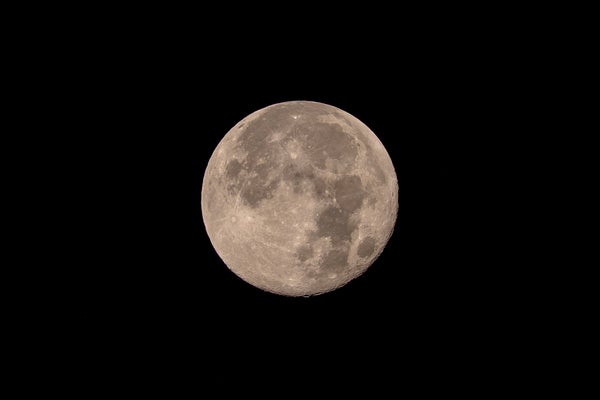
A stray piece of a SpaceX Falcon 9 rocket is set to crash into the Moon’s surface at several times the speed of sound this August. The collision is likely to leave a crater – and it highlights the risk of space debris on the lunar surface at a time when NASA and other national space agencies are working to return humans to the Moon.
The wayward booster was spotted by independent astronomer Bill Gray, who develops and sells software dedicated to tracking artificial and natural celestial objects. The rocket was initially launched in January 2025 and carried lunar landers from other private space companies: Blue Ghost from Firefly Aerospace and Hakuto-R from Japanese company ispace. After the rocket placed the landers on a trajectory toward the lunar surface, the booster was supposed to burn up after reentry into Earth’s atmosphere. But that’s not what happened.
Instead, it entered a 26-day orbit that took it 310,000 miles from the planet. Its orbit intersects that of the Moon, according to Gray, but the two are not in the same place at the same time. According to his calculations, this should change on August 5 at 2:44 a.m. EDT. At about that time, as the thruster is traveling at about 5,400 miles per hour, it will impact the moon’s surface.
On supporting science journalism
If you enjoy this article, please consider supporting our award-winning journalism by subscription. By purchasing a subscription, you are helping to ensure the future of impactful stories about the discoveries and ideas shaping our world today.
Gray first noticed the collision course last September, but he says that while calculating the effects of the Earth, Sun and Moon’s gravity was simple, there was another variable that made things more complicated. The rocket booster was hit by the pressure of solar radiation, caused by photons projected by the sun. When these photons hit an object, they apply a force. The amount is small, but it increases over time.
“That’s why, even now that we’re much closer to the event, I can be certain that the impact is going to happen, but there’s still an uncertainty of at least a few tens of kilometers as to where it’s going to happen,” Gray says, adding that his prediction of when the impact will occur could also be off by a few minutes. Most likely, the location where it will hit will be near Einstein Crater on the western flank of the Moon, making it difficult to view the impact from Earth.
This isn’t the first time Gray has predicted that a man-made object would crash into the moon. In 2022, he predicted that a component of a Chinese rocket from another lunar mission would also have an impact on the Moon: the ensuing crash would have created not one but two craters. Overall, such collisions highlight the risk of space debris on future lunar missions. Given the vastness of space, it may seem unlikely that an object as small as a rocket booster could end up perfectly aligned for this type of accident, but Gray says otherwise.
“Eventually your luck runs out and you both find yourself in the same place at the same time,” he says.
As an isolated incident, the accident poses no imminent danger, Gray emphasizes. It is, however, a sign that the space debris problem plaguing low Earth orbit is already being exported to the Moon. As U.S. and Chinese space agencies consider sending humans to the Moon in the coming years, that could eventually lead to real danger, warns John Crassidis, a professor at the University at Buffalo who works with NASA and the U.S. Space Force on solutions to space waste.
Although the chance of astronauts being hit by falling debris is low in the short term, Crassidis worries that in the coming decades, as more man-made objects are put into orbit around the Moon, “we’re going to start creating a debris field,” he says. “We can definitely be a lot more careful about this.”
“From a philosophical point of view, don’t bring to the Moon, and then eventually to Mars and other similar bodies, the problems we have on Earth,” he says, “because that will cause problems one day.”
SpaceX did not immediately respond to a request for comment.
It’s time to defend science
If you enjoyed this article, I would like to ask for your support. Scientific American has been defending science and industry for 180 years, and we are currently experiencing perhaps the most critical moment in these two centuries of history.
I was a Scientific American subscriber since the age of 12, and it helped shape the way I see the world. SciAm always educates and delights me, and inspires a sense of respect for our vast and magnificent universe. I hope this is the case for you too.
If you subscribe to Scientific Americanyou help ensure our coverage centers on meaningful research and discoveries; that we have the resources to account for decisions that threaten laboratories across the United States; and that we support budding and working scientists at a time when the value of science itself too often goes unrecognized.
In exchange, you receive essential information, captivating podcasts, brilliant infographics, newsletters not to be missed, unmissable videos, stimulating games and the best writings and reports from the scientific world. You can even offer a subscription to someone.
There has never been a more important time for us to stand up and show why science matters. I hope you will support us in this mission.


