Blame game over Air India crash goes on

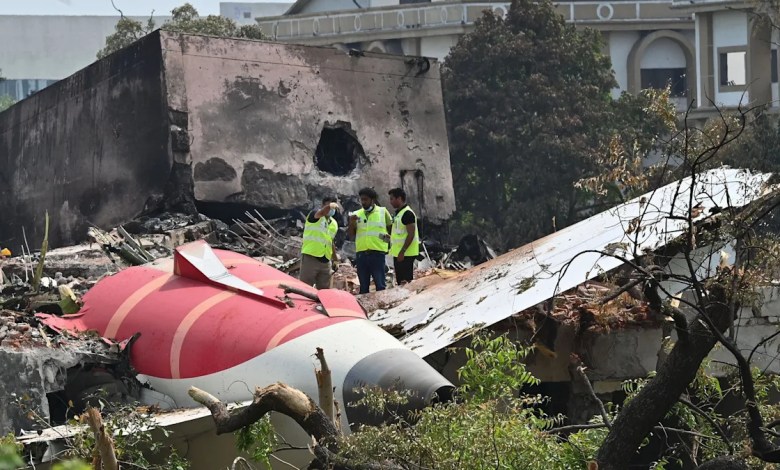
Nearly five months after a plane crash in India that killed 260 people, the investigation has become mired in controversy – with the country’s Supreme Court the latest to rule.
Flight 171 was en route to London from Ahmedabad in western India on June 12. It crashed into a building just 32 seconds after takeoff.
An interim report was released in July, but critics say it unfairly focused on the pilots’ actions, distracting from a possible problem with the plane.
An Indian Supreme Court judge insisted on Friday that no one could blame the plane’s captain.
His comments come a week after the airline boss insisted there was no problem with the plane.
During a panel discussion at the Aviation India 2025 summit in New Delhi in late October, Air India chief executive Cambell Wilson admitted the accident had been “absolutely devastating for those involved, for the families of those involved and for the staff”.
But he stressed that initial investigations by Indian authorities, summarized in a preliminary report, had “indicated that there were no problems with the aircraft, the engines or the operation of the airline.”
He added that while Air India was working with investigators, it was not directly involved.
As the accident occurred in India, the investigation is being carried out by the country’s Air Accident Investigation Bureau (AAIB). However, because the plane and its engines were designed and built in the United States, American officials are also involved.
A month after the accident, the AAIB published a preliminary report. This is standard procedure in major accident investigations and is intended to provide a summary of the facts known at the time of publication.
The report will typically draw on information gleaned from examining the accident site, for example, as well as basic material downloaded from the flight data recorder. He cannot normally draw definitive conclusions about the cause of the accident.
However, the 15-page report on Air India 171 proved controversial. This is largely due to the content of two short paragraphs.
First, he noted that within seconds of takeoff, the fuel cutoff switches — normally used to start engines before a flight and shut them down afterward — had been moved from the “on” position to the cutoff position.
This would have starved the engines of fuel, causing them to quickly lose thrust. The switches were replaced to restart the engines, but too late to avert disaster.
He then said: “In the cockpit voice recording, one of the pilots is heard asking the other why he cut off. The other pilot replied that he didn’t.”

What the fuel switches would have looked like in the cockpit of a Boeing 787 Dreamliner [BBC]
This indirectly reported exchange sparked intense speculation about the role of the two pilots, Captain Sumeet Sabharwal and his first officer Clive Kunder, who was flying the plane at the time.
A former chairman of the National Transportation Safety Board, Robert Sumwalt, said the report showed “this was not a problem with the plane or the engines.”
“Did someone deliberately cut off the fuel, or was it a mistake to inadvertently cut off the fuel?” he declared during an interview with the American channel CBS.
Indian aviation safety consultant Captain Mohan Ranganathan strongly suggested that the pilot’s suicide could have been the cause of the accident, in an interview with national channel NDTV.
“I don’t want to use that word. I heard the pilot had a medical history and… that can happen,” he said.
Mike Andrews, a lawyer acting on behalf of the victims’ families, said the manner in which the information was released “led people to unfairly and inappropriately place blame on these pilots who did not have all the information.”
“A plane like this – which is so complex – has so many things that could go wrong,” he explains.
“To take these two very small pieces of decontextualized information and automatically accuse the pilots of suicide and massacres… is unfair and wrong.”
This view is shared by Captain Amit Singh, founder of the Safety Matters Foundation, an India-based organization that works to promote a culture of safety in aviation.
It produced a report which said the available evidence “strongly supports the theory of an electrical disturbance as the primary cause of the engine shutdown” that led to the disaster.
He believes an electrical fault may have caused the digital engine control system (FADEC), a computerized system that manages engines, to shut down by cutting off the fuel supply.
Meanwhile, the flight data recorder, he suggests, could have recorded the command to cut off the fuel supply, rather than any physical movement of the cutoff switches in the cockpit.
In other words, the switches themselves may not have been touched at all until the pilots attempted to restart the motors.
Captain Singh also challenged the manner in which the investigation was conducted in the Supreme Court of India.
He told the BBC that the way the preliminary report was written was biased because it “appears to suggest pilot error, without disclosing all the technical anomalies that occurred during the flight.”
In the meantime, the Supreme Court itself has already ruled on the issue.
It is considering a petition filed by Pushkarraj Sabharwal, the father of Captain Sumeet Sabharwal. The 91-year-old man called for an independent judicial inquiry into the tragedy.
“This accident is extremely unfortunate, but you should not carry this burden of blaming your son. No one can blame him for anything,” Justice Surya Kant told him.
A new hearing is expected on November 10.
“It’s completely false.”
The theory that an electrical fault could have caused the accident is supported by the American Foundation for Aviation Safety (FAS).
Its founder is Ed Pierson, a former Boeing executive who has previously been highly critical of the American aerospace giant’s safety standards.
He said the preliminary report was “woefully inadequate… embarrassing.”
His organization has spent time looking into reports of electrical problems on board 787s. These include water leaks in wiring bays, which have already been noted by the US regulator, the Federal Aviation Authority. Concerns have also been expressed in other quarters.
“There were so many of what we consider to be electrical oddities in this aircraft that for them to be revealed and, for all intents and purposes, place blame on the pilots without comprehensively going through and examining the potential system failures, we just thought that was flat-out wrong,” he says.
He believes there was a deliberate attempt to divert attention from the plane to the pilots.
The FAS called for comprehensive reform of current international air accident investigation procedures, citing “outdated protocols, conflicts of interest and systemic failures that endanger public trust and delay life-saving safety improvements.”
“Keep an open mind”
Mary Schiavo, a lawyer and former inspector general for the U.S. Department of Transportation, disagrees that the pilots were deliberately put in the spotlight.
She believes the preliminary report was flawed, but only because investigators were under intense pressure to provide information while the world’s attention was focused on them.
“I think they were just in a hurry, because it was a horrible accident and the whole world was watching. They were just in a hurry to get something out,” she says.
“Then, in my opinion, the whole world jumped to conclusions and immediately said: ‘It’s pilot suicide, it was intentional.’
“If they had to do it again, I don’t think they would have included these little snippets of the cockpit voice recording,” she says.
According to her, “a computer or mechanical failure… is the most likely scenario.”
International rules for investigating air accidents stipulate that a final report must be published within 12 months of the event, but this provision is not always respected. However, until it is published, the true causes of the accident will remain unknown.
A former air accident investigator who spoke to the BBC stressed the importance of “keeping an open mind” until the process is complete.
Boeing has always maintained that the 787 is a safe aircraft – and it has a strong track record.
The company told the BBC it would rely on India’s AAIB to provide information on the investigation.


:max_bytes(150000):strip_icc()/Health-GettyImages-2194900535-dfd1a5e0fe334b4a9f0218c76e3e8087.jpg?w=390&resize=390,220&ssl=1 "4 Surprising Reasons Why Your Astigmatism Is Worsening")