Parenthood Has Made Me Detest Robots


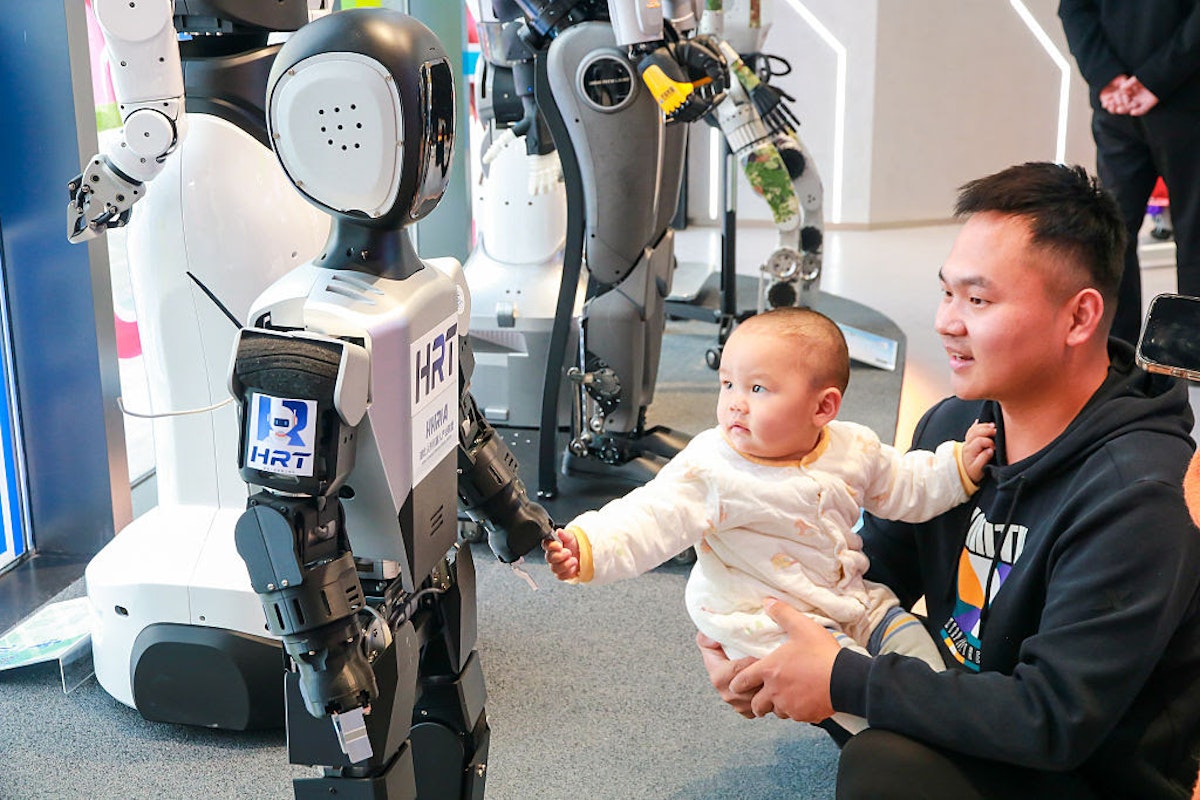
You can’t throw a pacifier into the American discourse without offending someone by telling them how much having children has changed them. From Pete Buttigieg to Sarah Palin to the legions of men who have had daughters and realized that sexual harassment is wrong, many people are apparently receiving wisdom from parenting that they weren’t getting otherwise.
This “as a parent…“talking might seem like enough, which is odd, given that these moral revelations come from the humiliating experience of having my ass handed to me daily by a creature the size of a groundhog. I never thought I’d be one of those people. But it’s true, being a parent has changed me in at least one way: I hate robots even more than before.
Last week, the Internet lit up with laughter when one of Russia’s first humanoid robots was presented in Moscow, shyly walking across the stage towards the Rocky theme song, only to faceplant and be taken away by embarrassed masters. The video do THE towerseven appearing on The Late Show with Stephen Colbert.
I can’t laugh at this thing. Instead, it makes me angry.
Humanoid robots are the perfect symbol of the suicidal absurdity of the AI frenzy. What’s the point of making a robot walk like a human – like a toddler for now, but one day like an adult? According to robotics industry publications, this is to be able to more easily replace humans. To borrow Nvidia’s chilling phrase: “Our world is built for humans by humans.” So making a robot look like a human makes it easier to take ownership of that world – sorry, “collaborating” with humans, as Nvidia puts it. These metal kids want your job, especially if you work in manufacturing.
Scratch that. The companies that make these metal toddlers want all of our jobs. As Colbert noted, immediately after mocking the downed robot, the best-selling country song digitally last week was written by AI. Social media companies, meanwhile, think they’ve found a particularly effective way to monetize the technology: AI-generated ads to sell you more products.
As Ketan Joshi recently wrote on TNR, “Meta’s efforts to force-feed advertising into every corner of the massive digital space it controls couldn’t have worse timing.” » Despite the company’s stated intention to purchase “renewable energy certificates,” the projected energy needed to power generative AI is breathing new life into the gas and even coal industry. This also drives up our electricity bills.
Tell all this to a member of the AI cult, and you’ll inevitably hear something about how AI is going to help humans, not harm them. It will save lives, they say, highlighting the algorithms’ ability to quickly process reams of medical data. Or you get some kind of warm-up West wing monologue about how many life-saving technologies were accidental byproducts of other scientific research, so the “discovery” is inherently good.
This is the same logical fallacy deployed by the plastics industry, which opposes policies discouraging single-use plastic packaging by pointing the finger at artificial heart valves. While this may sound compelling, it’s important to keep in mind that these two things are not mutually exclusive – it’s like saying that policies to reduce car use will eradicate ambulances – and that this talk is coming from people who profit from both products.
This is why the humanoid robot is the perfect symbol. While algorithmic data analysis can have good uses, very expensive efforts to develop technology that more specifically replicates human skills (think bipedal walking, think creativity) are the world’s worst party trick. This slows down, or even reverses, the energy transition at a time when each additional emission brings us closer to the crisis. This consumes vital resources like water and essential minerals. This creates a bubble that could soon collapse the economy. This produces a lot of garbage and misinformation. And all this with the sole aim of making investors money by replacing human labor.
These metal toddlers are no fun. They are part of a multi-billion dollar project to make the future uninhabitable for real toddlers.
Statistic of the week
$20,500
That’s the average decline in home values for the 25 percent of the nation’s homes most vulnerable to hurricanes and wildfires, according to an analysis by The New York Times. (That’s more than double for the most vulnerable 10 percent.)
What I read
First, the frogs are dead. Then people got sick.
Frog mortality was once an academic curiosity. Researchers then realized that this led to a huge increase in malaria in humans. From the JobThe new series on the impact of biodiversity decline:
In the United States, researchers have shown that a collapse in populations of insectivorous bats prompted farmers to use more pesticides on crops, leading to a higher infant mortality rate.
Around the Great Lakes, the re-emergence of gray wolves has had the surprising effect of keeping motorists safe. Dogs prowl along roadsides while hunting, scaring deer and reducing collisions with cars.
Also in North America, invasive emerald ash borers have devastated ash trees, contributing to high temperatures and increased cardiovascular and respiratory deaths.
India has witnessed perhaps the most astonishing ecological collapse of all. After vultures experienced mass die-offs, the livestock carcasses they once scavenged piled up. Packs of wild dogs have replaced vultures, leading to an increase in rabies deaths.
Read the full report by Dino Grandoni and Melina Mara at The Washington Post.
This article first appeared in Life in a Warming World, a weekly TNR newsletter written by associate editor Heather Souvaine Horn. Register here.