As tick bites surge, conspiracy theories follow


“Tell you what,” Drew Maciel told his Instagram followers in April, “I’m tired of finding dead moose.” He zoomed in on a dead bull moose lying on the ground, passing the camera over groups of ticks nestled in every crevice of the corpse.
Maciel is a shed hunter, which means he collects antlers that have been naturally “lost” by wildlife. But a winter tick frenzy in Maine, brought on by rising temperatures, means this year he has continued to find dead animals. Up to 90 percent of moose calves tracked by scientists in recent years have been bled to death by ticks — an ongoing crisis in a state that values these largest deer species.
But where scientists see the hand of climate change at work — average temperatures in Maine have risen 3 degrees Fahrenheit since 1985 — others see the designs of a global cabal.
“Man-made biological warfare,” read a comment on Maciel’s video posted by Dries Van Langenhove, a former far-right member of the Belgian government who was recently convicted of violating the country’s Holocaust denial laws. The comment received 32,000 likes. “It’s Bill Gates,” someone else posted.
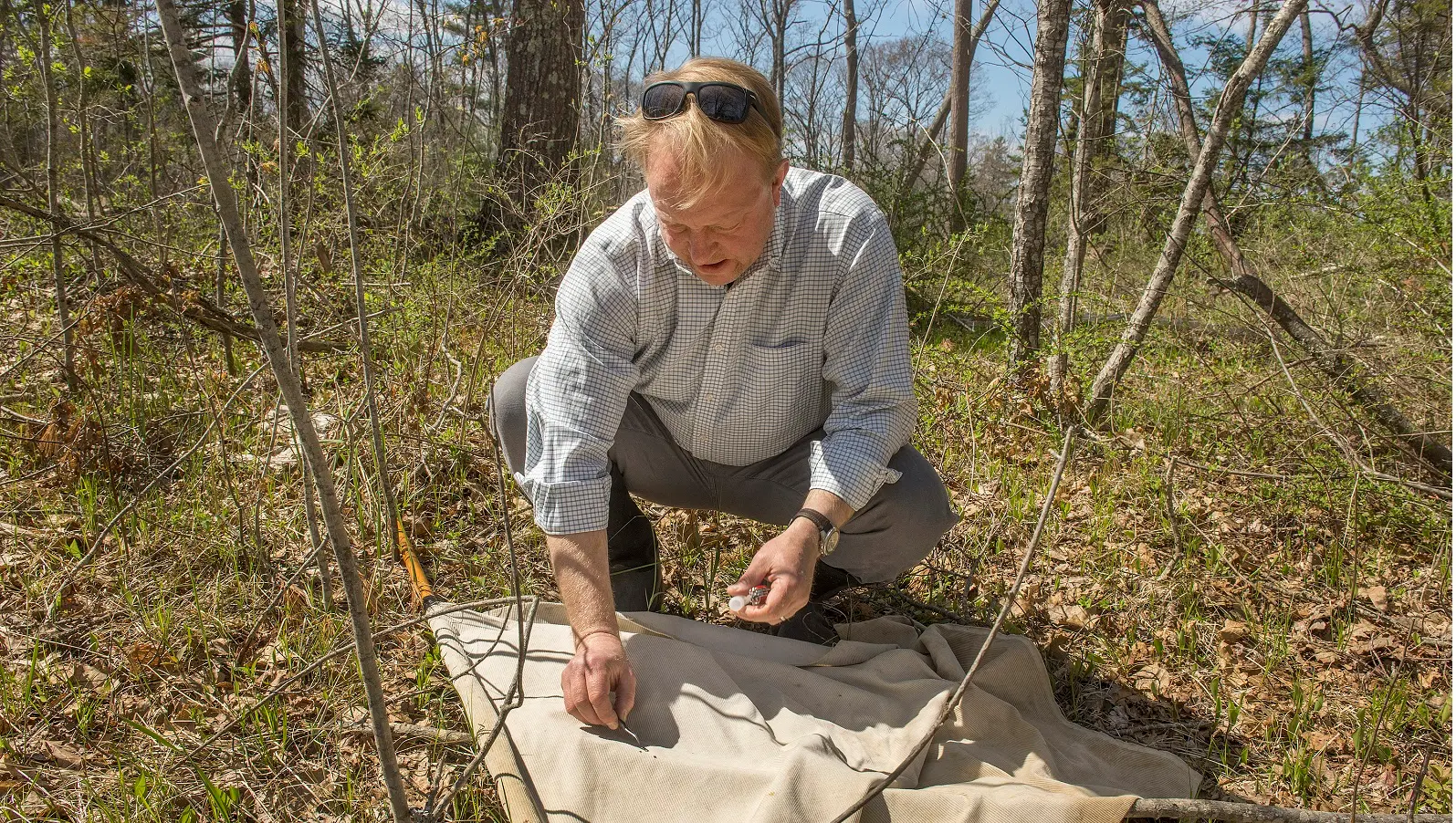
John Ewing/Portland Press Herald/Getty Images
The posts are part of a wave of tick-related conspiracy theories that are garnering millions of views online. In April, a self-described holistic doctor on Instagram claimed to have spoken with several Midwestern farmers who told him they were finding boxes of ticks left on their properties. “Something is happening with ticks right now, and farmers are starting to speak out,” she posted alongside a video that has been viewed 10 million times on Facebook, Instagram and TikTok. The MAHA Moms Coalition, a national group inspired by the Trump administration’s Make America Healthy Again agenda, republished the statement asking affected farmers to come forward.
The theory dates back to 2023, with viral claims that Pfizer and Valneva, pharmaceutical companies developing a Lyme disease vaccine, were planting boxes of ticks on farms to stimulate demand for their product.
Another theory that gained traction around the same time linked a British research program to genetically modify livestock ticks, funded in part by the Bill and Melinda Gates Foundation, to rising cases of red meat allergies in the United States. The biggest problem with this theory is that the allergy, Alpha-gal syndrome, is caused by the bite of a Lone Star tick – a completely different species from the livestock ticks in the research program.
Although all of these conspiracies involve different ticks, different diseases, and different alleged culprits, they are often treated as interchangeable evidence of the same broader claim: that the increase in tick encounters is part of a nefarious human conspiracy.
Theories are right on one thing: ticks are worse. Some of the ecological changes fueling Maine’s winter tick boom are also making tick encounters more common across large swaths of the United States. Arachnids are appearing earlier in the year, expanding into new terrain, and biting people more often than before. But the force driving these changes isn’t a clandestine bioweapons program, a vaccination project, or Bill Gates – it’s climate change.
Richard Ostfeld, an ecologist at the Cary Institute of Ecosystem Studies, said global warming is “causing ticks to appear earlier in the year” in states like New York, where he lives. “We used to be pretty safe in May,” he said. “Now, not so much.”
Tick season got off to an unusually early start this year in much of the United States, the Centers for Disease Control and Prevention, or CDC, said in an alert issued late last month. Emergency department visits for tick bites in four of the five geographic regions tracked by the agency are the highest for this time of year since the CDC began tracking tick-borne disease rates in 2017.
Although the CDC hasn’t specified what’s behind the uptick in bites this spring, heavy snow cover earlier in the year helped insulate adult ticks from winter’s cold, and an early spring bloom across much of the United States likely brought these hungry adults out of the leaf litter earlier than usual. But regardless of the specific dynamics at play this year, rising average temperatures will lead to greater exposure to ticks overall. This is because warmer temperatures bring ticks north into territory once too cold to support them and also extend the length of time ticks are active each year.
More tick bites means more opportunities for infection – and the list of infections doctors watch for is growing. Positive tests for alpha-gal syndrome have increased 100-fold since 2013; Nearly half a million people in the United States are now allergic to red meat. Cases of anaplasmosis, a disease transmitted by blacklegged ticks that hospitalizes about 30% of people who contract it, increased 16-fold between 2000 and 2017. Babesiosis, a malaria-like disease also transmitted by blacklegged ticks, has increased by about 10% year over year since 2015. It is not uncommon for a single tick to be a carrier of two or more diseases.
Ecologists who study ticks see a mix of intertwined factors driving these increases. Changes in land use and wildlife are increasing contact between humans and ticks, invasive and expanding tick species are bringing different disease risks to new areas of the country, and better testing and reporting of tick-borne diseases is making diseases more visible. But there is broad consensus within the scientific community that these trends are occurring in the context of climate change.
Ostfeld worries that the complexity of the factors that lead to higher rates of tick-borne illnesses, coupled with the lure of online conspiracies, will make it harder for people to understand why backyards in some parts of the country are becoming more dangerous. “The more I learn that people actually believe some of these conspiracy theories, the more I worry that even moderately complex explanations or phenomena that interest us – like the likelihood of us being bitten by a tick – are too excessive,” he said.
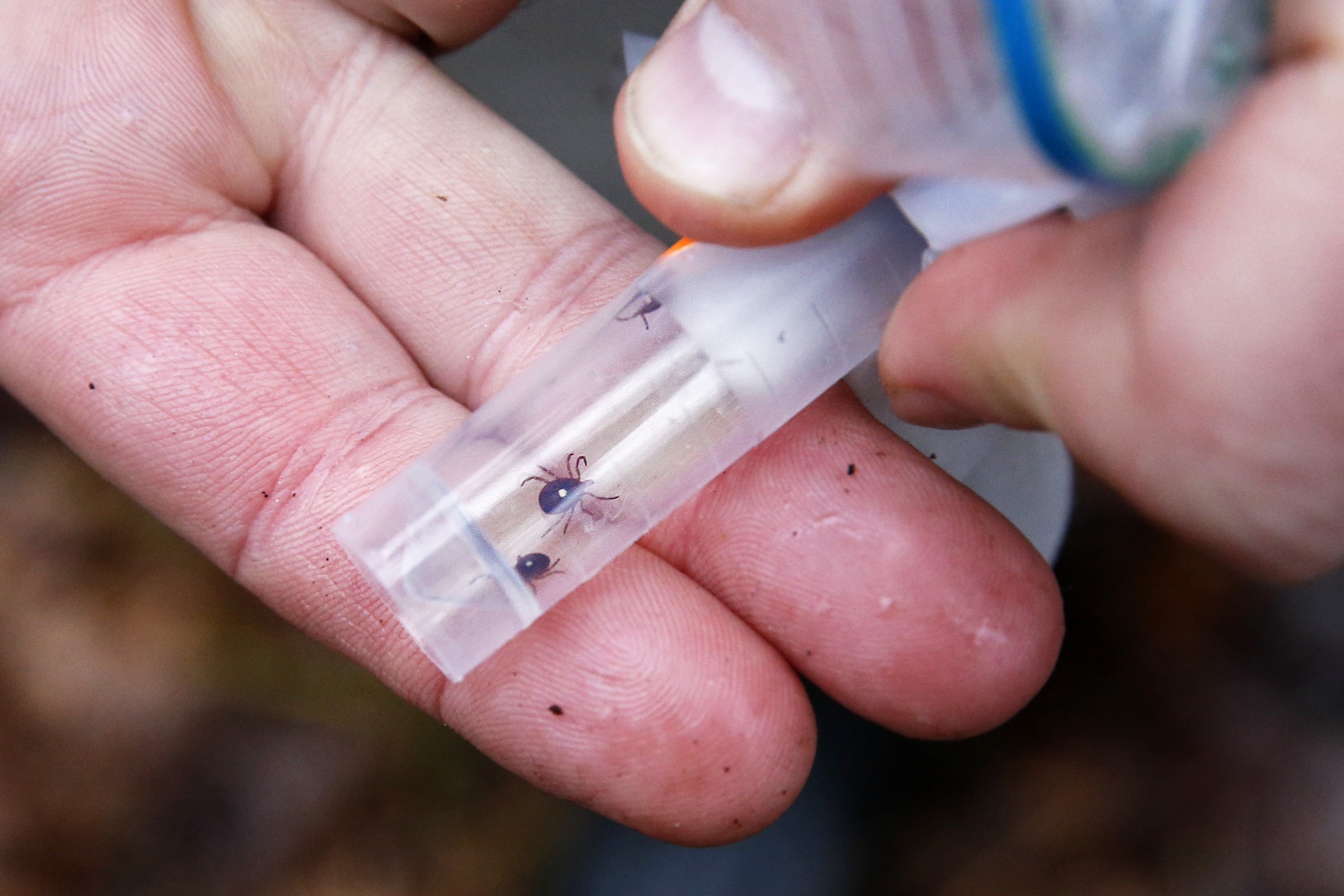
Ben McCanna/Portland Portland Press Herald via Getty Images
It doesn’t help that tick conspiracies are now being legitimized by federal government officials. Robert F. Kennedy Jr., Secretary of Health and Human Services, has estimated repeatedly during his career that Lyme disease, which now affects about half a million Americans each year, was created as a byproduct of vaccine research and originally used as a military bioweapon. (This runs counter to genomic evidence that the bacteria that causes Lyme has existed in North America for at least 60,000 years.)
Kennedy and Tucker Carlson, one of America’s most prominent Republican-aligned media figures, have hosted writer Kris Newby on their podcasts in recent years. In both cases, Newby espoused debunked claims about Lyme’s military origins.
The idea that Lyme disease and other tick-borne illnesses were created by a U.S. military biological weapons program is so widespread that a formal initiative to investigate the origin has twice been introduced by lawmakers in the House of Representatives. Chris Smith, a Republican representative from New Jersey who led those efforts, was successful on his second attempt. A directive in the National Defense Authorization Act for Fiscal Year 2026, signed by President Donald Trump last December, includes a provision requiring the Government Accountability Office, or GAO, to investigate whether the military used ticks as biological warfare agents in the mid-20th century.
“GAO will be fully empowered to leave no stone unturned, and they will now have a mandate from Congress to get to the bottom of this, because they were using ticks as a weapon,” Smith said at a roundtable discussion on Lyme disease convened by Secretary Kennedy last year.
But far from the Congressional roundtables and viral videos, the plot begins to lose a little of its dramatic side. Even in the Midwest, where millions of viewers on social media were informed that boxes of ticks were being thrown at unsuspecting farmers, evidence of foul play is hard to find. Terry Hoerbert and her husband Bob own Little Brown Cow Dairy, a small dairy farm in Delavan, Illinois. The path to the farm is short, Terry said, so she would have seen someone dropping off packages of ticks. Had the Hoerberts heard of other farms in the area receiving packages of live ticks?
“We didn’t,” Terry told me. “You are the first to enlighten us.”


