Breakthrough brings factory in space closer to reality


Rebecca Morelle,Scientific editorAnd
Alison François,Senior Science Journalist

 Tony Jolliffe/BBC News
It sounds like science fiction: a factory hundreds of miles above Earth, producing high-quality materials.
But a Cardiff-based company is close to making that goal a reality.
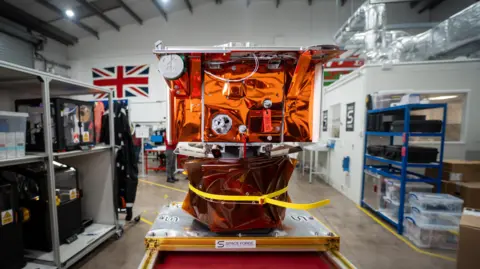
Space Forge sent a microwave-sized factory into orbit and demonstrated that its furnace can be turned on and reach temperatures of around 1,000°C.
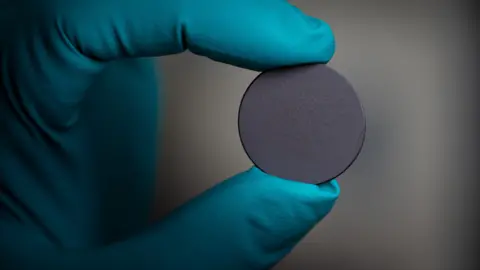
They plan to make semiconductor materials, which can be used on Earth in electronics, communications infrastructure, computing and transportation.
 Tony Jolliffe/BBC News
Conditions in space are ideal for making semiconductors, whose component atoms are arranged in a highly ordered 3D structure.
When made in a weightless environment, these atoms align perfectly. The vacuum of the space also means that contaminants cannot infiltrate.
The purer and more ordered a semiconductor is, the better it performs.
“The work we’re doing now allows us to create semiconductors in space that are up to 4,000 times purer than we can currently make here today,” said Josh Western, CEO of Space Forge.
“This type of semiconductor would be in the 5G tower that you get your cell phone signal in, it would be in the car charger that you plug an electric vehicle into, it would be in the latest airplanes.”
 Tony Jolliffe/BBC News
The company’s mini-factory launched on a SpaceX rocket this summer. Since then, the team has been testing its systems from its mission control center in Cardiff.
Veronica Viera, the company’s payload operations manager, shows us an image the satellite sent back from space.
It is taken from inside the furnace and shows plasma – a gas heated to around 1,000°C – glowing brightly.
She told us that seeing the image was “one of the most exciting moments of my life.”
“It’s very important because it’s one of the essential ingredients we need for our manufacturing process in space,” she explains. “So to be able to demonstrate that is incredible.”
 Space Forge
The team now plans to build a larger space factory, capable of making 10,000 chips.
They must also test the technology to bring the material back to Earth.
On a future mission, a heat shield named Pridwen after the legendary shield of King Arthur will be deployed to protect the spacecraft from the intense temperatures it will experience upon re-entry into Earth’s atmosphere.
Other companies are also looking to the sky: to make everything from pharmaceuticals to artificial fabrics.
“Manufacturing in space is something that’s happening right now,” says Libby Jackson, head of space at the Science Museum.
“It’s early days and they’re still showing it in small numbers at the moment.
“But by proving the technology, it really opens the door to an economically viable product, where things can be manufactured in space and come back to Earth and be used and benefit everyone on Earth. And that’s really exciting.”


