
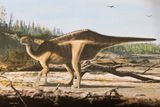
The Isle of Wight off the coast of England has yielded yet another spectacular dinosaur discovery — a flashy dinosaur with a set of spines fringing its back and tail.
Described in a new study in Papers in Palaeontology, the iguanodontian dinosaur, named Istiorachis, lived on the island around 125 million years ago, and its spines likely supported a spiked sail.
“Evolution sometimes seems to [favor] the extravagant over the practical,” said study author Jeremy Lockwood, who discovered the dinosaur during his Ph.D. studies at the University of Portsmouth and the Natural History Museum in London, according to a press release. “While the exact purpose of such features has long been debated […], the most likely explanation in this case is visual [signaling], possibly as part of a sexual display, and this usually is because of sexual selection.”
Read More: Why Is the Isle of Wight Rich in Dinosaur Fossils?
Sailed Dinosaur Show-Offs
Dinosaur discoveries have become a remarkably regular occurrence on England’s Isle of Wight, fueling an idea of the island as a hotspot of dinosaur diversity during the Early Cretaceous, between around 145 million years and 100 million years ago.
The new discovery only adds to that idea, throwing another large, bulky bipedal herbivore into the mix — this time with a long line of “neural spines” that, in all likelihood, supported a sail spanning its back and tail.
Neural spines and sails appear in many modern reptiles, including many male lizards, which flaunt the appendages to visually signal their overall health and vitality.
“In modern reptiles, sail structures often show up more prominently in males, suggesting that these attributes evolved to impress mates or intimidate rivals,” Lockwood said in the release. “We think Istiorachis may have been doing much the same.”
Read More: Most Complete Dinosaur Fossil Found In U.K. Was 125 Million Years Old
Sexual Selection in Iguanodontians
Discovered from fossils at the Isle of Wight’s Dinosaur Isle Museum, the specimens of Istiorachis were previously attributed to another iguanodontian — one of the two iguanodontian dinosaurs that were thought to inhabit the island in the past. But studying the fossils, Lockwood and his colleagues identified its showy spines, which distinguished it from the island’s other dinosaurs.
“While the skeleton wasn’t as complete as some of the others that have been found, no one had really taken a close look at these bones before,” Lockwood said in the release. “It was thought to be just another specimen of one of the existing species, but this one had particularly long neural spines, which was very unusual.”
Comparing the fossils from Istiorachis’s back and tail to the fossils from the backs and tails of other dinosaurs, Lockwood and his colleagues then traced the evolution of neural spines throughout the iguanodontian family tree.
“These methods let us move beyond simply describing the fossil and actually test hypotheses about its function,” Lockwood said in the release. “We showed that Istiorachis’s spines weren’t just tall — they were more exaggerated than is usual in Iguanodon-like dinosaurs, which is exactly the kind of trait you’d expect to evolve through sexual selection.”
Dinosaur Diversity on the Isle of Wight
The results revealed that the spines of the iguanodontians started to lengthen in the Late Jurassic and continued to lengthen in the Early Cretaceous, as the exaggerated traits of males became more and more exaggerated over time.
Ultimately, the discovery stresses the incredible diversity of the Isle of Wight and its iguanodontians dinosaurs, whose spiked backs and tails were shaped to attract by the forces of sexual selection.
“Jeremy’s careful study of fossils that have been in museum collections for several years has brought to life the [iguanodontian] dinosaurs of the Isle of Wight,” said study author and Natural History Museum paleontologist Susannah Maidment, according to the release. “Istiorachis demonstrates we still have much to learn about Early Cretaceous ecosystems in the U.K.”
Read More: Europe’s Largest Land Predator Discovered On The Isle of Wight
Article Sources
Our writers at Discovermagazine.com use peer-reviewed studies and high-quality sources for our articles, and our editors review for scientific accuracy and editorial standards. Review the sources used below for this article:


